
Real-time voice analytics for B2B support coaching turns tense calls into teachable moments
B2B support calls are high-stakes, directly influencing risk and revenue. Agents must navigate complex products, rigorous security reviews, and the sensitivities of account management. Real-time voice analytics functions like an expert co-pilot: it automatically transcribes calls, detects moments of friction, and provides on-the-spot guidance while the conversation is ongoing. This leads to more confident interactions and rapid issue resolution. For a deeper dive, see our guide on how Voice AI is transforming customer service through live transcription, agent coaching, and more. As one industry leader put it: real-time cues beat post-call reviews. The eight platforms below set themselves apart for their in-call coaching capabilities tailored to B2B support environments.
Selection criteria for the best voice analytics platforms for real-time agent coaching in B2B support calls
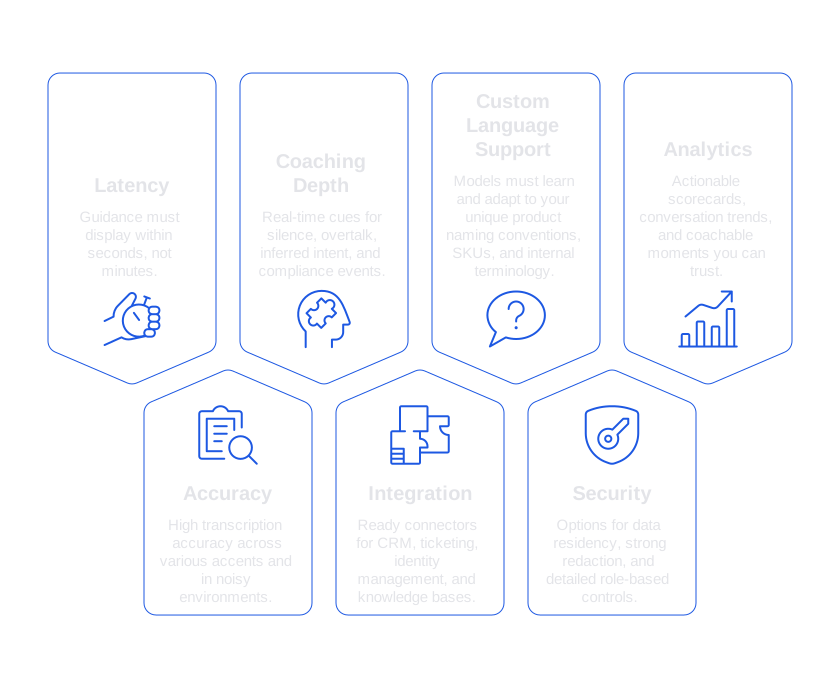
Use well-defined criteria before shortlisting tools. Voice analytics delivers real value only when it aligns with your specific tech stack and operational workflows.
- Latency: Guidance must display within seconds, not minutes.
- Accuracy: High transcription accuracy across various accents and in noisy environments.
- Coaching depth: Real-time cues for silence, overtalk, inferred intent, and compliance events.
- Integration: Ready connectors for CRM, ticketing, identity management, and knowledge bases.
- Custom language support: Models must learn and adapt to your unique product naming conventions, SKUs, and internal terminology.
- Security: Options for data residency, strong redaction, and detailed role-based controls.
- Analytics: Actionable scorecards, conversation trends, and coachable moments you can trust.
The use of custom language specific to your business is mandatory in B2B communication. Ensure that the analytical software models learn and adapt to your internal language, such as product and feature names. Start with a focused glossary and expand as needed. See our guide on how to train AI on your internal product language for a step-by-step approach teams use in practice.
For example, a real-time coaching system might be set up to guide agents during live B2B calls with a direct, neutral tone. It could be programmed to recognize specific product terms like “SLA tier 3,” “token bucket,” or “cross-tenant sync,” and take actions such as flagging compliance issues, suggesting clarifying questions, or surfacing relevant knowledge base articles when needed.
The 8 best voice analytics platforms for real-time agent coaching in B2B support calls
The platforms are listed alphabetically. Select the one based on your specific business needs, not just the one that is most promoted.
-
Balto Balto is recognized for delivering live in-call guidance and customizable checklists. Agents receive real-time prompts, talk tracks, objection-handling tips, and reminders during the call. Managers can easily A/B test scripts, supporting rapid adaptation. This solution is well-suited for teams seeking consistent call flow adherence during high call volumes.
-
CallMiner Eureka CallMiner delivers comprehensive interaction analytics and theme discovery. Real-time alerts instantly surface sentiment changes, moments of silence, or missed compliance steps. The platform maps issues across multiple accounts to proactively identify potential churn signals. Enterprises needing deep analytical insight and rigorous governance will find it a strong choice.
-
Cogito Cogito specializes in analyzing behavioral signals and emotional cues in real time. It prompts agents to adjust their pace, display empathy, or seek clarification based on conversational dynamics. This is particularly effective in managing escalations or high-stress calls where human connection is critical.
-
Genesys Cloud CX with Agent Assist Genesys offers integrated orchestration and AI across communication channels. Its Agent Assist feature delivers in-call tips and automatically surfaces relevant knowledge articles. Supervisors gain access to advanced analytics and flow controls, making it ideal for teams standardizing on the Genesys platform for routing and reporting.
-
NICE Enlighten and Nexidia NICE provides advanced speech analytics and real-time guidance capabilities, supporting large scale contact centers with strict compliance demands. Its solution includes behavioral modeling, trend detection, and policy alerting. While implementation requires careful planning, the platform’s ability to scale and its deep security controls are substantial benefits.
-
Observe.AI Observe.AI combines automated quality assurance (QA) with robust coaching workflows. It detects risky moments and nudges agents with contextual, real-time tips. Managers can assign targeted feedback through integrated scorecards and workflows, ideal for teams wanting a single platform for QA and coaching.
-
Talkdesk AI and Quality Management Talkdesk features native assist cards, QA modules, and comprehensive contact center tooling. Real-time cues are tied directly to enterprise knowledge bases and compliance policies, and the unified platform reduces integration overhead. It is a strong fit if your operations already use Talkdesk’s telephony solutions.
Operational playbook to deploy voice analytics for agent coaching on B2B calls
Start with a single queue and a well-defined objective. Choose a call type with a repeatable structure. Integrate voice interactions, CRM, and knowledge sources. Populate your glossary with product and policy terms. Develop three proactive coaching cues for your top failure scenarios. Begin training with lead agents, then expand to your broader team. Set up feedback loops through regular weekly coaching reviews. Before scaling, finalize and archive your consent and data retention policies.
For example, if you want to address long silences or missed keywords (such as “SLA credit”), prompt agents to ask for a contract ID and confirm the service window via a brief on-screen cue, and provide quick access to the relevant knowledge base article if needed.
Oversight is essential after launch. Conduct systematic reviews to identify drift or misleading cues. For detailed guidance on oversight, see our resource on auditing AI in customer support conversations to ensure your coaching remains dependable.
Metrics that prove voice analytics improves real-time coaching outcomes in B2B support
Capture a two-week baseline and then compare results after your rollout. Keep metrics focused and transparent:
- First contact resolution: Track by queue and customer segment.
- Average handle time: Focus on the median as well as the mean.
- Supervisor escalations: A decline indicates more stable calls.
- Compliance misses: Monitor these by policy type.
- Silence and overtalk: Target improved, balanced conversation ratios.
- Suggestion acceptance: Measure the rate at which agents follow coaching prompts, by type.
- Customer effort: Use concise post-call surveys for direct feedback.
Limitations and risks when using voice analytics for real-time coaching in B2B support
Voice analytics have their limitations. Accents and specific field jargon can confuse the analytical models. Excessive prompts may distract agents and disrupt the conversation. It’s vital that redaction features reliably handle names, keys, and sensitive identifiers. Policy updates can lag in the system and not reflect promptly in coaching cues. Minimize risk by using a simple release checklist for every coaching change. Keep human review in place for exceptions; train agents to flag misleading prompts and request corrections when necessary. Document all sampling, retention, and access policies prior to audits.
Where voice analytics meets writing assistance for B2B support teams
Support calls often require subsequent communication, whether through emails, tickets, or summaries. This is where Typewise excels. The result is on-brand communications across all customer interaction channels, reducing the need for rewrites and driving better outcomes.
If you’re seeking real-time support that respects your company’s domain language and privacy requirements, consider starting a pilot program with Typewise. Experience the impact on your support operations firsthand. Contact Typewise to explore a tailored fit for your team.
FAQ
What makes real-time voice analytics valuable in B2B support?
Real-time voice analytics provides immediate insights, allowing agents to adjust their approach during live calls. Unlike post-call reviews, this proactive method prevents issues before they escalate, preserving customer relationships and minimizing risks.
How can real-time voice analytics platforms integrate with existing tech stacks?
These platforms must offer ready connectors for CRM, ticketing, and identity management systems to ensure seamless integration. Failure to align with your tech stack can lead to operational chokepoints, derailing efficiency gains promised by the technology.
Why is custom language support crucial in B2B communications?
Each business has unique vocabulary, including product names and internal jargon, which analytics platforms must recognize to provide accurate guidance. Without custom language models, there's a risk of misunderstandings during critical client interactions.
What are some potential risks of using voice analytics for real-time coaching?
Inconsistent accuracy across accents and excessive in-call prompts can distract agents. Reliable redaction processes are critical, and failing to update compliance cues promptly may expose your operation to unnecessary liabilities.
How do you measure the success of voice analytics in support coaching?
Key metrics include improved first contact resolution rates, shorter average handle times, and fewer escalations. These metrics must be rigorously tracked and compared to benchmarks to verify real-world effectiveness.
What operational strategies enhance the deployment of real-time voice analytics?
Starting with a single queue and well-defined objectives facilitates focused improvements. Tailoring coaching cues to address common failure scenarios and integrating feedback loops are paramount to scaling effectively.