

Deploying AI Customer Service Agents in Healthcare: Achieving HIPAA and GDPR Compliance in 2026
AI agents are now handling patient inquiries, refill requests, and benefits checks more efficiently than ever before. You can confidently operate these systems with strong privacy protections in place. The foundation for compliance lies in a systematic and thorough product design process, not wishful thinking. HIPAA and GDPR set demanding requirements, but you can achieve compliance by implementing a clearly defined scope and repeatable, documented controls.
Privacy is a product choice, not just paperwork.
This article provides actionable and practical steps for 2026. It covers core legal concepts, secure data flows, prompt construction, auditing processes, vendor evaluation, and the steps for a compliant launch. Treat this as operational guidance, not legal advice.
Understand HIPAA and GDPR Compliance Requirements for AI Customer Service Agents in 2026
HIPAA regulates protected health information (PHI). Your AI agent should only process the minimum amount of information necessary, taking care to safeguard data both in transit and at rest. If a third-party vendor handles PHI, a Business Associate Agreement (BAA) is required. Clearly document the roles and responsibilities of all parties before the system goes live.
GDPR places health data in a special category requiring heightened protections. You must establish a clear legal basis for processing, define a specific purpose, set data retention limits, and ensure transparency with users. Many organizations rely on contractual terms or legitimate interests with strong safeguards; others secure explicit consent for optional features. Complete a Data Protection Impact Assessment (DPIA) prior to launch and secure a Data Processing Agreement (DPA) with every data processor. Make sure you are prepared to respond to data rights requests and plan for secure deletion and export of data.
Pay special attention to cross-border data transfers. Use approved mechanisms like Standard Contractual Clauses and keep EU and UK data within regional borders whenever feasible.
Design a Privacy-by-Default Data Flow for AI Customer Service in Healthcare
Map out the entire journey of data from the initial point of contact to the AI model’s processing and final logging. Then eliminate any data collection or retention that is not strictly necessary. A robust workflow often includes:
- Channel intake: Receiving requests via email, patient portal, chat, or voice transcription.
- Pre-processing: Tagging intent and detecting PHI or other personally identifiable information (PII).
- Redaction: Remove identifiers before any model calls. Replace them with secured and encrypted tokens for enhanced privacy and control.
- Policy engine: Enforce routing and apply narrowly defined data scopes.
- Retrieval: Access only the relevant knowledge base articles needed for the interaction.
- Model call: Use concise, auditable system prompts and permitted tools only.
- Post-processing: Restore necessary tokens locally if required.
- Human review: Route sensitive or ambiguous requests to a human agent for approval.
- Logging: Maintain structured, immutable logs with restricted access.
- Retention: Implement short, well-documented content expiration schedules.
Choose regional hosting for better latency and enhanced data privacy. Implement strong encryption and robust key management to secure all information. Segregate customer data by tenant, enforce role-based access control with single sign-on (SSO), and document all administrative changes. By default, prevent training on production tickets unless explicitly permitted.
Build Explainable Prompts and Redaction Strategies for Protected Health Information
System queries and prompts dictate the behavior of AI agents. Keep them concise, testable, and easy to audit. Ensure there is no storage or reuse of Protected Health Information (PHI) within system queries or prompts. Place safety and privacy policies at a higher priority than stylistic choices, and ensure every operational rule is verifiable.
System: You are a healthcare support agent. Follow HIPAA and GDPR requirements. Access and use only the minimum necessary data. Never store, cache, or reuse content. If identity is unconfirmed, prompt for secure verification.
Design redaction to occur at the initial data input. Remove names, addresses, dates of birth, claim numbers, and free-text identifiers. Substitute these with secured and encrypted tokens to protect sensitive information.
\{ task: redact_phi, fields: \[name, address, dob, member_id, claim_id\], token_format: PHI_\{type\}_\{hash\} \}
Use explicit categories for different intents. Set higher thresholds for confidence on sensitive actions such as release of medical records, and ensure that requests with low confidence levels are routed to a human agent for further review.
\{ task: classify_intent, labels: \[billing, refill, appointment, records_request\], approval_required: \[records_request\] \}
Operationalize HIPAA and GDPR Compliance with Auditing, Incident Response, and Contracts
Compliance issues mostly arise during everyday operations, not simply within the business plan or presentation phase. To address these risks, implement continuous feedback loops. Regularly sample and review conversations every week, tracking errors and adherence to policy. Score each case for compliance and clarity.
Establish a clearly documented audit program. For a detailed process, see this practical guide on auditing AI customer support conversations. This guide covers sampling, scoring, and effective reporting, forming the basis for a robust compliance cycle.
Introduce independent verification steps before responses are delivered to patients. These verifiers can check the accuracy of information, communication tone, and how PHI is handled. For practical implementation, learn how to add verifiers to catch potentially problematic support answers. Start by implementing checks for citation accuracy and proper redaction.
Be prepared for incidents. Develop clear scripts and assign roles in advance. Define specific halt conditions for various types of failures. Build out detailed playbooks for addressing hallucinations and service outages. Refer to this comprehensive guide on AI incident response playbooks as an example.
Secure your contracts carefully. Sign BAAs and DPAs that detail third-party subprocessors and data scopes. Maintain documentation for data processing with every integration. Annually review all external parties to ensure ongoing compliance.
Select AI Customer Service Platforms for Healthcare with Real Compliance Features
Evaluate vendors based on their ability to deliver effective results, strengthen operational controls, and offer robust system models. Request concrete evidence of compliance controls, do not settle for ambiguous assurances.
- Hosting options: Availability of private cloud regions and customizable data residency.
- BAA and DPA support: Standard legal templates and willingness to negotiate terms.
- Training isolation: Default exclusion of your support tickets from vendor model training.
- Comprehensive access control: SSO, SCIM support, and granular permissions.
- Auditable operations: Structured logs and exportable audit reports.
- PHI redaction and tokenization prior to model engagement.
- Verifier frameworks for factual accuracy and policy enforcement.
- Performance in terms of latency and throughput aligned with your SLAs.
Shortlist well-established options. Ada is known for high-volume deflection, while Typewise emphasizes privacy-centric workflows and brand alignment. Salesforce Service Cloud Einstein is valuable for tight CRM integration, and Zendesk is recognized for its versatile ecosystem. Pilot your top candidates using real support tickets with defined, measurable objectives.
Where Typewise Stands Among AI Customer Service Tools for Healthcare
Typewise is focused on high-quality, reliable responses and robust workflows. It integrates directly with your CRM, email, and chat environments. Typewise helps maintain your organization’s voice and reduces response times without compromising safety or compliance.
All privacy decisions are intentional: data scopes are readily visible and adjustable. Redaction can be triggered before any model call, and inclusion of your data in training requires explicit opt-in consent. The audit trail is comprehensive and transparent, and you can implement verifiers for critical checks like citations and PHI masking. Decision rules are straightforward and easy to explain to privacy stakeholders.
Typewise is well-suited for complex, distributed teams. Features include review queues, multilingual tone control, region-segmented processing, and support for rigorous regulatory requirements.
Reduce Risk by Aligning People, Process, and AI Technology for Healthcare Support
Even the best technology will falter without solid processes in place. Clearly define responsibilities for prompt design, audit execution, and incident handling. Train your staff on essential verification procedures and measure the results. Update operational policies as circumstances evolve.
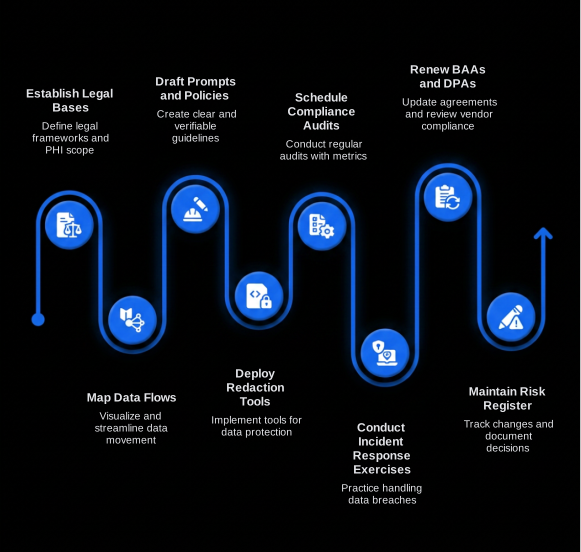
- Establish your legal bases and PHI processing scope.
- Fully map data flows; eliminate unnecessary fields.
- Draft concise, verifiable prompts and policies.
- Deploy redaction tools and verifiers from the outset.
- Schedule weekly compliance audits with defined metrics.
- Conduct quarterly incident response exercises.
- Routinely renew BAAs, DPAs, and review vendor compliance.
Maintain an up-to-date risk register, track all changes, revisit your DPIA with significant workflow updates, and carefully document every key decision for future audits.
Next Steps to Deploy Compliant AI Customer Service Agents in Healthcare
Begin on a manageable scale with a low-risk use case. Build the redaction workflow and system prompts, and implement verification checks. Start with a two-week pilot using human review. Evaluate results quantitatively, then expand gradually.
If your organization values privacy and quality communication, consider partnering with a provider who aligns with these goals. Learn more about how Typewise can fit your technology stack and privacy policies, and start your focused pilot at typewise.app.
FAQ
What are the main compliance challenges when deploying AI in healthcare customer service?
The primary challenges are meeting stringent data privacy laws like HIPAA and GDPR while ensuring secure data flows, proper redaction, and documented auditing. Failure to address these can expose organizations to legal risks and erode patient trust.
How can AI customer service agents maintain data privacy for healthcare inquiries?
A robust approach includes encrypting all data, utilizing redaction tools to protect PHI, and employing tokenization before processing. Typewise emphasizes privacy-centric workflows and ensures no training occurs on production data without explicit consent.
What is the significance of ‘privacy-by-default’ in AI systems?
'Privacy-by-default' ensures that the most restrictive privacy settings are applied automatically, incorporating data minimization and stringent access controls. This practice reduces risks of data breaches and aligns with legal standards like GDPR.
Why is verbatim adherence to compliance not enough in AI deployment?
Mere compliance isn't enough; systems need continuous auditing, effective incident response, and solid vendor evaluations. Typewise stands out by integrating verifiers for consistent checks and maintaining comprehensive audit trails.
How can organizations prepare for compliance audits of their AI systems?
Organizations should establish structured logs, conduct regular audits, and maintain clear documentation of all data processing activities. Developing a well-documented audit program, as outlined in Typewise resources, ensures operational transparency and compliance.
What role do human agents play in AI-driven healthcare customer service?
Human agents are crucial for overseeing complex or sensitive requests that AI might misinterpret, ensuring compliance and accurate responses. Typewise supports this by routing ambiguous queries to human reviewers, maintaining high service quality.
Why is cross-border data transfer a concern for AI healthcare applications?
Cross-border data transfers can expose organizations to compliance risks if data moves outside regions with protective laws, compromising user privacy. Ensuring data residency within specific regions, as practiced by Typewise, mitigates these risks.