
Support intent misclassification hides in the everyday language of your customers
Some routing mistakes may originate from wording that appears harmless. Customers often mix product names, plan tiers, and conversational expressions. AI models process words as data, not as the nuanced requests that experienced agents learn to recognize over time.
The app freezes after the last update. Also, I cannot find my invoice.
This message comprises two issues. One relates to a technical glitch, the other involves billing. When using a single-label classifier, the system often chooses incorrectly. The result? A misrouted case, slower handling times, and more customer frustration.
- Abbreviations can conceal underlying needs. For example, Env could stand for environment or envelope, depending on context.
- Shorthand can create confusion. The term chargeback is not synonymous with refund.
- Product nicknames can trip up generic models unfamiliar with your organization’s internal lexicon.
Unlike AI, humans can interpret and understand slang based on context, something that AI models require expertise decoding, clear guidance, high-quality labels, and contextual information to achieve.
Support intent classification mistakes come from weak labels and generic taxonomies
Broad, unspecific categories invite errors. Labels like General or Other obscure actual issues. Agents often add supplementary manual tags, which only leads to fragmented data.
Design a taxonomy that reflects true ownership. Every intent should have an associated team and a clear protocol. If an intent is shared between two teams, try to categorize it based on triggering events or possible outcomes.
Create labels that align to actions, not just topics
- Frame each intent as an action using verb form. For example, use Request refund instead of simply Refunds.
- Assign each label to a specific resolver team. If a team isn’t responsible, the label shouldn’t exist.
- Log negative examples and similar sounding phrases to understand and prevent repeated misclassifications.
Clear labels can often lead to more efficient routing, potentially making a noticeable difference to your agents’ performance.
Support intent routing fails when models ignore conversation context and metadata
Many classification models only consider the first customer message, missing critical information shared later. They may also overlook metadata that agents use to diagnose cases.
- Customer account plan or tier frequently indicates urgency and the correct support path.
- Communication channel implies urgency too, live chat tickets generally need faster attention than email follow-ups.
- Locale, device, and build version can all hint at the underlying problem.
- Previous support history uncovers patterns and recurring issues.
Combine these signals, both text and contextual metadata, to predict intent and route cases effectively. Systems that can’t leverage this information will likely face ongoing misrouting challenges.
Multilingual and code-switching increase support intent misclassification across markets
Customers frequently blend languages or use different writing scripts within a single message. Literal translation can fail, stripping out essential product references and emotion. This leads to distorted intent recognition.
Build tailored glossaries for every supported language and thoroughly test with translated prompts. Adjust your system’s sensitivity thresholds according to the volume of your market data. For deeper insights, explore approaches that work for scaling multilingual customer support with AI. The right methods will help you prevent subtle intent routing errors as you expand internationally.
Data strategies that reduce support intent misclassification and routing errors
Your AI system needs to understand your unique product language. Generic natural language models miss crucial synonyms and acronyms familiar to your team. Train your model using targeted approaches.
- Develop a living glossary that includes product names, features, and internal terminology.
- Collect and map near-miss or similar phrases to the correct intent to continuously refine the model.
- Label both short and long conversation threads to increase your model’s robustness.
If you haven’t started this process, kickoff with a focused sprint. This practical guide to training AI on your product language details the best steps.
Moreover, use challenging, lookalike cases (so-called hard negatives) to train your model. Such data tightens decision boundaries and reduces unnecessary re-routing.
A practical workflow to audit intent routing and measure improvement
Regular audits catch problems before they affect customers and expose weak areas in your taxonomy or labeling process.
- Each week, examine a random sample of misrouted cases, including both closed and escalated tickets.
- Create a confusion matrix for your top 20 intents to visualize frequent classification mistakes.
- Identify and tag the root cause of each issue, whether it’s due to poor labeling, missing context, or weak training data.
- Refine thresholds and re-test on separate validation data. Track improvements by support queue.
For step-by-step instructions, see this detailed guide to auditing AI support conversations. Audits ensure your intent routing remains reliable as your product and services evolve.
Comparing platforms that handle support intent classification and routing
Many platforms promise effective intent routing, but their strategies and results differ. Here’s a brief overview:
- Salesforce Service Cloud with Einstein: Provides deep CRM integration, especially valuable if your underlying data is well maintained.
- Zendesk with triggers and custom models: Offers flexible workflows; quality depends on your training rigor.
- Typewise: Emphasizes writing assistance and routing within existing tools, connecting to email, chat, and CRM. It adapts messaging style to your brand and is designed to safeguard data privacy.
- Intercom bots and Fin: Easy to deploy for teams led by chat and quick response needs.
- Ada: Best suited for handling high-volume self-serve scenarios and user flows.
- Forethought: Focuses on automating case deflection and surfacing relevant knowledge for agents.
- Lang.ai: Helps uncover new conversation topics, which can inform and improve your intent taxonomy.
- Kustomer: Useful for support organizations that require a unified, end-to-end customer timeline.
Choose based on your text database (corpus), privacy requirements, and handoff protocols. Begin with a small set of intents, measure the results, and scale from there.
Metrics that prove support intent classification is fixed
Use metrics tied directly to agent workflows and customer outcomes. Monitor them on a weekly basis and report trends to ensure visibility.
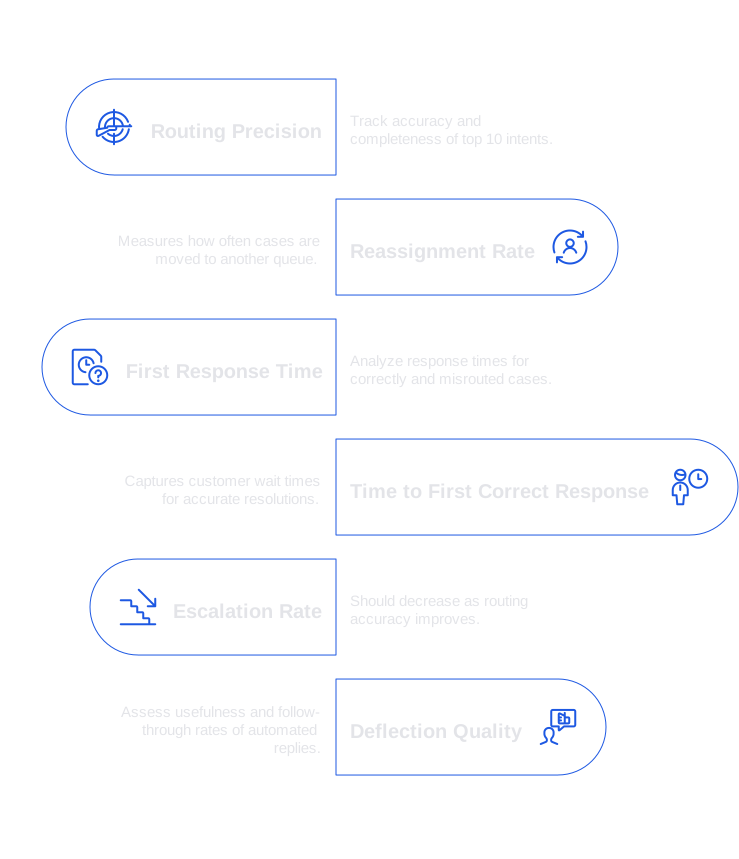
- Routing precision and recall by intent: Track your top 10 intents for accuracy and completeness.
- Reassignment rate: Measures how often cases need to be moved to another queue after the first assignment.
- First response time: Analyze separately for correctly routed versus misrouted cases.
- Time to first correct response: Captures actual customer wait times for accurate resolutions.
- Escalation rate: Should decrease as routing accuracy improves, aligning issues with the right expertise the first time.
- Deflection quality: If your system provides automated replies, assess their usefulness and follow-through rates.
For instance, if you process 10,000 tickets a month and 5% are misrouted (500 cases), reducing misroutes to 2% will prevent 300 unnecessary handoffs. Multiply by the average time per ticket to estimate total resource gains.
To speed up responses while refining your routing system, check out these practical ways AI can improve first response time. Quick, accurate replies help calm difficult sessions and limit frustration.
From misclassification to clarity in support intent routing
You can correct routing errors without a costly overhaul. Refine your labels, teach your model the specifics of your language, and audit regularly. Take a gradual approach, start small, measure progress, and expand with confidence.
Looking to tailor this solution to your own support stack and data? Connect with the team behind Typewise and discuss a custom pilot. Visit typewise.app to get started.
FAQ
Why does AI often misclassify customer support intents?
AI struggles with context, slang, and language nuances that humans naturally understand. Moreover, generic models lack the specialized vocabulary critical to support environments. Tailored training, like Typewise offers, is essential to reduce misclassifications.
How can weak labels affect support intent classification?
Weak labels obscure the true nature of support requests, leading to misrouted cases. They beg for a rigorous taxonomy that aligns with real actions and responsible teams. Misclassification is inevitable without precise labels and structured categories.
What is the impact of ignoring metadata in customer support interactions?
Ignoring metadata results in missed signals like customer urgency or past interaction patterns. This blindness to context drastically affects routing accuracy, leading to customer frustration and inefficiencies in support workflows.
How to handle multilingual and code-switching issues in AI models for support?
Literal translations fall flat, often losing essential context and emotion. Building comprehensive glossaries and testing with local language prompts are crucial. Typewise helps avoid these pitfalls by refining sensitivity thresholds across markets.
What strategies can improve the precision of AI support intent classification?
Success hinges on actionable labels, rich metadata incorporation, and continuous feedback loops. Training models with clearly defined intents and broadening language horizons, as advised by Typewise, enhances precision and reduces costly reroutes.
Why are random audits necessary for support intent routing?
Regular audits reveal systemic cracks before they translate into customer discontent. They pinpoint flawed labels or training data, enabling teams to adjust and refine models, ensuring routing remains accurate even as services evolve.
How does poor support intent classification affect customer satisfaction?
Poor classification extends resolution times and elevates customer frustration due to repeated misrouting. Precise models ensure prompt resolutions, preserving trust and satisfaction—neglecting these leads to long-term reputational damage.
Does every platform effectively classify and route support intents?
The promise varies across platforms; some integrate deeply with CRM systems, while others like Typewise focus on brand-specific communication. Selection should be based on a clear understanding of needs, data capacity, and routing strategies.
What metrics indicate improvements in support intent classification?
Metrics like routing precision, reassignment rates, and escalation frequency expose inefficiencies. Monitoring these metrics helps gauge improvements, revealing whether classification enhancements actually shift customer experience.