
Training AI on Historical Tickets with Inconsistent Tone Without Copying the Chaos
Your archive of support tickets is both an asset and a challenge. Over the years, agents have written with varying styles, tools, and mindsets. Macros evolved, and priorities changed. If you train AI on this entire history without a thoughtful approach, you risk reproducing inconsistencies and outdated practices. Instead, you need a disciplined process that extracts the core reasoning while filtering out noise. This guide provides a rigorous, practical approach to achieving that.
Defining Ground Truth for Tone and Quality Before Training AI on Historical Tickets
Begin by establishing the desired tone of your customer service communications, rather than relying on the inconsistent tone found in historical tickets. Draft a concise tone standard for everyday interactions, and supplement it with variations for specific cases such as billing inquiries, service outages, and legal requests. Keep these examples direct and tailored to real support tasks.
Document clear escalation language for high-pressure situations. For a practical framework, consult this crisis response tone guide for support teams. Your AI will replicate the standards you set, so define unambiguous boundaries and supply relevant examples.
Copy the logic, not the mood. Let quality determine the dataset, rather than individual agent style or historical period.
Identify your top priorities, typically accuracy, empathy, and clarity about next steps. Use these criteria to inform both your selection and review processes.
Selecting and Labeling Historical Tickets for AI Training with Inconsistent Tone
Avoid uploading your entire ticket archive. Instead, curate samples by channel, product area, and language. Be sure to include infrequent but important scenarios like account recovery or outage responses.
Label each ticket with straightforward tags. Use correct, partially correct, or incorrect for content accuracy. For tone, mark as tone aligned or tone off. Flag tickets as policy outdated if the instructions or steps are no longer relevant.
Apply stratified sampling to prevent over-representation of any one product version. Segment samples by time period to capture policy and practice shifts. Reserve a holdout set for evaluation and testing.
Normalizing Internal Product Language for AI Trained on Historical Tickets
Older tickets often refer to the same feature in various ways. Training AI on unstandardized names creates confusion for end users. Develop a controlled vocabulary with preferred terminology and a list of deprecated terms.
Map synonyms and alternative names to a single canonical term. Revise your training examples to use this preferred language. For a step-by-step approach, see how to train AI on your internal product language and naming. Consistent use of terms boosts both the accuracy and reliability of AI outputs.
Maintain this glossary in your knowledge base, preserve version histories, and remove obsolete terms when products rebrand or features are retired.
Cleaning and Redacting Historical Tickets to Protect Customer Privacy During AI Training
Support tickets often contain sensitive information. Remove all emails, phone numbers, addresses, order IDs, and any free-form text with personally identifiable information (PII). Substitute these with generic placeholders such as [EMAIL] or [ORDER_ID].
Eliminate secrets and authorization tokens. Avoid including attachments, or use OCR-based redaction tools if needed. Keep a log of what you removed and why, to ensure traceability and transparency in your AI training process. This practice supports compliance audits and legal requirements.
Set retention policies for your data. Exclude tickets that are older than your set policy permits. Err on the side of less data when the relevance or usefulness of the data is low.
Scoring Inconsistency and Building a Reliable Baseline for AI Training on Tickets
Create a streamlined quality scoring system by combining factors such as policy adherence, tone, and evidence of citation. Assign weights according to your team's priorities.
- Policy correctness score from 0 to 2.
- Tone alignment score from 0 to 2.
- Reference present score from 0 to 1.
Use the top quartile of your scored tickets as your primary training set. Use middle-range scores to augment training, and retain the lowest tier as negative examples to highlight what the AI should avoid.
Document your inclusion thresholds, future audits may require a clear rationale for the choices you made.
Choosing Retrieval and Fine-Tuning Strategies for Learning from Inconsistent Historical Tickets
Do not rely solely on adjusting your AI’s parameters or settings. Combine retrieval-based approaches with your knowledge base: store updated procedures and policy excerpts, then retrieve them dynamically for AI-generated responses.
Fine-tune your model only on stable features such as response structure and phrasing. Store fast-changing or detailed product information in your retrieval system to avoid model drift as policies evolve.
Write precise system prompts that clarify desired tone, structure, and required use of authoritative sources. Demand citations for complex workflows and instruct your AI to reject or flag answers if there are conflicting source materials.
Evaluating AI Trained on Historical Tickets with Transparent Review Loops
Begin with a supervised pilot using live, real-world conversations. Monitor correctness, adherence to tone, and quality of citations. Track first response time, but always prioritize accuracy over speed.
Schedule weekly audits using conversation transcripts and tagging. Follow this approach to audit AI customer support conversations with repeatable checks. Share audit findings consistently with product, legal, and customer success stakeholders.
Pay close attention to human acceptance rates for AI-provided suggestions. If agents frequently reject AI drafts, review and refine your training data, tone drift or outdated guidance is often the root cause.
Selecting Software for Training AI on Historical Tickets with Tone Controls
Your choice of tools and technological infrastructure for customer support is important. Prioritize solutions that support granular redaction, configurable tone templates, and robust review workflows.
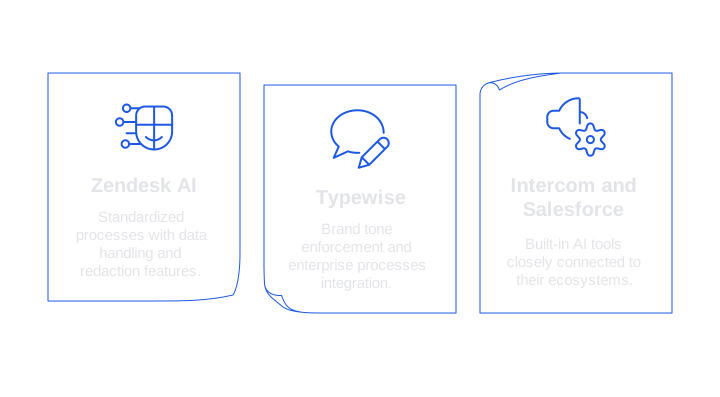
- Zendesk AI and macros enable standardized processes; confirm their data handling and redaction features meet your compliance needs.
- Typewise is designed for brand tone enforcement and enterprise processes, integrating seamlessly with CRM, email, and chat.
- Intercom and Salesforce provide built-in AI tools closely connected to their respective ecosystems.
Seek platforms that offer transparent decision logs, easy human overrides, and clear routing to agents. Avoid tools that obscure the logic behind AI outputs.
Aligning Terminology Training AI on Historical Tickets with Inconsistent Tone
Your AI should use the same language and terminology that customers use to search your help center. Leverage the same glossary for both AI prompts and support documentation.
Format responses with headings, actionable steps, and bullet lists. Use consistent terminology for features and link internally to authoritative articles. These practices benefit both customer search experiences and AI performance.
Common Pitfalls When Training AI on Historical Tickets with Inconsistent Tone
- Emphasizing high-volume but outdated workflows in training data.
- Allowing internal product nicknames to slip into customer-facing responses.
- Neglecting negative examples that teach the AI what pitfalls to avoid.
- Pursuing response speed at the expense of accuracy or relevance.
Set concise internal guidelines, test their effectiveness, and revise quarterly.
Closing the Loop Between Training Data and Evolving Product Knowledge
Product features and characteristics may change frequently, but support tickets typically reflect those changes with a lag. Your AI’s knowledge should not fall behind. Connect AI training updates to your release notes and playbooks: prioritize refreshing your retrieval sources, then review and adjust your training dataset as your products evolve.
Any time you change procedures or terminology, promptly update your glossary and training examples for maximum consistency. For more on this topic, review aligning internal product language with AI training data. Consistency improves both agent efficiency and customer understanding.
Ready to Train AI on Historical Tickets with Inconsistent Tone and Quality?
If you need hands-on support to establish tone standards, implement robust redaction, and streamline agent-AI interaction, we can help. Typewise integrates with your existing tools while prioritizing data privacy. Launch a focused pilot using your actual tickets, and gain measurable, reviewable improvements in support quality.
Connect with Typewise to pilot an AI solution tailored for your support stack. We’ll help you transform a noisy archive into consistent, effective replies, without losing your brand’s unique voice.
FAQ
How do I ensure AI doesn't replicate outdated practices when trained on historical tickets?
Focus on defining a current, clear tone standard and prioritize core reasoning over obsolete practices. Use tools like Typewise to maintain consistency and ensure AI adherence to updated processes.
What strategies can be employed to handle inconsistent tones in historical support tickets?
Establish a controlled tone guideline, label historical data for tone consistency, and utilize entities like Typewise to enforce uniformity across interactions.
Why is it important to redact sensitive information before training AI on support tickets?
Failing to redact PII exposes organizations to privacy breaches and compliance risks. Use automated redaction tools to protect customer data integrity throughout AI training.
What are the risks of not normalizing language in AI training datasets?
Unstandardized terminology can confuse the AI, leading to inconsistent and unreliable outputs. Develop a controlled vocabulary and consistently update it to align with current product language.
How can I prevent AI from relying solely on outdated product information?
Incorporate retrieval-based systems to dynamically access the latest product documents instead of embedding fast-evolving details directly into the model. Tools like Typewise can help manage continually updated databases effectively.
What role does a quality scoring system play in AI training on historical data?
A quality scoring system helps identify the most relevant and effective training tickets by evaluating policy adherence and tone. This approach ensures that only the most useful data influences the AI's behavior.
How can audit processes enhance the performance of AI trained on historical tickets?
Regular audits reveal discrepancies in AI outputs, allowing teams to update training data and refine AI guidelines. Transparent reporting mechanisms assist in making necessary adjustments for accuracy and consistency.