
Stop Guessing: Run Structured A/B Tests on AI Support Replies Like a Scientist
A/B testing is the best way to compare two AI support reply strategies using real customer data. Instead of relying on guesswork, split your support tickets, control for key variables, and measure which approach performs better. This method works for testing prompt changes, model settings, or routing logic.
Start with the essentials: assign tickets randomly (not based on agent preference), keep detailed logs of each prompt, model version, and ticket context, and define clear start and end dates for your tests. Make sure every metric directly aligns with your customer support objectives.
- Define a clear hypothesis and set a specific benchmark for success.
- Randomize tickets across different channels and times to avoid bias.
- Apply uniform quality checks and clear escalation protocols.
- Ensure your analytics provide an auditable trail for every test variant.
How to Build a Clean Experiment Framework for A/B Testing AI Support Replies
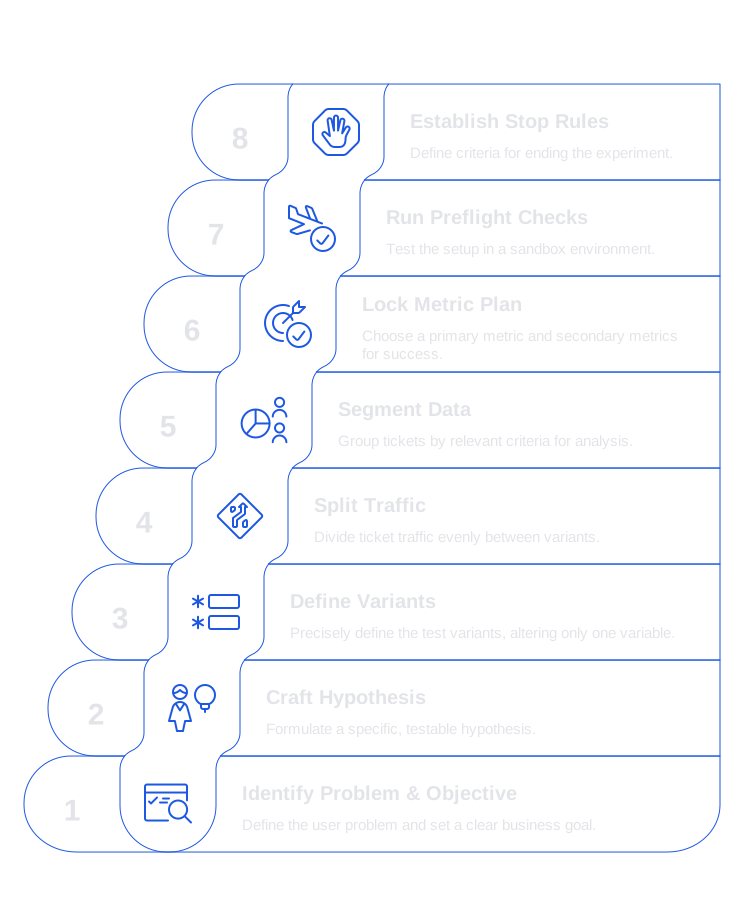
- Identify the user problem and set a business objective. For example, your aim could be to reduce the number of password reset tickets that get reopened. Keep the experiment scope focused and trackable.
- Craft a specific hypothesis. For instance, “Variant B will increase confirmed resolution rates for login tickets by 3 percentage points.”
- Define your test variants precisely. Alter only one variable at a time. Common variables include the wording of a prompt, depth of knowledge retrieval, use of function-calling, or reply format.
- Decide on the testing unit and split the ticket traffic. Split your traffic at the level of individual tickets, not the level of agents. Initially, allocate 50 or 60 percent of tickets to Variant A and the rest to Variant B for a balanced testing environment. If possible, keep agents unaware of which variant they’re using to reduce bias.
- Segment your data before launch. Group tickets by intent, channel, support tier, language, and customer tenure. Keep these segments stable throughout the test and analyze your results by segment afterward.
- Lock in your metric plan. Choose one main metric for success. Supplement with secondary metrics and safeguards. Predetermine what improvement will qualify as a meaningful win.
- Run preflight checks. Test your setup in a safe sandbox and with a small portion of live traffic. Make sure prompts, citations, function calls, and escalations all work correctly across all scenarios.
- Establish stop rules and a review schedule. Define a minimum test duration and a sample size before launching. Don’t monitor results hour-by-hour; instead, review outcomes twice weekly and keep a log of changes and decisions.
Select Metrics and Thresholds that Drive Real Impact
Use metrics that directly reflect resolved customer issues and overall satisfaction. Prioritize outcomes you can tie to business value, such as costs, efficiency gains, or risk reduction. To avoid analysis noise, stick with a single primary metric for each test.
Main Outcome Metrics
- Confirmed resolution rate: Measures tickets closed without a re-open within seven days.
- First Response Time: Tracks how quickly the AI provides a helpful initial reply. See practical advice for this in the AI response time improvement guide .
- Containment rate: The proportion of tickets fully handled by AI, without needing transfer to a human agent.
Agent-Assist and Quality Indicators
- Suggestion acceptance: For agent-assist workflows, measure the AI suggestion acceptance rate KPI . High acceptance rates indicate trust and alignment with agent needs.
- Policy and tone adherence: Randomly sample and score transcripts for proper tone and compliance. Reference this audit guide for AI customer support for more information.
- Ticket touches: Count the number of replies it takes to resolve a ticket; lower numbers typically mean clearer guidance and faster resolution.
Protective Checks to Prevent Negative Outcomes
- Escalation spikes: Trigger alerts if escalations go above a defined threshold.
- Negative CSAT share: Monitor the percentage of poorly rated interactions, not just the average score.
- Refund and credit anomalies: Flag unusual patterns by ticket type for further review.
Set your “success bar” before running the test, determine in advance what level of improvement justifies switching to a new variant. Use either absolute or percentage-based gains that align with business needs. Ensure you sample enough tickets per variant and run the experiment through at least one full business cycle to collect meaningful data. Remain disciplined and avoid stopping early just because early headlines look promising.
Sample Prompt and Reply Variants for AI Support A/B Testing
Test one change per experiment. The following ideas for variants provide significant insights or results:
- Tone and structure: Compare brief and direct replies with more empathetic, supportive responses. Keep response steps consistent across variants.
- Clarification-first approach: Require one targeted question before delivering solutions. Compare with a variant that gives immediate answers.
- Knowledge source strictness: Restrict the AI to the official product knowledge base and compare results with versions that access a wider set of documents.
- Step formatting: Present solutions as numbered steps versus condensed paragraphs.
- Auto-send versus agent approval: In agent-assist scenarios, compare automatic AI replies with versions requiring agent confirmation.
- Function-calling strategies: Test calling an API function as the first response versus offering manual troubleshooting steps first.
- Localization approaches: Contrast native-language replies with translations from English to measure impact on understanding and satisfaction.
Prompt Variant A Example
Role: Support assistant. Goal: Resolve the user's issue in 3 sentences. Style: concise and direct. Steps: 1) Acknowledge the issue. 2) Give exact, numbered steps. 3) Offer one next action if needed. Constraints: No emojis, no marketing phrases, no assumptions. Knowledge: use the official product KB only. If missing info, ask one clarifying question.
Prompt Variant B Example
Role: Support assistant. Goal: Resolve the user's issue with a reassuring tone. Style: empathetic and clear. Steps: 1) Validate the concern. 2) Provide numbered steps with one-sentence context each. 3) Offer to stay available. Constraints: Avoid promises or discounts. Knowledge: trust the product KB and approved macros. If uncertain, escalate to a human.
Ensure the reply length fits the channel context. Mobile chat interactions should be brief, while email conversations can support more detailed responses including contextual background and citations. Keeping this distinction helps maintain fair testing across different communication channels.
Reliable Rollout Plan for A/B Testing AI Support Replies
- Start small: Route 5 to 10 percent of tickets to Variant B initially.
- Monitor stability: Closely track protective checks for the first couple of days.
- Scale up gradually: Move to 25 percent, then 50 percent if metrics remain positive and stable.
- Freeze experiment settings: Do not alter prompts, logic, or assignment mid-test.
- Make clear decisions: When your success criteria are met, shift the successful variant to 90 percent of traffic and retain 10 percent as a shadow control for a week.
- Document comprehensively: Record all prompts, datasets, run dates, and key decisions. This documentation allows you to reuse the playbook for future intents and tests.
Integrate A/B Testing Into Existing Tools and Team Workflows
Your technology stack drives success. Make sure you have CRM integration, prompt version control, reliable fallback options, and transparent logs. Choose analytics tools that directly connect AI variant performance to ticket outcomes.
Typewise is suitable for teams that rely heavily on CRM tools, email, and chat for everyday operations. It offers AI writing assistance that ensures the grammar, style, and phrasing of your communications stay on-brand, addressing enterprise privacy needs and delivering faster, more precise responses. For agent-assist workflows, suggestion acceptance and editing histories are automatically tracked, feeding data for your next test cycle.
Keep your team agile. Allow space for rapid field experiments and deeper audits. Standardize on a shared template so product, data, and support teams can quickly deploy new experiments and learn from every result.
Consistent Wins: Practical A/B Testing Tips for AI Support
- Fix traffic routing logic at the outset. Assign tickets randomly once and maintain assignments throughout the test.
- Standardize macros and templates. Align all non-AI macros so comparisons between variants remain fair.
- Use structured quality reviews weekly. Evaluate samples using a consistent rubric with multiple reviewers for objectivity.
- Track learnings, not just wins. Archive unsuccessful prompts with detailed notes on their performance and shortcomings.
- Close the learning cycle. Convert insights from tests into new ticket intents and improved team training materials.
FAQ
What is the primary benefit of A/B testing AI support replies?
A/B testing eliminates guesswork by scientifically measuring which reply strategy performs better. This method helps agents make informed decisions that directly align with customer support objectives.
How can A/B testing improve AI support systems?
By isolating variables like prompt wording or model settings, A/B testing can reveal inefficiencies and optimization opportunities, potentially leading to cost savings and better customer satisfaction.
Why should I randomize ticket assignments during A/B tests?
Randomization prevents bias and ensures that your test results are statistically valid. This process helps maintain an objective comparison between variants.
What are the risks of not using detailed analytics during A/B testing?
Without detailed analytics, you risk misinterpreting results, leading to misguided strategy changes. It can cause resource wastage on strategies that don't truly impact performance.
How can Typewise assist in the A/B testing process?
Typewise provides AI writing assistance that integrates with CRMs to maintain brand consistency. It offers detailed analytics, ensuring you have the data necessary to optimize support workflows.
What caution should be exercised with A/B testing AI support?
A/B testing should be meticulously planned to avoid premature conclusions and poor decision-making. A structured framework is essential to extract actionable insights and prevent costly strategic errors.
Is it necessary to test one variable at a time in A/B experiments?
Testing one variable at a time is crucial to accurately identify which change leads to performance improvement. Multiple variables can confound results, making it difficult to pinpoint effective strategies.
Why should I maintain a control group even after a successful test?
Retaining a small control group provides ongoing comparison and helps in identifying any anomalies post-rollout. This strategy facilitates continuous improvement and decreases over-reliance on potentially flawed results.