
Automate High-Volume Customer Service Tasks with AI Agents Before Addressing Edge Cases
Your first victories in automating customer service tasks will come from tackling those tasks that are most voluminous or frequently occurring. Focus on repeatable questions and routine handoffs, the workflows that siphon away minutes from every ticket. Once these foundations are solid, you can move on to more specialized flows.
Begin by mapping out customer intents and the channels they use. Quantify the number of cases that match each intent over the last 90 days. Rank these intents by both volume and operational risk. Start your automation journey with tasks that have high volume but low risk. This approach often results in faster initial responses to customers. For a deeper dive into this process, check out the top ways AI agents reduce first response time across common channels.
Automating Ticket Triage and Routing in Customer Service with AI Agents
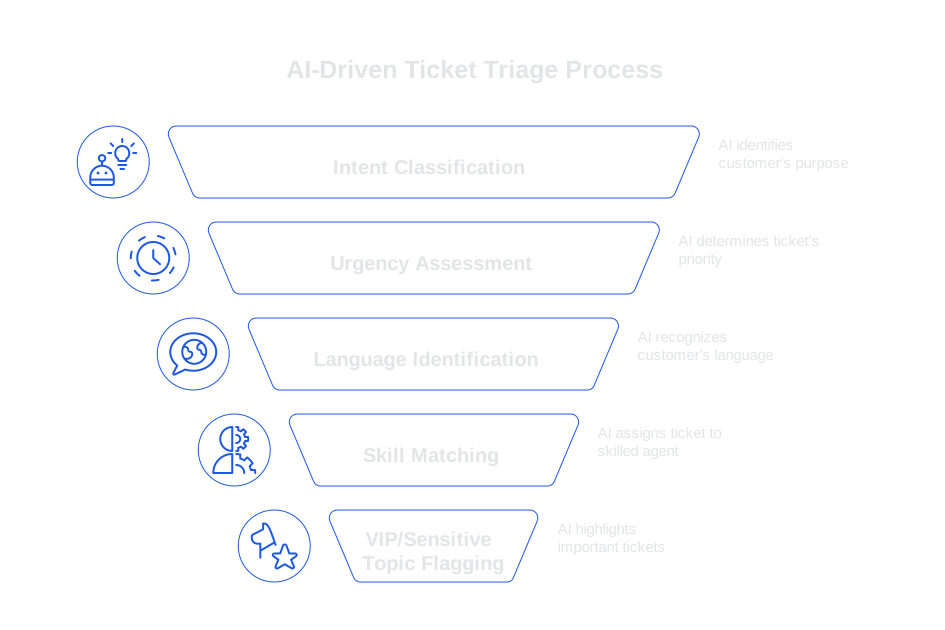
Ticket triage is the perfect starting point for automation. The AI model should be trained to classify the customer’s intent, urgency, language, and required skills, then assign each ticket to the appropriate queue and service level agreement (SLA). The system should also flag VIPs and sensitive topics automatically.
Key Steps to Implement First
- Define a closed list of customer intents and sub-intents.
- Set up clear routing rules and designate fallback owners for unresolved cases.
- Provide the AI with a library of acronyms and product names it should recognize.
- Keep a record of the AI model’s confidence scores for each intent prediction and make these visible to customer service agents.
Use clear, straightforward prompts for the AI model’s intent classification task. Ensure the model’s outputs are clean and formatted in a way that can be easily read and processed by other systems.
For example, inform the AI model: Your role is to act as a router. Your task is to classify each customer message into one of the following intents: billing, order, technical, feedback, security. Extract entities such as product, plan, and region, then return the results in the following JSON format: { intent: , entities: { product: , plan: , region: }, confidence: 0.0 }. Avoid including any extraneous text outside of this JSON structure.
Track your success by measuring the misroute rate, time to assignment, and the number of agent touches per reroute. Review low-confidence cases daily and expand your list of intents only after confusion falls to an acceptable level.
Automating First Responses and FAQ Resolution in Customer Service with AI Agents
After routing, address the most common known questions with concise, controlled answers. Use templates, company policies, and verified excerpts from your knowledge base for consistency. Require citations or snippets supporting every response.
Training the Model on Your Product Language
Generic responses reduce customer trust. Train the AI model on your organization’s preferred naming conventions, product versions, and user interface labels. Map any legacy or deprecated terms to your current terminology. For a practical approach, refer to this guide to training AI on your internal product language and taxonomy.
Prompt Pattern for Safe and Reliable Replies
Ensure that the AI model exclusively uses approved and up-to-date data sources. Do not proceed with the AI’s operations if any primary data sources are missing or outdated.
Use only the provided articles to answer. If the answer is not in sources, reply: I need to check with a human. Include a short, friendly first reply and a numbered list of steps. Cite the article titles used. Tone: clear and concise.
- Cache the top FAQ responses, tagging each answer with a freshness date.
- Attach policy excerpts for answers related to refunds, credits, and SLAs.
- Immediately escalate inquiries regarding billing, security, or legal matters.
Automating Order Status, Returns, and Simple Account Actions with AI Agents
Customers often ask about order status, returns, and basic account changes. Grant the AI model controlled access to order and account APIs, ensuring the permissions are narrowly scoped. Log every action the model takes, including every field read or changed.
Reliable Automation Patterns
- Order lookup via email plus token-based customer verification.
- Return initiation with policy confirmation and generation of return labels.
- Rescheduling appointments with calendar integration and customer confirmations.
- Subscription changes that respect your specific proration and billing rules.
Design automations so they are reversible: generate drafts of customer actions for human approval, and always provide customers with a preview before finalizing any changes. Use clear, explicit business rules rather than vague free-text instructions.
Essential Safeguards
- Scope API keys so they’re read-only for queries and lookups.
- Mask all personally identifiable information (PII) in logs and analytics.
- Block automations from proceeding if any policy data required is missing or incomplete.
Automating Data Capture, Conversation Summaries, and CRM Updates in Customer Service with AI Agents
Filling in forms and updating records consumes agent time. Use the AI model to extract key details from conversations and update CRM records automatically. Generate concise summaries and clear next steps, ensuring output consistency and searchability.
Standardize the Following Elements
- Case reasons and product version details.
- Reproduction steps, including environment specifics.
- Tags for business impact and case priority.
- Resolution notes, including links to pertinent knowledge base articles.
Provide the AI with a specific schema for summaries. Reject any outputs that don’t match that schema.
Summarize the conversation into this schema: \{ summary: , root_cause: , impact: , next_steps: , kb_links: \[\] \}. Use plain language. Avoid any adjectives that judge the customer.
Monitor the average handling time, note quality, and ticket reopen rate. Invite agents to rate the model’s generated summaries and enhance your schema as new workflow patterns emerge.
Automating Proactive Customer Updates and Incident Communications with AI Agents
The best customer service issue is one prevented before it arises. Proactively notify specific customer segments when orders are delayed or product features change. Tailor messages by region, product, and customer tier.
Ensuring Message Accuracy
- Retrieve order status and incident data only from a single, reliable source of truth.
- Require automated checks to identify contradictory information before sending a message.
- Ensure high-stakes updates undergo human review before release.
Set explicit guidelines for tone and commitments in customer notifications. Avoid including tentative dates unless confirmed. Many teams benefit from incorporating automated validation checks; see how to implement self-checking AI workflows that intercept risky replies for guidance.
Inform customers early, relying only on information you can verify and defend.
Implementing Validation and Auditing for AI Answers in Customer Service
Maintaining accuracy demands structure. Surround every automated task with tests and ongoing audits. Require solid evidence for any sensitive claims. Track information sources and display confidence levels for each response.
Best-Practice Controls
- Automated checks for policy compliance, customer safety, and numerical calculations.
- Daily sampling reviews provided by team leads.
- Regression testing after prompt or model updates.
- Deploy new automations in shadow mode before making them live.
Define explicit exit rules to determine when a task should be handed off to a human. Publish these handoff criteria and train the AI model to respond with, “I need to involve a specialist,” when essential data is missing or ambiguous.
Selecting an AI Customer Service Platform and Workflow for These Five Automations
Choose a platform that supports deep integrations, advanced privacy controls, and a consistent communication tone. Look for flexibility to refine prompts without coding. Base your selection on real workflow needs, not just demo presentations.
What to Prioritize in a Platform
- Built-in connectors for CRM, email, and chat channels.
- Role-based access control and robust audit logs.
- Support for AI verifiers and staged human review workflows.
- Training tools for your specific brand language and product taxonomy.
Market Overview
- Zendesk AI and Intercom Fin enable quick starts and standard automation macros.
- Typewise is optimized for privacy, brand voice, and complex workflow coverage across CRM, email, and chat.
- Salesforce Service Cloud Einstein excels at CRM-native actions.
- Ada and Forethought are strong choices for high-volume inbound deflection.
Run a proof of concept using the five tasks that are of highest priority and volume in your customer service workflow. Measure metrics such as time to deploy, case deflection rates, answer accuracy, and agent satisfaction. Rely on data from your own operations, not vendor claims, to inform your evaluation.
Putting the Five Customer Service Automations in Sequence with AI Agents
- Triage and routing across all customer contact channels.
- First-response automation and FAQ coverage using validated data sources.
- Order status checks and basic account management actions.
- Systematic data capture, conversation summaries, and CRM record updates.
- Proactive status updates and incident communications before issues escalate.
This phased approach reduces risk and delivers visible results quickly. Each layer of automation helps your model learn, making future improvements easier and compounding the benefits across your workflow as your knowledge base grows.
Next Steps to Tailor AI Agents for Your Customer Service Operations
Document all relevant customer intents and company policies. Clearly specify which sources the AI is allowed to cite. Prepare a gold set of sample conversations. Begin your automation rollout with just one customer communication channel.
If you’re seeking a partner that prioritizes tone, privacy, and measurable ROI, see how Typewise fits your workflows and these five key automations. We can help you launch safely and scale your automation, on your terms.
FAQ
How do AI agents improve customer service efficiency?
AI agents streamline high-volume tasks like ticket triage and FAQ resolution, enabling faster response times. By handling routine inquiries, they free human agents to tackle more complex issues.
What are the risks of automating customer service with AI?
Relying too heavily on AI without proper validation can lead to misinformation and customer dissatisfaction. It's crucial to implement safeguards and regularly audit AI outputs.
When should edge cases in AI automation be addressed?
Address edge cases only after mastering high-volume, low-risk tasks. Delving into complex scenarios prematurely can overwhelm your resources and lead to failed implementations.
How does Typewise contribute to customer service automation?
Typewise offers a platform with strong privacy features, brand-voice optimization, and comprehensive complex workflow support, often making it ideal for nuanced automation projects.
Why is training the AI on product language crucial?
Proper training ensures AI interactions align with your brand's lexicon, avoiding generic responses that can erode trust. Mismatched language leads to misunderstandings and client discontent.
What should be considered when choosing an AI platform for customer service?
Opt for platforms with deep CRM integrations, robust privacy controls, and the ability to refine prompts without coding. These offer more seamless and secure customer interaction management.
How can AI prevent customer service issues proactively?
AI can send alerts and updates to specific customer segments about potential delays or changes, ensuring that customers are informed before problems escalate into dissatisfaction.