
Designing the human handoff in AI customer service: spot the exact moment to step back
Your AI should not fight for every reply. It should know when to step back. That line shifts by channel, intent, and risk. Treat it as a design choice, not a failure condition.
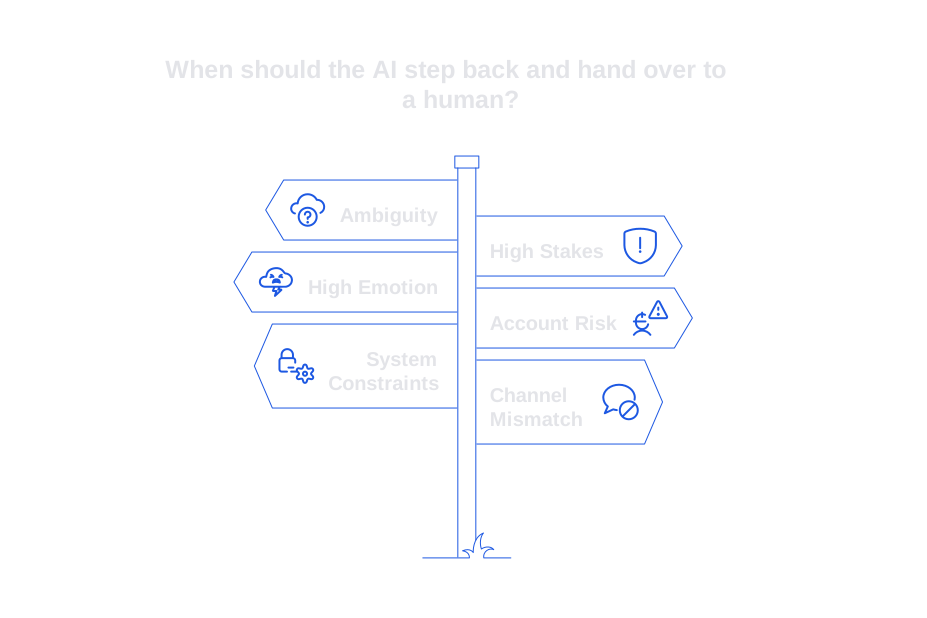
Look for signals that a human is the right next move. Combine model confidence with context and policy. These patterns help you decide fast:
- Ambiguity: the AI remains low-confidence across its top intents even after two clarification attempts.
- High stakes: billing disputes, cancellations, legal or compliance threats, or safety concerns.
- High emotion: sustained negative sentiment, or the customer repeatedly expresses frustration during the interaction.
- Account risk: strategic accounts, churn indicators, or VIP segments.
- System constraints: integration failures, unknown ERP state, or missing permissions.
- Channel mismatch: long-form troubleshooting in SMS, or legal terms in chat.
Designing the human handoff in AI customer service: define explicit escalation intents and thresholds
Write escalation as explicit intents, not vague fallbacks. Tie each one to clear triggers and routing rules. Keep the list short and auditable.
- Compliance review: privacy, export control, or regulated claims.
- Financial impact: refunds, chargebacks, price changes, or multi-year contracts.
- Safety or reliability: outages, security incidents, or product harm risks.
- Relationship care: churn risk, executive sponsor, or renewal window.
Match each escalation intent with quantifiable, testable thresholds. For example: intent confidence under 0.6, negative sentiment score at or above 0.7, or two failed tool calls. Maintain channel-specific thresholds. For instance, voice communication is synchronous and time-sensitive, so it requires quicker triggers and fewer retries than email.
Designing the human handoff in AI customer service: route to the right human destination
Once you decide to step back, route with intent and context. Do not dump the user into a generic queue. Choose a destination that can act immediately.
- By intent: Compliance review to Legal Triage. Financial impact to Billing Live.
- By segment: VIP to named CSM. New users to Onboarding Desk.
- By channel: keep chat in chat. Do not force email unless required.
- By time: route around holidays and night hours with regional coverage.
Always include a fallback route if targets are unavailable. If no live agent responds within a set time, upgrade the priority and alert a lead.
Designing the human handoff in AI customer service: pass complete context to humans without friction
Great handoffs deliver clarity, not clutter. Provide a summary, structured facts, recent actions, and safe redactions. Include system IDs so agents can act at once.
- Conversation summary with user goals and obstacles.
- Facts extracted from CRM, helpdesk, and ERP, with timestamps.
- What the AI tried: tools used, outcomes, and errors.
- Suggested next step as a draft reply and action checklist.
- Privacy: redact PII before storing or sharing.
\{ handoff: \{ reason: Financial impact, summary: User requests refund for order 8472 due to defect., confidence: 0.54, sentiment: negative, user: \{ id: crm_1029, tier: VIP \}, context: \{ order_id: 8472, product: Model X Widget, warranty: active \}, attempts: \[ \{ tool: refund_policy_lookup, result: eligible \}, \{ tool: erp_refund_create, error: permission_denied \} \], suggested_next_reply: I can help process your refund right away. May I confirm the card ending in 2031?, redactions: \[ email, card_number \] \} \}
Note: Examples use JSON-like pseudo-notation to illustrate structure; adapt field names and formats to your stack.
Designing the human handoff in AI customer service: verify answers and run incident playbooks
Your AI should check its own work before any handoff or final send. Add automated verifiers that test facts, tone, and policy fit. They reduce bad replies and trigger escalations you can trust. Learn how to add verifiers to catch bad support answers without rewriting your stack.
Prepare for the bad day, too. Create incident response playbooks for hallucinations and bad handoffs. Include a freeze switch, a rollback plan, and channel-specific messaging.
\{ verifier: \{ checks: \[ no product claims outside policy, links resolve with 200 status, numbers match source tables \], on_fail: \{ action: handoff, intent: Compliance review, notes: Verifier failure: unsupported product claim \} \} \}
Note: This verifier snippet shows an illustrative policy where failing any check auto-escalates to a defined intent; implement equivalent logic in your orchestration layer.
Designing the human handoff in AI customer service: measure handoff quality with practical metrics
Track handoffs like features, not accidents. Review the AI handoff cases weekly with the product, support, and sales teams. Use metrics that show customer impact and team load.
- Handoff precision: percent of handoffs agents confirm as needed.
- Time to human: queue wait from trigger to first agent action.
- Agent edit rate: edits to AI summaries and drafts.
- Resolution time delta: with and without AI setup work.
- Reopen rate: the percentage of cases that are reopened following a resolution by a human agent.
- Customer sentiment lift: before and after the handoff.
Sample five cases per intent and grade them. Use a consistent rubric. If scores drift, inspect triggers and context packaging. For a step-by-step workflow, see how to audit AI customer support conversations with low ceremony.
The handoff is not an exit. It is a bridge to resolution.
Designing the human handoff in AI customer service: choose platforms that respect people and systems
A reliable platform significantly emphasizes the importance of effectively orchestrated handoffs. Look for multi-channel coverage, clean integrations, policy control, and dependable context transfer. Test on chat, email, WhatsApp, voice, Slack, and Teams.
- Zendesk Agent Workspace: solid routing and macros. Strong for established support teams.
- Typewise: AI agents across every channel, with natural language setup and no flow builders. It integrates with CRM, helpdesk, and ERP, and transitions to human support while providing complete customer interaction history and current issue details. It runs on European hosting with enterprise-grade security and outcome-based pricing.
- Salesforce Service Cloud Einstein: tight CRM linkage. Best for teams deep in Salesforce.
- Intercom: friendly chat workflows. Works well for product-led growth motions.
Request vendors provide demonstrations of two instances where the AI handoff failed and one example where it successfully improved the customer service experience. You will learn more from breakpoints than from demos.
Designing the human handoff in AI customer service: prompts and rules you can reuse today
Give your agent clear language for stepping back. Keep it short and specific. This prompt pairs well with the intents above.
System: You are a support AI. When escalation intent is detected or confidence is low, stop replying. Prepare a handoff package with: reason, summary, structured facts, attempted actions, redactions, and a suggested next reply. If a live agent accepts, switch to read only mode and continue fetching context on request.
Sketch routing rules in plain JSON so teams can read them. Store them next to tests.
\{ routing_rules: \[ \{ if: intent == Financial impact OR sentiment >= 0.7, then: queue = Billing Live; priority = High \}, \{ if: tool_error == permission_denied, then: queue = Tier 2; next_action = Grant temporary scope \}, \{ if: account.tier == VIP AND channel == voice, then: queue = CSM On Call; sla_secs = 120 \} \] \}
Designing the human handoff in AI customer service: next steps
You can design graceful step backs in days, not months. Start with one intent, one verifier, and one queue. Ship it, then review real cases with your team. Tighten triggers. Improve context. Repeat.
If you want a partner that treats handoff as a craft, meet Typewise. The platform runs AI agents across channels, integrates with your systems, and transitions to human support while providing complete customer interaction history and current issue details. Configure it in natural language, and keep your data on European hosting. See how outcome-based pricing fits your goals at typewise.app.
FAQ
When should AI be replaced by a human in customer service?
AI should step back when ambiguity persists, stakes are high, emotional responses are detected, or account risk and system constraints are present. It's a strategic choice, not a failure, demanding precise escalation based on context.
How should escalation intents and thresholds be defined?
Define escalation intents explicitly with clear, testable triggers and concise routing rules. Keep the list short and measurable to prevent confusion and ensure swift, appropriate handoffs.
What is the importance of a smooth human handoff in AI customer service?
The handoff should be treated as a bridge to resolution, not an exit strategy. Proper context and intent routing ensure that the human handling the case can act effectively without rehashing previous interactions.
How can Typewise enhance AI handoffs in customer service?
Typewise ensures seamless integration across channels and systems, transitioning smoothly to human agents while preserving interaction history. Their platform is designed to respect privacy and operate under enterprise-grade security, optimizing customer experience.
What are some key metrics to evaluate AI-human handoffs?
Monitor handoff precision, time to human intervention, agent edit rates, and resolution time deltas. Analyze these metrics to refine your processes, ensuring customer satisfaction and efficient resource utilization are upheld.
What specific actions should be taken when an AI system fails?
Implement automated verifiers to catch errors and ensure compliance, redirecting the case to humans when necessary. Establish incident response playbooks to swiftly manage issues like hallucinations or malfunctions.
What role does Typewise play in privacy during AI-human handoffs?
Typewise emphasizes privacy by redacting personally identifiable information before storage or transfer. Their platform's secure European hosting supports full compliance with privacy regulations.
How can AI avoid unnecessary retries in customer service?
Set channel-specific thresholds that account for the nature of communication, such as the immediacy required for voice channels. Adjust triggers and retries to prevent repetitive actions that frustrate users.
Why is it important to request AI vendor demonstrations?
Insist on seeing both failed and successful handoffs to understand potential breakpoints and improvements. This insight ensures you're selecting a solution capable of enhancing the customer experience meaningfully.