
How to spot when migrating from a legacy chatbot to agentic AI makes sense
Your legacy chatbot follows scripts. Your customers do not. You feel it when repetitive intents pile up, brittle flows break, and edge cases stall. You also see it in metrics. Long back-and-forth threads. Handovers without context. Internal tickets bouncing between teams. If this sounds familiar, agentic AI is ready for you.
- Customers ask multi-step questions your bot cannot chain together.
- Policies and prices change, then your flows lag behind.
- Agents retype context after every handoff.
- Channels multiply, but logic remains siloed.
- Leads and upsell moments go unrecognized in support chats.
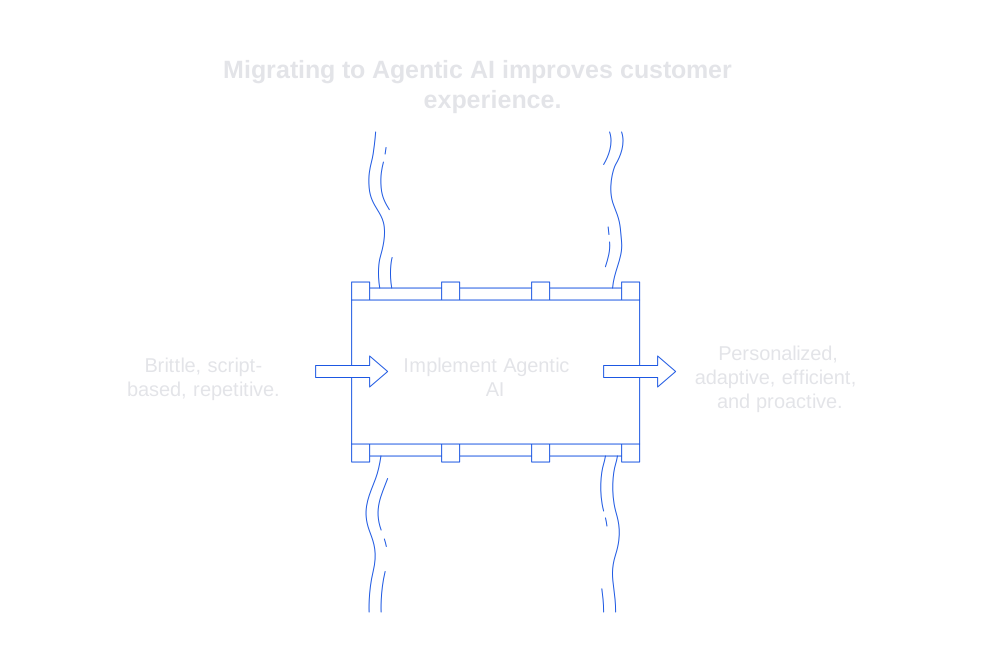
Agentic AI tackles these gaps by focusing on resolving problems (outcomes), instead of relying solely on scripted responses (intent trees). It consults knowledge, calls tools, and chooses next actions. It writes emails, answers in chat, schedules callbacks, and posts updates to Slack or Teams. It also knows when to pull in a human, with full context preserved.
What migrating from a legacy chatbot to agentic AI actually involves
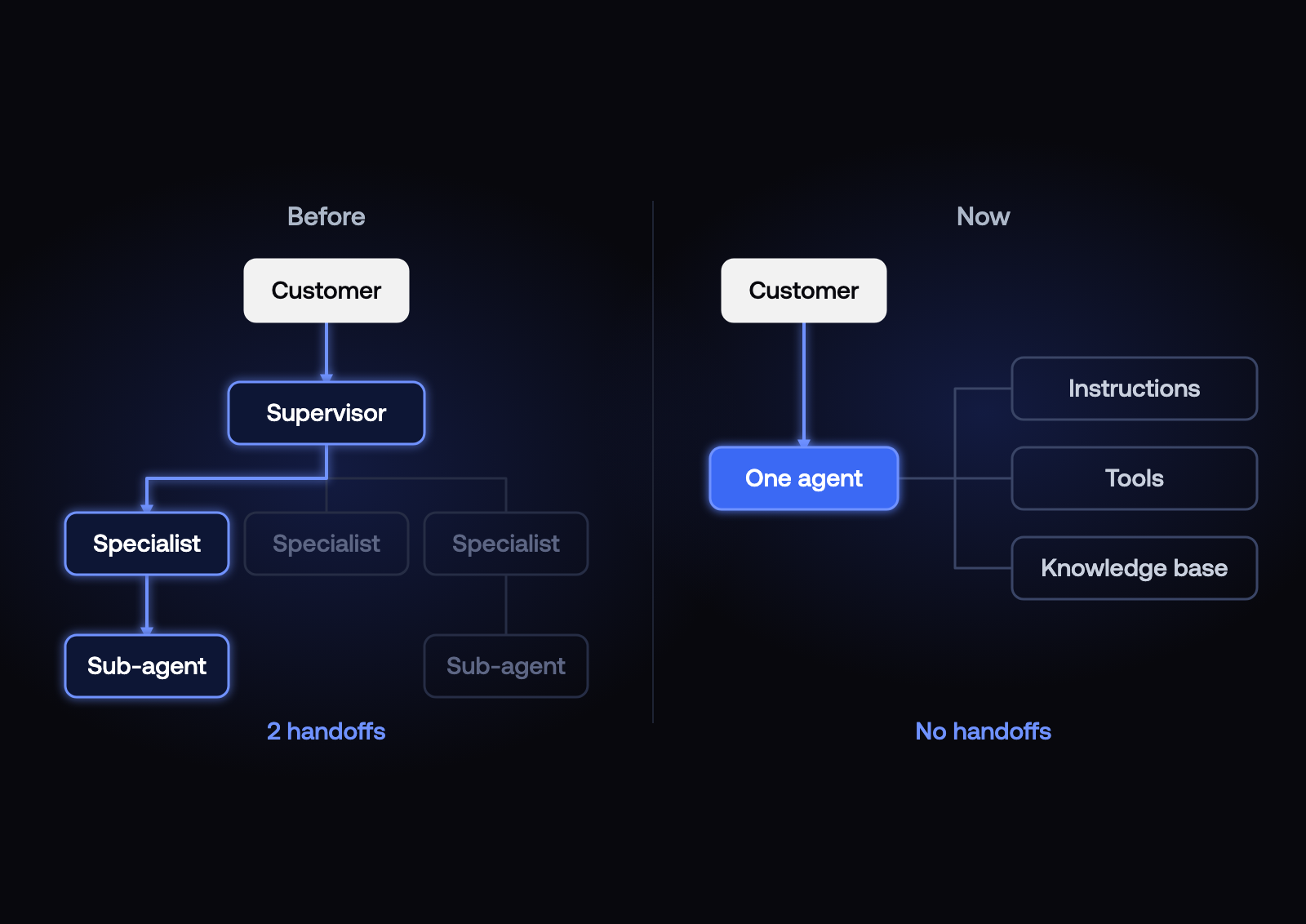
Migration is not a rip-and-replace event. It is a staged rollout where you replace outdated or inflexible steps in your current system with flexible, goal-driven agents. Expect five building blocks.
- Unified context. Connect CRM, helpdesk, ERP, and billing. Give the agent a single customer view.
- Policy-aware reasoning. Encode eligibility, SLAs, and regional rules as callable checks.
- Channel reach. Cover chat, email, WhatsApp, voice, and workplace chat in one brain.
- Human handoff. Pass full state to agents and back, without losing pace.
- Observability. Track decisions, citations, and tool usage. Review and improve continuously.
You also need a plan to train the AI on your company’s specific operational language and procedures. That step keeps answers precise and on brand.
A practical migration blueprint from legacy chatbot to agentic AI
1) Map outcomes, not intents
List target outcomes like resolve refund under policy, quote renewal, or qualify enterprise lead. Attach rules, systems, and data sources. Your map becomes the agent’s playbook.
2) Wire core tools
Start with authentication, case creation, knowledge search, and order lookup. Add payment, subscription changes, and entitlement checks next.
3) Write narrow, testable prompts
Keep prompts short. Bind them to policies and tools. Include refusal rules and escalation paths.
system : You are the customer concierge. Always cite sources. Use tools before guessing. Escalate when policy is unclear.
developer : Available tools: get_order , create_case , check_refund_policy , send_email . If refund denied, explain policy and offer options.
4) Ship one agent to one journey
Choose a customer interaction route with a high transaction volume and clear, available data. Replace only the brittle segments. Keep your legacy flows as fallback during ramp.
5) Observe, verify, and iterate
Instrument every decision. Add automated checks for policy and tone. For deeper guidance, see how to add verifiers that catch wrong answers before customers see them.
6) Expand channels
Once chat works, switch on email and WhatsApp. Add voice with transcription and summaries. Keep one brain across channels.
Key migration risks when moving from legacy chatbots to agentic AI and how to mitigate
- Policy drift. Answers slip when policies change. Connect policy sources and schedule refresh checks.
- Hallucinations. Use retrieval and verify key claims. Fail safe if sources conflict.
- PII exposure. Redact sensitive data in logs and memory. Restrict tool outputs by role.
- Brand voice. Provide tone exemplars and banned phrases. Review weekly during ramp.
- Change fatigue. Inform agents early. Show how context sharing reduces busywork.
Make auditing routine, not exceptional. Establish sampling rules, rubrics, and issue coding. Here is a practical way to audit AI customer support conversations and turn findings into prompt and policy fixes.
How to compare platforms for agentic AI migration without bias
Judge platforms by the work they remove and the outcomes they deliver. Then check governance and pricing fit. Consider this short list as a starting field: Dialogflow, Intercom, Typewise, Salesforce Service Cloud Einstein, Ada, and Ultimate. Run the same tasks on all.
- Configuration model. Can you express behavior in natural language without flow builders.
- Integration reach. Does it connect to your CRM, helpdesk, ERP, and data warehouse.
- Channel parity. One brain across chat, email, WhatsApp, voice, and workplace chat.
- Observability. You need clearly traceable activity records, citations, and logs of how your tools are utilized in the system.
- Security posture. Check hosting location, isolation, and audit trails. EU hosting helps GDPR programs.
- Pricing logic. Prefer outcome-based models over raw token metering.
Typewise sits near the top for teams that want an AI-native customer operating system rather than a standalone bot. It deploys agents across channels, integrates with existing tools, and hands off to humans with full context. It runs on European hosting with enterprise-grade security and uses outcome-based pricing. Still, you should test it head to head with others on your journeys.
How to prepare your data and prompts for agentic AI migration
Start with knowledge hygiene. Remove duplicate articles. Mark stale content. Add structured FAQs for edge cases. Align product names and abbreviations across teams. Then bring policy docs under version control. That lets the agent track change history.
Give the agent tone exemplars by product tier and region. Provide denial templates that respect local rules. Encode mandatory disclaimers by country. These steps shorten review cycles and reduce risk.
Finally, create scenario suites. Cover refunds, warranty, renewals, entitlements, and sensitive billing topics. Include adversarial tests for slang, typos, and emotional language.
user : I was charged twice for Pro X. Order id maybe 54O1 . Need refund today .
expected : Verify order, check policy, grant or deny with rationale, open case, email summary, log trace id.
How to measure success after migrating from a legacy chatbot to agentic AI
Pick metrics that reward real outcomes. Avoid vanity counts like raw deflection. Track resolution rate by journey, median replies per resolution, and time to first action. Record human handoff quality and rework. Monitor citations used per answer for traceability.
- Customer outcomes. Resolution rate, refunds processed, orders corrected.
- Operational flow. Cases created with full context, escalations with history attached.
- Quality signals. Policy adherence, tone match, and verification pass rate.
Run weekly reviews. Feed findings back into prompts, tools, and knowledge. Keep a changelog, so regressions stand out.
What migration looks like with Typewise agentic AI in practice
Typewise works like an AI concierge that knows each customer. It connects to your CRM, helpdesk, and ERP. It writes across chat, email, WhatsApp, and voice. It can also message inside Slack or Teams for internal follow-ups. You configure behavior in natural language. No IT involvement or flow builders. When a human is needed, Typewise hands off the full case state, not a summary. Every step remains observable and auditable.
To keep quality steady, pair Typewise with a verification layer. Use automated checks for policy and calculations before sending replies. This is the same principle covered in our overview on how to add verifiers to intercept wrong answers. For domain mastery, follow the playbook to teach the AI your company’s terminology and processes. Then set up review loops using the guide to audit AI customer support conversations.
Reasonable cost and timeline expectations for migrating from a legacy chatbot to agentic AI
Treat this like a sequence of small wins. Ship one route, then two, then four. Costs concentrate in three places: integration work, knowledge cleanup, and quality operations. If tools are ready and content is clean, teams often deliver a first agent within a few sprints. Avoid large bang releases. Ramp traffic in slices and keep fallbacks for complex paths.
- People. One product owner, one enablement lead, and rotating SMEs.
- Time. Short cycles give faster feedback than long projects.
- Budget. Prefer contracts that price on outcomes shipped.
Maintain open communication with your finance department as changes in operations could potentially affect budgeting and resource allocation. Show measurable outcomes per route. That helps renewals and sets the pace for expansion.
Ready to plan your move from a legacy chatbot to agentic AI
If you want a candid walkthrough of your interactions, we can help. Try a short discovery, then a focused trial on one outcome. Meet the agent in your data and channels. Reach out to Typewise at typewise.app and start the migration on your terms.
FAQ
What is agentic AI and why is it beneficial over legacy chatbots?
Agentic AI focuses on resolving customer issues by considering specific outcomes and using data-driven approaches, unlike legacy chatbots reliant on rigid scripts. This paradigm shift reduces breakdowns in communication and enhances customer satisfaction through adaptable, context-aware responses.
What does the migration from a legacy chatbot to agentic AI entail?
Migration involves a phased approach where inflexible components are systematically replaced with adaptable AI-driven agents focused on achieving specific outcomes rather than following static scripts.
How can Typewise aid in agentic AI migration?
Typewise integrates smoothly with existing systems to provide a unified customer experience across multiple channels, ensuring human handoffs come fully documented. Its European hosting ensures compliance with GDPR and offers enterprise-level security.
What are the potential risks when transitioning to agentic AI?
Risks include policy drift where outdated policies lead to incorrect outputs, and 'hallucinations', which can cause AI to generate faulty data. Careful integration of policy checks and validation systems is essential.
How should success be measured after adopting agentic AI?
Focus on metrics that reflect actual improvements such as the resolution rate of customer inquiries and the quality of handoffs, instead of vanity metrics like simple interaction counts.
What are common pitfalls to avoid during migration?
Overlooking policy and data integration can lead to poor AI performance. Instead, ensure continuous updates and checks to prevent erroneous decision-making by the AI system.
How does Typewise ensure security in AI-driven operations?
Typewise offers GDPR-compliant European hosting with strict data isolation, providing secure and accountable AI operations, essential for maintaining customer trust and compliance.
Why is it important to audit AI customer support conversations?
Regular auditing allows for identifying errors and biases, ensuring the AI remains aligned with business objectives and customer service standards, thus preventing the propagation of incorrect responses.