
How to Audit AI Customer Support Conversations with a Forensic Mindset
Your support transcripts are a goldmine of insights that can inform your product, policy, and training decisions. Approach your audit with a forensic mindset: start with clearly defined goals, rigorous sampling methods, and consistent scoring, then transform findings into meaningful improvements.
This comprehensive guide walks you through setting up an effective audit. You’ll define your audit scope, select representative samples, score conversations with a clear rubric, monitor key operational metrics, and connect your findings to practical improvements.
Define the Audit Scope for AI Customer Support Conversations Before Sampling
Begin by documenting exactly what you intend to evaluate. Specify the channels, languages, markets, and key customer segments you’ll include. Identify which AI model versions and prompt strategies are in use, as well as any human-in-the-loop rules and escalation protocols.
- Objectives: Focus areas such as quality, accuracy, tone, safety, and speed.
- Volume window: Select a clear date range and activity level.
- Issue focus: Prioritize key intents like refunds, outages, or onboarding.
- Policies: Factor in brand voice, refund policies, and legal guidelines.
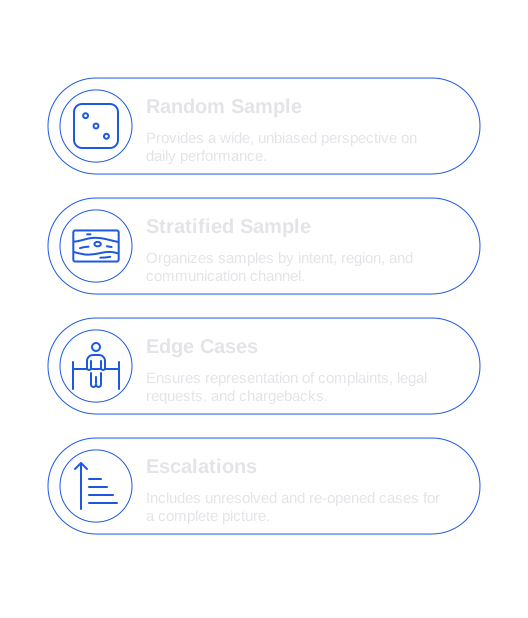
Assemble a Representative Sample of AI Customer Support Conversations for Audit
Your sample should reflect the true diversity of your support cases. Blend routine, complex, and sensitive conversations. Include threads from high-traffic and incident-heavy periods, avoid cherry-picking.
- Random sample: Offers a broad, unbiased view of daily performance.
- Stratified sample: Organize samples by intent, region, and communication channel.
- Edge cases: Ensure representation of complaints, legal requests, and chargebacks.
- Escalations: Include unresolved and re-opened cases for a full picture.
Prioritize privacy by redacting all personal data from transcripts, remove names, emails, payment details, and other identifiers before review.
Create an Evaluation Rubric to Audit AI Customer Support Conversations Consistently
Build your rubric to be objective and easy to apply. Use explicit criteria and a concise scoring range for reliability across reviewers.
- Accuracy: Information, facts, and policies are correctly conveyed.
- Relevance: The response directly addresses the customer’s intent.
- Completeness: The conversation resolves the root issue, not just symptoms.
- Actionability: Provides clear next steps or a definitive resolution.
- Tone: Demonstrates empathy and aligns with brand voice, even under stress.
- Safety and compliance: Does not include harmful or restricted content.
- Escalation: Properly escalates when needed, including full case context.
- Hallucination check: No invented features, facts, or policies present.
Suggested Scoring Method for AI Customer Support Conversation Audits
Apply a 0 to 3 scale for each criterion, with greater weight assigned to accuracy and safety than to style. Ensure score transparency for all reviewers.
Measure Operational KPIs During Your Audit of AI Customer Support Conversations
While rubrics determine quality, KPIs spotlight impact. Track both and align improvement actions to quantifiable results.
- First response time: Time from the customer’s opening message to the initial meaningful reply. Explore strategies for faster responses .
- Resolution time: Duration from first customer contact through to case closure.
- Containment rate: Percentage of cases resolved without escalating to a human agent.
- Escalation quality: Assesses how thoroughly cases are handed off to human agents.
- Customer sentiment: Track CSAT or customer effort scores per resolved interaction.
- AI suggestion acceptance rate: How often support agents accept AI-generated drafts. Dive into the AI suggestion acceptance rate KPI .
- Cost per resolution: Calculate by dividing total support costs by the number of resolved cases. See cost per resolution KPI details .
Review Conversation Quality in Depth During the Audit of AI Customer Support Interactions
Assess the full conversation thread, not just the latest message. Understand the user’s original goal and context, and map each exchange to the evaluation rubric.
- Cross-check information against product and policy references.
- Flag ambiguous or leading AI prompts.
- Identify any missing clarifying questions.
- Ensure links and actions provided are specific and actionable.
- Confirm secure management of any personal data.
Audit note: The AI declined a refund request without referencing company policy and overlooked a goodwill option. Recommend updating prompts to suggest compliant alternatives.
Check Safety, Privacy, and Compliance in AI Customer Support Conversation Audits
Document and verify your AI system’s handling of restricted topics and personal data throughout the audit process. Validate how the AI responds to unsafe prompts and confirm secure redaction of all sensitive information in logs and transcripts.
- Review guardrails and prompts for handling restricted queries.
- Test the AI’s refusal behavior using adversarial prompts and jailbreak attempts.
- Evaluate customer consent flows for data use and ongoing AI learning.
- Work with legal teams to ensure compliance with GDPR, CCPA, and other regulations.
- Implement access controls for transcripts and analytics dashboards.
Trace AI Decision Paths to Audit Model Prompts and Suggestions in Customer Support
The most valuable insights often arise from understanding how suggestions translate into actions. Log every decision step for reviewer transparency.
- Capture initial user queries, system prompts, and model parameters.
- Archive AI-generated drafts, agent edits, and the final sent response.
- Record which agent accepted or modified each AI suggestion.
- Link outcomes (including follow-ups) to specific AI interventions.
- Report acceptance and change trends by team, intent, or shift.
Pair these data traces with your AI suggestion acceptance metrics to reveal where coaching or prompt refinements have the most impact.
Identify Root Causes and Remediation Actions from Your AI Support Conversation Audit
Group issues by recurring themes to address systemic problems rather than isolated incidents. Tie every improvement to a measurable outcome.
- Knowledge gaps: Enrich your database with canonical answers and illustrated examples.
- Prompt gaps: Refine intent classifications and clarify instructions for the AI.
- Policy clarity: Share internal playbooks and decision thresholds.
- UI friction: Adjust macros, templates, or quick-reply shortcuts.
- Training needs: Coach teams on tone, empathy, and proper follow-up.
If speed is a common bottleneck, review your current workflows for inefficiencies. See more in this guide to accelerating first responses.
Compare Platforms for Auditing AI Customer Support Conversations Without Bias
Choose auditing tools that match your tech stack and governance requirements. Here’s a balanced comparison:
- Intercom and Zendesk: Provide rich ticket histories, robust macros, and comprehensive reporting, ideal for operational audits.
- Typewise: Embeds writing support within your CRM, email, or chat platforms. Tracks usage of AI suggestions, monitors tone consistency, and logs approval edits. Designed with privacy as a core principle.
- Salesforce Service Cloud: Offers advanced data modeling and customizable dashboards, useful for organization-wide and cross-functional audits.
- Freshdesk: Simple deployment with intuitive analytics and built-in SLA tracking.
Position audit logs near agent workflows for convenience. Keep reviewers using tools they know best.
Turn Audit Results into Continuous Improvement for AI Customer Support Conversations
An audit should change behavior, not only report it. This means findings should be transformed into steady improvements such as structured experiments. Furthermore, it’s important to publish playbooks, update prompts, and retrain using curated examples.
- Set quarterly goals for quality and resolution speed.
- Conduct A/B tests on prompts and response templates.
- Use high-performing cases to further tune your support models.
- Hold monthly reviewer calibration meetings.
- Celebrate and share learning wins in team communications.
Audit Checklist for AI Customer Support Conversations You Can Start Today
- Define scope, audit dates, and target intents.
- Sample 100 to 300 threads across key segments.
- Apply a concise, weighted rubric for evaluation.
- Track first response and resolution times.
- Monitor AI suggestion acceptance rates for teams.
- Calculate cost per resolution over your chosen period.
- Review how your system refuses unsafe requests and processes sensitive data.
- Publish action items with clear owners and deadlines.
Invite Typewise into Your Next Audit of AI Customer Support Conversations
If you’re seeking audits that drive clearer communication and faster resolutions, try a short pilot with Typewise. The tool integrates with your existing workflows and prioritizes privacy, while providing actionable suggestion tracking and tone guidance for your reviews. Connect with Typewise to discuss a tailored audit solution that fits your operational needs.
FAQ
How can I effectively define the scope of an AI support conversation audit?
To define the scope effectively, pinpoint key focus areas like quality, accuracy, and compliance. Specify channels, markets, and customer segments, and include the AI models in use. Without this, your audit lacks direction and impact.
Why is it important to have a representative sample in AI support audits?
A representative sample captures the true diversity of interactions, including outliers and common cases. Without it, insights are skewed, jeopardizing decision-making. Use Typewise to ensure your samples reflect real-world complexities.
What should an evaluation rubric for AI support conversations include?
An effective rubric should cover accuracy, tone, and actionability among other criteria. Avoid oversimplifying; a shallow rubric fails to identify underlying issues. With Typewise, integrate suggestions for rubric refinement.
How can I track operational KPIs during AI conversation audits?
Focus on metrics like first response time and containment rate to evaluate impact. Neglecting KPIs results in audits that don't translate into actionable improvements. Typewise facilitates monitoring and aligns findings with KPIs.
What role does privacy play in AI support conversation audits?
Privacy is non-negotiable; redact sensitive data before analysis to comply with regulations. Failing to do so exposes your organization to compliance risks. Typewise prioritizes privacy in its audit processes, securing user data.
Why should I consider using Typewise for my AI support audits?
Typewise offers integrated suggestions and privacy-focused solutions that enhance audit accuracy and compliance. Ignoring specialized tools could leave critical insights missed or mishandled. Leverage their expertise to refine your processes.
How can I ensure continuous improvement from my AI support audit findings?
Transform findings into structured experiments and measure the outcomes. Without continuous improvement, audits become stagnant reporting exercises. Typewise facilitates this transformation with actionable insights and integration tools.
How do I handle AI conversation cases that need escalation?
Include unresolved or re-opened cases for a complete picture and assess escalation quality thoroughly. Mismanagement leads to poor customer experience and unresolved issues. Typewise helps log and scrutinize escalations effectively.
What is the importance of tracing AI decision paths during audits?
Understanding AI decision paths uncovers the 'why' behind actions, fostering transparency and improvement. Ignorance in this area perpetuates inefficiencies. Use Typewise for comprehensive logging of AI decision pathways.