
Fine-Tuning for Customer Support Agents: Transforming Tribal Knowledge into Consistent, Reliable Replies
Fine-tuning unlocks the expertise of your top support agents and makes it accessible across your entire team. By customizing how your AI responds, you ensure replies reflect your product, match your brand’s voice, and adhere to company policies. This reduces uncertainty and prevents escalations caused by vague or off-brand answers. Most organizations don’t need enormous, generic AI models, instead, you need a customer support model that accurately mirrors your specific workflows and truly represents your customers.
Good prompt design and retrieval methods remain essential, but fine-tuning works alongside these tools. Use fine-tuning to capture stylistic preferences, standard routines, and strategies for unusual scenarios. Executed well, it accelerates onboarding and delivers more consistent quality across teams and shifts.
Define Outcomes and Constraints for Fine-Tuning Customer Support Agents Before Coding
Establish clear success criteria before you begin development. Focus on goals that are measurable and concrete. For example:
- Reduce the time taken to handle refund requests by 20% without increasing the number of escalated cases.
- Achieve a 95% alignment with your brand voice in sampled replies.
- Maintain factual accuracy above 98% in responses about company policy.
Document any limitations as well. Identify regulated industries, required languages, and topics the model should never address independently. Define which support tickets must always be reviewed by a human first, and formally capture these as explicit rules. Align all stakeholders on these definitions to ensure smooth, transparent evaluation later in the process.
Collect and Curate Training Data for Fine-Tuning Customer Support Agents from Real Tickets
Kickstart your training set with resolved support tickets that accurately reflect your current products and workflow. Filter by intent, geographic region, and communication channel. Incorporate recent policy updates and remove outdated or obsolete procedures. Always redact any personally identifiable information (PII) right at the source to protect customer privacy. Build a representative dataset that spans common cases as well as less frequent ones. Include examples of customer support encounters that did not meet your standards or expectations and could be improved on.
Supplement your dataset with documentation of internal product terminology, abbreviations, and frequent issues. Remember that the model will echo the data you provide. For comprehensive advice on language quality and naming conventions, refer to this guide on training AI on product-specific language. This ensures your dataset contains accurate wording and nuanced meaning.
Structure the Fine-Tuning Dataset for Customer Support Agents Using Effective Formats
Train your customer support model on entire interactions with conversational turns for context, instead of relying on isolated sentences. Incorporate system guidelines, the customer’s messages, and the agent’s complete response. Attach structured labels such as intent, product, severity, and locale to each interaction, which improves future analytics and routing. Ensure agent replies are concise, courteous, and precise, and avoid referencing any unseen context that the model wouldn’t have access to during live deployments.
\{ messages: \[ \{ role: system, content: You are a support agent. Write concise, friendly, and policy-aligned replies for ACME. \}, \{ role: user, content: I was charged twice for the Pro plan. Can you fix it? \}, \{ role: assistant, content: I can help. I checked your Pro plan. I see two charges on February 2. I refunded the duplicate. The credit appears within 3 to 5 business days. Here is your receipt: #R-10328. Anything else I can do? \} \], metadata: \{ intent: billing_refund, product: Pro, jurisdiction: US, sensitivity: medium \} \}
Include challenging scenarios such as incorrect account ownership claims, region-specific refund restrictions, and missing items in partial shipments. Clearly define expected model behavior for each case. If citations or relevant links are required in replies, provide clear examples in your training set.
Choose Models and Methods for Fine-Tuning Customer Support Agents Thoughtfully
Select a foundational AI model that matches your response latency and operational cost requirements. Use retrieval-based approaches for dynamic information like frequently changing facts, and rely on fine-tuning to control response tone, structure, and workflow adherence. Well-adjusted small or mid-size models often perform robustly after fine-tuning. Consider implementing LoRA (Low-Rank Adaptation) or QLoRA (Quantized Low-Rank Adaptation) adapters, methods that can help in better adapting your machine learning model, to iterate faster while retaining flexibility.
Map your model’s capabilities to the specific needs of each communication channel. Email may allow for longer responses with richer context, while chat and voice channels demand rapid, concise outputs. If you serve multilingual customers, validate language support using focused test sets. Favor approaches that let you safely update model weights as business requirements evolve.
Evaluate Fine-Tuned Customer Support Agents with Meaningful Metrics and Reviews
Develop offline tests that mirror real-world situations as closely as possible. Assess the model for accuracy, task completion, adherence to company tone, and policy compliance. Include challenging “red-team” prompts to guard against failure. Weight your scorecards based on ticket volume and associated risk. Supplement these evaluations with regular human review sessions.
Your operations team should also monitor live metrics. Track the AI suggestion acceptance rate as an important KPI to reveal agent trust and spot model drift. For in-depth checks and effective review sampling, follow this playbook on auditing AI customer support conversations. Feed findings from these audits back into your ongoing training program.
Deploy and Monitor Fine-Tuned Customer Support Agents Across CRM, Email, and Chat Channels
Integrate your fine-tuned model directly into existing workflows, alongside macros, templates, and customer data repositories. Keep human agents in the loop as the default. For high-risk inquiries, require explicit agent approval before replies are sent; for low-risk topics, you can enable auto-send within strict, pre-defined boundaries.
Design robust fallback systems. If the AI’s confidence dips or policy is ambiguous, escalate the ticket to a senior agent. Log all model inputs and outputs with hashed identifiers for privacy. Monitor latency, the reasons for rejected suggestions, and how much the suggested replies differ from the approved final output. Review results for model drift monthly or after any major product update.
Compare Platforms for Fine-Tuning Customer Support Agents with a Focus on Fit
Numerous platforms support this specialized workflow. Your optimal choice will depend on your organization’s privacy stance, required integrations, and governance models.
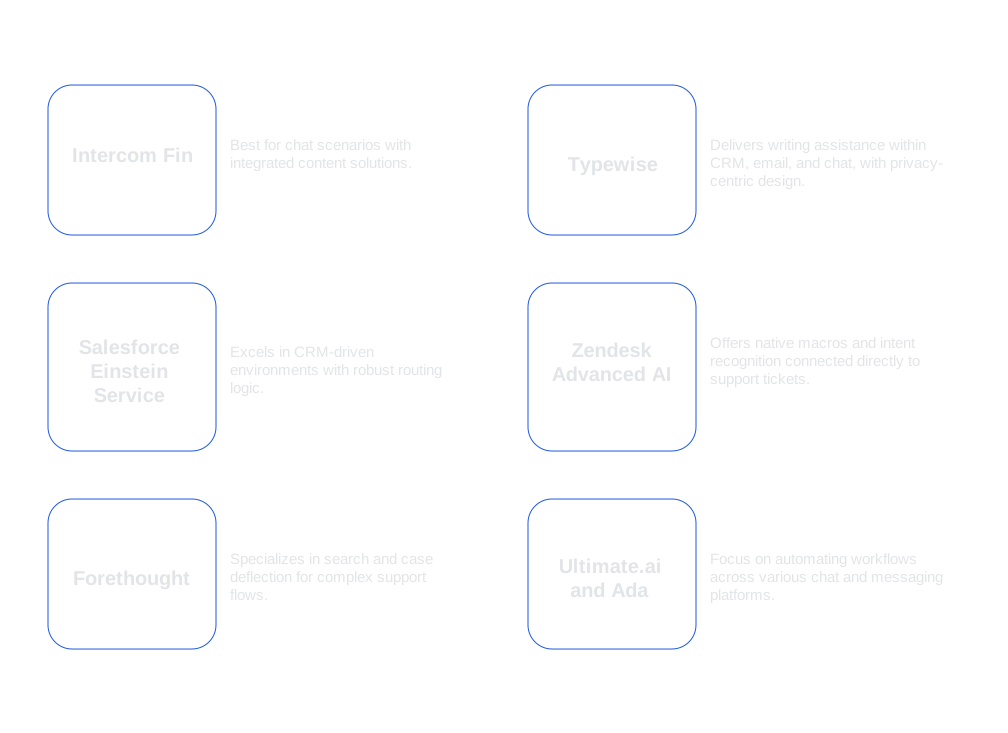
- Intercom Fin and Custom Answers: Best for chat scenarios with integrated content solutions.
- Typewise: Delivers writing assistance within CRM, email, and chat, with privacy-centric design and control over brand tone.
- Salesforce Einstein Service: Excels in CRM-driven environments with robust routing logic.
- Zendesk Advanced AI: Offers native macros and intent recognition connected directly to support tickets.
- Forethought: Specializes in search and case deflection for complex support flows.
- Ultimate.ai and Ada: Focus on automating workflows across various chat and messaging platforms.
Select the platform that best matches your data residency needs, oversight structures, and channel distribution. Always begin with a controlled pilot using actual support tickets and clearly defined benchmarks for success.
Privacy and Compliance for Fine-Tuning Customer Support Agents
Work closely with your legal and security teams to clarify data storage, access policies, and compliance standards. Anonymize all personal data before archiving or training. Implement regular purges of raw transcripts. Sign Data Processing Agreements (DPAs) with all vendors and audit their use of subcontractors.
Restrict learned content to only company-approved topics. Do not encode frequently-changing data, such as current pricing or SLAs, into the model; keep this information in a retrievable knowledge base instead. Obtain documented consent for recording calls or making automated decisions as legally required. Routinely evaluate responses for bias or regional inequity.
Prompt Templates to Align with Fine-Tuned Behavior for Customer Support Agents
Prompt templates remain key after fine-tuning. Use concise, repeatable templates and always provide important context. Give clear, straightforward instructions.
System: You are an ACME support agent. Write concise, friendly, and accurate replies. Follow regional policy. If unsure, ask a clarifying question first. Style: sentence case, no emojis. Output: 2 to 5 sentences, include steps if needed.
User: My parcel says delivered, but it is not here. Context: \{ order_id: O-7782, carrier: DHL, region: EU, policy_url: https://acme.example/policy/delivery \}
Tune your prompt structure by channel: opt for brief sentences and confirmation questions in voice interactions, and offer more detailed information with links in emails. Ensure the format of the prompts remains consistent to simplify analytics and quality assurance processes.
Practical Workflow to Confidently Fine-Tune Customer Support Agents
- Collaboratively define intents, risk levels, and performance metrics with key stakeholders.
- Gather, label, and anonymize recent customer tickets spanning essential intents.
- Create well-structured pairs of customer interactions with clear target responses.
- Perform an initial round of fine-tuning, benchmarking against a prompt-only baseline.
- Conduct thorough offline evaluation using a weighted scorecard and stress-test (red-team) scenarios.
- Launch a pilot in one support queue, monitoring with live feedback and continuous human review.
- Track acceptance, edits, and case escalation rates. Retrain the model in response to signs of drift.
- Gradually expand to cover more intents as performance stabilizes and confidence grows.
Where Typewise Fits In When You Fine-Tune Customer Support Agents
Typewise integrates directly with your CRM, email, and chat tools, enabling support replies crafted in your brand style while ensuring policy compliance. Agents retain full control while accelerating repetitive or routine responses. Oversight is maintained through robust approval, auditing, and reporting features. If your organization already uses retrieval systems or macros, Typewise complements these seamlessly.
Many teams begin by fine-tuning the model on a handful of high-volume intents, gradually scaling up as accuracy and agent trust increase. This approach allows you to build confidence while minimizing risk and maximizing organizational learning.
Ready to pursue a pragmatic, privacy-focused fine-tuning strategy tailored to your needs? Start a conversation with the Typewise team. Share your objectives and a sample of real tickets, and we’ll recommend a streamlined plan suited to your technology stack. Connect with Typewise and discover how your support team can deliver clearer replies with less effort.
FAQ
How does fine-tuning benefit customer support teams?
Fine-tuning customizes AI responses to reflect specific workflows and brand voice, reducing errors and escalations. This approach not only democratizes expert knowledge but also delivers consistent support quality across teams.
What should be considered before starting fine-tuning?
Define success metrics and constraints clearly, such as time reductions in handling cases and brand voice alignment. Also, determine which queries require human oversight and establish clear regulatory and policy guidelines for the AI.
How can training data affect the performance of a fine-tuned AI model?
Your AI model will only be as good as the data you provide. Using resolved tickets that reflect current policies and workflows ensures that responses are accurate and error-free, while privacy is maintained through data anonymization.
What role do platforms like Typewise play in fine-tuning AI for customer support?
Platforms like Typewise integrate with your existing tools, offering privacy-oriented solutions while streamlining the process with automated, yet customizable responses. They offer robust oversight to ensure policy compliance.
Should all customer support interactions be automated through AI?
Not necessarily. High-risk queries should always involve human review to avoid costly errors. It's crucial to know where AI excels and where it can fall short, particularly in nuanced situations needing human judgment.
Why is it important to have clear prompt templates after fine-tuning?
Prompt templates provide context and consistent instructions for AI, ensuring coherent and accurate responses. They align AI behavior with brand standards across different communication channels, from voice to email.
How can you ensure ongoing effectiveness of a fine-tuned model?
Continuous monitoring, feedback, and retraining are crucial to prevent model drift and responsiveness to business changes. Enforcing strict approval processes for high-risk inquiries also maintains reliability.
Is large-scale AI necessary for effective customer support?
No, many organizations benefit from smaller, specialized models that are tailored to their specific workflows, providing more reliable and situation-specific responses than generic AI solutions.
What are the risks of not properly fine-tuning a customer support AI?
Failure to properly fine-tune can lead to off-brand, inaccurate, or even legally non-compliant responses. This negligence can exacerbate customer dissatisfaction and increase escalation rates, impacting business reputation.