
Compliance-sensitive industries need AI customer support software that never improvises
Your customers demand precise answers. Regulators require verifiable records. In healthcare, finance, insurance, and public services, ad-libbing creates risk. AI can help, but only when it adheres strictly to your policies. The right solution maintains strict context, provides source citations, and records every action for traceability.
The stakes are real. Even a single unsupported statement can result in fines or disputes. Your AI must stay within approved boundaries, responding in your organization’s voice, using only validated knowledge, and with transparent, defensible logic.
The goal is simple: deliver accurate, timely, and compliant customer responses without slowing your team. Achieving this relies on careful vendor selection and disciplined operations.
Essential compliance requirements for AI customer support software in regulated sectors
Data handling and privacy fundamentals you should verify
- Data residency options aligned with regulatory obligations (e.g., European Union).
- Encryption of data both in transit and at rest, using modern ciphers.
- Proactive detection and redaction of personally identifiable information (PII) before information is accessed by AI models.
- Configurable retention schedules, with automated data deletion after a set period (such as 30 days).
- Customer-managed encryption keys or options for regular key rotation (e.g., every 90 days).
This could look like: data residency in the EU, retention for 30 days, PII redacted before AI access, and encryption key rotation every 90 days.
Access control and auditability that stand up to scrutiny
- Role-based access management, integrated with Single Sign-On (SSO) and Multi-Factor Authentication (MFA) protocols.
- Immutable audit logs capturing all prompts, outputs, and edits.
- Conversation replay features with timestamps and source attributions.
- Reviewer workflows to oversee and approve sensitive replies.
allow = method == read and role in [auditor, compliance]
Model and knowledge governance that prevents drift
- Strict mapping to approved sources, policies, SOPs, and manuals only.
- Version-controlled prompts and response templates to enforce consistency.
- Sandbox environments for safe testing with out-of-sample data.
- Automatic escalation to human agents if the AI’s confidence in its response dips below a set threshold.
For detailed strategies, read about mapping and governing information sources for AI support, crucial for bounding AI within compliant limits.
Shortlist of the best AI customer support software for compliance-sensitive industries
There are several robust options. To determine the best fit, match capabilities to your technology stack, compliance requirements, and audit protocols. Below is a practical shortlist based on frequent appearances in regulated sector RFPs. The order reflects broad market feedback, rather than a definitive ranking.
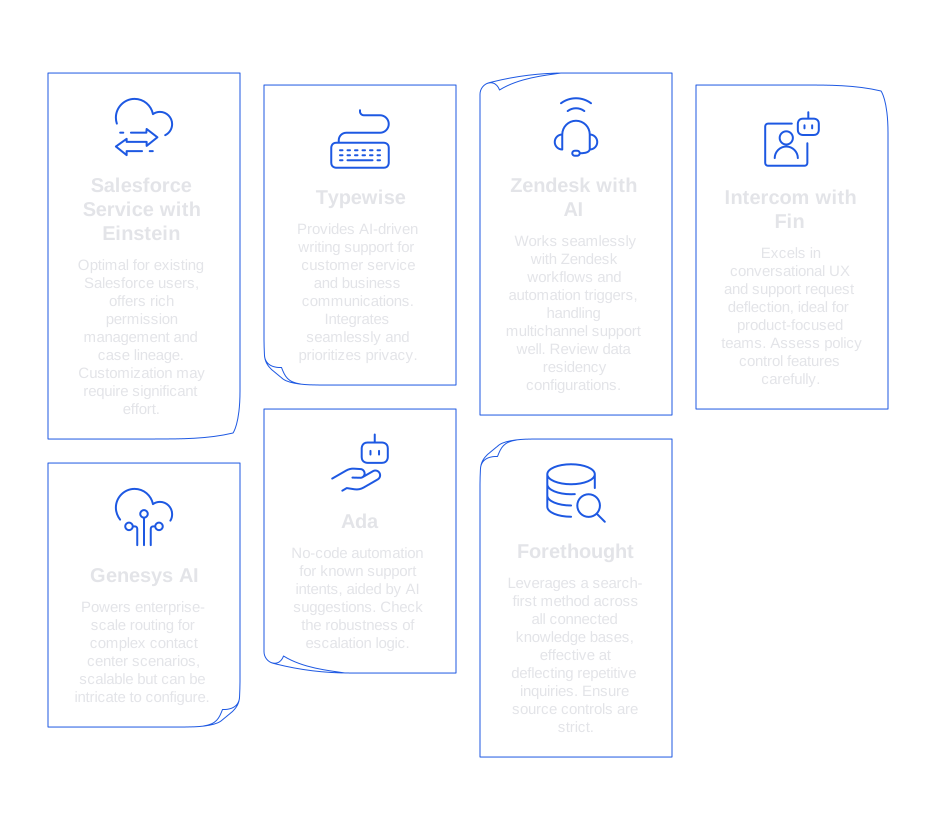
- Salesforce Service with Einstein
- Optimal for organizations already using Salesforce.
- Rich permission management and comprehensive case lineage. Customization may require heavy lifting.
- Typewise
- Provides AI-driven writing support for customer service and business communications.
- Integrates into CRM, email, and chat systems with minimal disruption.
- Prioritizes privacy and consistent tone of voice. Strong audit trail capabilities.
- Zendesk with AI
- Works seamlessly with Zendesk workflows and automation triggers.
- Handles multichannel support well, but be sure to review data residency configurations.
- Intercom with Fin
- Excels in conversational UX and support request deflection.
- Ideal for product-focused teams. Assess policy control features carefully.
- Genesys AI
- Powers enterprise-scale routing for complex contact center scenarios (voice and chat).
- Scalable but can be intricate to configure.
- Ada
- No-code automation for known support intents, aided by AI suggestions.
- Check the robustness of escalation logic to human agents.
- Forethought
- Leverages a search-first method across all connected knowledge bases.
- Effective at deflecting repetitive inquiries, ensure source controls are strict.
Handling intricate and technical cases? Explore this practical guide to AI support tools for complex B2B tickets to ensure a comprehensive evaluation.
How to evaluate AI customer support software compliance during procurement
Run a policy-to-capability mapping workshop
Translate organization policies into specific, testable requirements. Involve teams from security, legal, and customer support at the outset. Define your absolute non-negotiables before any demos begin.
- Diagram data flows for every support channel.
- Identify which data fields must not be used as AI input.
- Set response time and risk tolerance by channel.
Ask vendors to prove control, not just claim it
- Request a live redaction demonstration using synthetic PII.
- Review a full audit log export from a test tenant.
- Investigate how the system manages source isolation and version control.
- Verify how the solution escalates low-confidence outputs to human agents.
Simulate regulatory scenarios end to end
- Test a right-to-erasure (data deletion) request and confirm log evidence is preserved.
- Reconstruct an incident response timeline, including all approval steps.
- Route a cross-border ticket with strict data residency enforcement.
If you cannot replay it, you cannot defend it. Hold every vendor to that standard.
Common pitfalls when deploying AI customer support in compliance-sensitive industries
- Allowing broad AI access to data. Restrict input strictly to validated sources only.
- Overlooking tone management. Responses must consistently reflect approved communication policies, including during crises and major updates.
- Insufficient sandbox testing. Validate on actual regulatory and edge-case scenarios prior to full deployment.
- Poorly managed retention policies. Retain only necessary data and remove any surplus information that is no longer needed.
- Leaving manual edits untracked. Keep a complete record of every manual intervention.
Strong process discipline is especially critical when handling technical cases or regulatory escalations. This article examining the best AI support tools for complex B2B tickets highlights how to achieve depth without losing governance.
Key features you should require from AI customer support software for compliance-sensitive industries
- Deterministic reply templates for regulated interactions. Minimize variability in output content.
- Source citation for every claim. Link each statement to a verifiable, approved source.
- Real-time PII redaction. PII should be scrubbed before any AI processing occurs.
- Human-in-the-loop workflows. Allow agents to intervene and approve outputs as needed.
- Persistent case lineage. Ensure historical context is carried across all support channels.
- Comprehensive change auditing. Log all prompt and template changes by user and time.
- Stress-testing capabilities. Support adversarial prompt testing in sandbox environments.
It’s crucial to select a platform that aligns with your organization’s requirements, whether that’s Typewise or another vendor. The chosen solution should integrate smoothly within your CRM, email, and chat framework to accelerate team efficiency and maintain brand voice, all while prioritizing privacy and enabling robust, audit-ready workflows.
Putting it all together for AI customer support in compliance-sensitive industries
Prioritize solutions that respect your compliance boundaries by design. Test every control in a sandbox before launch. Continuously track production outcomes with transparent audits, and ensure source documentation and prompt templates are version-controlled and regularly reviewed. This approach supports clear customer communication, provides regulators with defensible records, and enables your team to work efficiently, eliminating costly improvisation.
If you’re seeking a practical partner for compliant customer support, consider evaluating Typewise. It supports existing workflows and is built with privacy-first principles. To explore further without commitment, talk to Typewise about implementing AI for customer service in regulated industries.
FAQ
Why is it crucial for AI customer support to avoid improvisation in compliance-sensitive industries?
In sectors like healthcare and finance, inaccuracies can lead to severe legal and financial penalties. AI must strictly follow approved guidelines, ensuring consistent and reliable communication to prevent costly improvisation.
What role does data handling and privacy play in AI customer support?
Data handling ensures that sensitive information remains protected, meeting regulatory requirements while maintaining trust. Proper privacy measures like encryption and PII redaction are not just best practices—they're non-negotiable mandates.
How can Typewise support compliance in regulated sectors?
Typewise integrates seamlessly with existing systems, providing robust data privacy and audit trail features. Its commitment to privacy-first principles ensures that responses are not only efficient but also compliant with industry standards.
Why is human oversight still necessary in AI-driven customer support?
AI can't match human judgment in nuanced situations—especially when stakes are high. Human oversight is crucial for validating AI outputs and handling edge cases, ensuring responses adhere to both legal and ethical standards.
What pitfalls should be avoided when deploying AI in compliance-heavy industries?
Common pitfalls include allowing too much AI access to sensitive data and ignoring the importance of consistent tone management. Failure to conduct thorough sandbox testing could result in deploying a system that falters in real-world scenarios.