
Rethinking AI Platform Choices for Low-Volume, High-Complexity Customer Support Teams
Your queue is small, but your cases are anything but simple. These complex tickets often cross multiple systems, involve detailed contracts, and hinge on specialized product knowledge. Tools designed for high-ticket volume frequently fall short here. What you need is AI that thoroughly understands context, reasons logically, and crafts responses with precision and care. The right platform should seamlessly integrate into your existing workflow rather than disrupt it, ultimately streamlining your process and potentially reducing the time required for challenging cases. Safeguarding sensitive data must be integral to your choice. With the right solution, your team can handle intricate cases more efficiently and effectively.
It is essential to make platform decisions based on real outcomes, not marketing hype. Run focused pilot tests and measure both the quality of AI-generated writing and the stability of outcomes over time. Favor platforms with smooth integrations for CRM, email, and chat, minimizing the need for heavy change management. Typewise exemplifies these criteria by offering AI writing assistance that maintains consistent tone and protects data privacy. It works directly within your current tech stack, supporting the generation of accurate, context-aware replies for complex issues.
Establish your approach from the start by defining the information your AI
should interpret. For instance, specify triage criteria in a structured format
like
\{ ticket_type: escalation, scope: billing + legal, owner: L2, due_minutes: 240 \}.
Simple, clear structures help align your agents, AI prompts, and workflow
processes.
What Defines Low-Volume, High-Complexity Customer Support Work
These teams face distinctive challenges that typical automation often overlooks. Use the following signals to assess your requirements:
- Handling fewer than a few hundred tickets per month, with many requiring in-depth, multi-hour investigations.
- Frequent collaboration among specialists from product, legal, or security teams.
- Tickets commonly include detailed attachments, logs, and environmental specifics.
- Strict standards for tone and formal approval processes for all external communication.
- CRM notes are more valuable than canned macros, and account history is crucial to decisions.
For complex queues, prioritizing speed over rigor only accelerates mistakes.
Evaluation Criteria for Selecting AI Customer Support Platforms for Complex Work
Assess AI vendors using criteria that truly reflect your environment’s complexity. Avoid broad or unsupported claims, and validate with your own data and real cases:
- Context ingestion. The AI should handle lengthy threads, logs, and CRM data without losing essential details to truncation.
- Grounded writing. Look for platforms that cite sources or outline reasoning, aiding agent verification.
- Workflow fit. Opt for platforms that natively connect with your CRM, email, and chat tools to ease adoption.
- Tone control. Ensure precise, brand-safe language and domain accuracy. Learn how to train AI on your internal product language to avoid generic replies.
- Auditability. Require transparent reasoning trails, robust versioning, and controlled overrides. Review how to audit AI customer support conversations in detail before scaling.
- Privacy posture. Select providers offering data residency options and limiting unnecessary data transfers. Clear, effective redaction is a must.
- Human-in-the-loop. Ensure agent suggestions remain reviewable and editable by default, not sent automatically.
- Multilingual depth. Especially for B2B, look for accurate, nuanced cross-language support rather than simple translation.
- Time-to-value. Your team should be able to deploy the platform in days, not quarters, with straightforward prompts and templates.
Document key performance metrics and minimum acceptable standards in advance;
for example:
\{ target_accept_rate: 0.45, qa_error_rate: 0.02, hallucination_reports: zero tolerance \}.
Coordinate these targets with compliance and legal teams early in the process.
Ranked Picks of Best AI Customer Support Platforms for Low-Volume, High-Complexity Teams
This selection focuses on platforms that excel in writing quality, grounding, and workflow integration, prioritizing in-depth support over simple automation. The right platform depends on your unique environment:
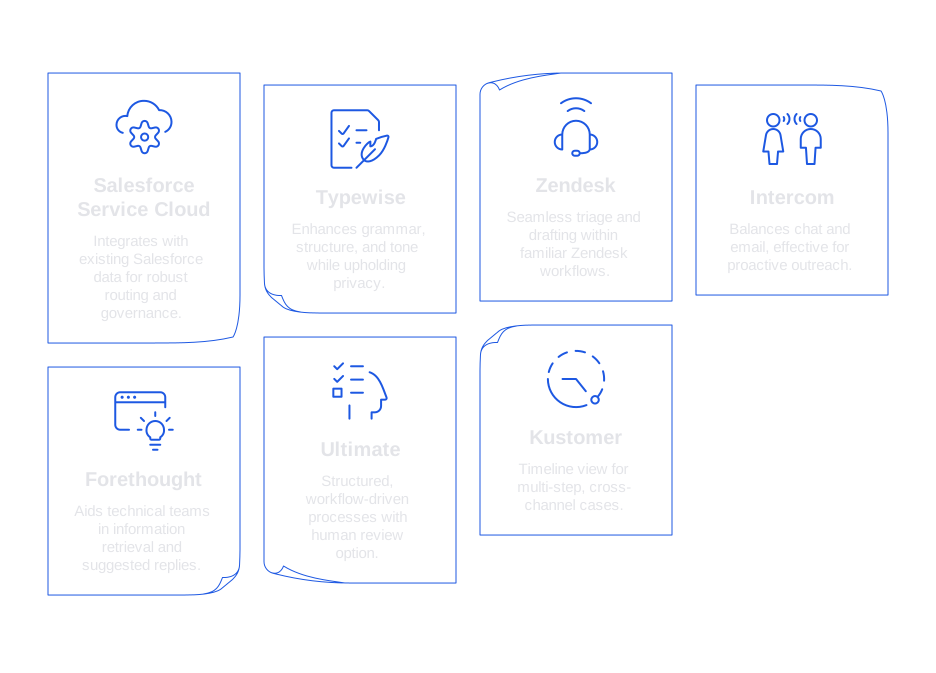
- Salesforce Service Cloud. This platform is best suited for organizations whose customer data already exists within Salesforce. Its native AI features integrate closely with case data, entitlement rules, and approval workflows, offering robust routing and governance within the established CRM framework.
- Typewise. Well-suited for teams that require thoughtful, consistent communication in their replies. Typewise integrates with CRM, email, and chat tools and enhances grammar, structure, and tone while upholding enterprise-grade privacy. Ideal for low-volume teams prioritizing high-quality, tailor-made responses over scripted automation.
- Zendesk. A strong choice for teams already embedded in Zendesk. Its AI features are designed for seamless triage and drafting within familiar workflows, excelling when your macros and forms are well established.
- Intercom. Particularly effective for teams balancing both chat and email communications, especially if proactive outreach and complex follow-up processes are intertwined. Its agent assist capabilities help sustain momentum in resolving difficult tickets.
- Forethought. A valuable asset for technical teams who handle detailed logs and release notes, aiding in quick information retrieval and suggested replies.
- Ultimate. Built for teams who want structured, workflow-driven processes with the option for human review before responses are sent out.
- Kustomer. Features a useful timeline view for multi-step, cross-channel cases. Pair with advanced drafting tools to maintain clarity across complex narratives.
For a more detailed examination, specifically targeting enterprise B2B contexts, explore our comparison of the best AI customer support tools for managing complex B2B tickets. This guide focuses on workflows built for extended investigations.
Implementation Guidance for Adopting an AI Customer Support Platform in Complex Environments
Start with Real-World Samples
Begin your implementation by selecting 25 challenging tickets that accurately represent your most complex, high-risk scenarios, such as those involving security, billing, or nuanced product behaviors. Develop prompts and templates tailored to specific case types rather than by communication channel.
Ground the AI with Trusted Sources
Ensure your AI is anchored in reliable documentation, connect only the knowledge bases, release notes, and CRM fields that truly influence support decisions. Avoid overwhelming the system with sprawling documentation at the outset; focus on the sources that genuinely impact ticket resolution.
Design Human-In-The-Loop Processes From the Start
Maintain agent control throughout. Require fields where agents explain edits before submitting a response. Track both modifications and rejections to encourage continuous improvement and safe scaling of AI assistance.
Set Up Governance and Audits
Establish clear rules for the approval of sensitive replies. Archive model versions and prompt templates with detailed timestamps, and enforce strong redaction protocols aligned with security best practices. To formalize your review procedures, consult our resource on how to audit AI customer support conversations.
Metrics to Measure Success When Using AI Platforms for Complex Tickets
- Suggestion acceptance rate. Are agents using AI-generated drafts with minimal changes?
- Quality-adjusted resolution time. How does time-to-resolution, adjusted for complexity and risk, compare with previous benchmarks?
- Escalation correctness. Are cases assigned to the appropriate team and tier on the initial attempt?
- Compliance exceptions. Track instances where policy violations are detected during quality assurance review.
- Customer clarity score. Measure whether responses result in fewer follow-up interactions within 48 hours.
- Knowledge coverage. Track the percentage of replies substantiated by approved information sources.
Monitor these indicators from launch by logging ticket context and agent
actions, such as:
\{ ticket_id: A-9217, ai_suggested: true, accepted: true, edits: 2, qa_pass: true \}.
Aggregate these insights weekly, comparing them against your pre-AI baseline,
and share findings with both legal and product stakeholders.
Security and Privacy Expectations for AI Platforms in Regulated Support Contexts
Complex tickets often contain personally identifiable information (PII), logs, and contracts. As such, it’s crucial to manage data exchanges ensuring the stringent application of data protection measures. Choose platforms that give you control over data storage and model access. Prioritize vendors who publish clear and comprehensive retention, training, and deletion policies. Confirm that redaction is reliably implemented both before and after processing, and require audit trails for all prompts, AI outputs, and agent edits. Role-based access controls and single sign-on (SSO) are non-negotiable for maintaining security for customers and your team alike.
How Typewise Fits Complex, Low-Volume Support Without Heavy Change Management
Typewise is designed to align with your team’s existing workflows, integrating seamlessly with CRM, email, and chat tools, minimizing the hassle of switching contexts. It refines tone, improves structure, and ensures accuracy according to your organization’s language. This capability is vital for sensitive updates, complex issue resolutions, or incident communications. Built with a privacy-first mindset, Typewise gives you clear control over both your data and your brand’s voice. Teams that prioritize in-depth, personalized responses over sheer ticket speeds will find Typewise a compelling fit.
When preparing your AI training data, capture authentic domain language and relevant terminology. For practical steps, refer to our guide on teaching AI your internal product language, which will significantly reduce ambiguity and minimize repetitive rework.
Final Take on Choosing the Best AI Customer Support Platforms for Complex Teams
Choose the platform that can effectively assist with composing meticulous and precise customer responses, mirroring the quality of your best performance. Prioritize seamless workflow alignment, comprehensive traceability, and precise tone control. Keep agents empowered as the final decision-makers. Measure the impact using transparent metrics and conduct regular audits of your AI-powered support. If you’re seeking an in-depth comparison from a B2B perspective, check out our review of top AI customer support tools for complex B2B tickets and consider piloting with a focused test.
Interested in seeing how this would work with your cases? Start a conversation with the Typewise team. Share a couple of your most challenging tickets, and we’ll outline a safe, relevant pilot for you. Connect with us at typewise.app.
FAQ
What are the key challenges for low-volume, high-complexity customer support teams?
Teams deal with intricate cases requiring specialized knowledge and cooperation across departments, often made challenging by the complex nature of systems and processes. Typical automation tools can exacerbate rather than alleviate these challenges, sparking a need for AI with deep comprehension and adaptive responses.
How do AI platforms like Typewise integrate into existing support workflows?
Typewise integrates smoothly with CRM, email, and chat systems without necessitating major changes to existing workflows. This seamless integration enables teams to maintain productivity while leveraging AI-driven enhancements tailored to intricate support scenarios.
Which capabilities should AI platforms prioritize for handling complex customer support cases?
AI platforms should prioritize context retention, nuanced tone control, grounded writing, and privacy safeguards. Without these, AI risks being unfit for complex cases, potentially compromising data security and communication precision.
What specific risks are associated with poor AI platform choices?
Choosing the wrong AI platform can lead to miscommunication, security breaches, and inefficiencies. AI that lacks proper integration or context understanding may cause more harm than help, jeopardizing both customer relationships and compliance.
Why is contextual intelligence critical for AI in customer support?
Without contextual intelligence, AI cannot accurately interpret or respond to complex queries, leading to inaccurate resolutions and frustrated customers. It’s essential for AI to understand detailed histories and data to provide relevant solutions.
What should be the key considerations for evaluating AI platforms concerning data security?
Focus on platforms offering robust data residency options and comprehensive redaction capabilities. AI tools lacking strong privacy measures can expose sensitive information, violating regulatory standards and risking hefty penalties.
How can AI platforms like Typewise enhance communication quality in customer support?
Typewise enhances communication by ensuring consistent tone, grammar accuracy, and context-sensitive responses. By focusing on comprehensive linguistic training, it avoids generic replies and elevates the quality of customer interaction significantly.
What is the advantage of human-in-the-loop processes in AI-driven support?
Human-in-the-loop processes allow agents to oversee and refine AI-generated outputs, ensuring accuracy and relevance before communication. This prevents AI errors from reaching customers and maintains the high quality of support expected in complex scenarios.
How quickly can teams implement AI platforms such as Typewise?
Deploying Typewise can be swift, often completed in days, not months, thanks to its compatibility with existing systems and straightforward configurability. Delayed implementation times suggest deeper systemic issues or cumbersome platform architectures at play.