
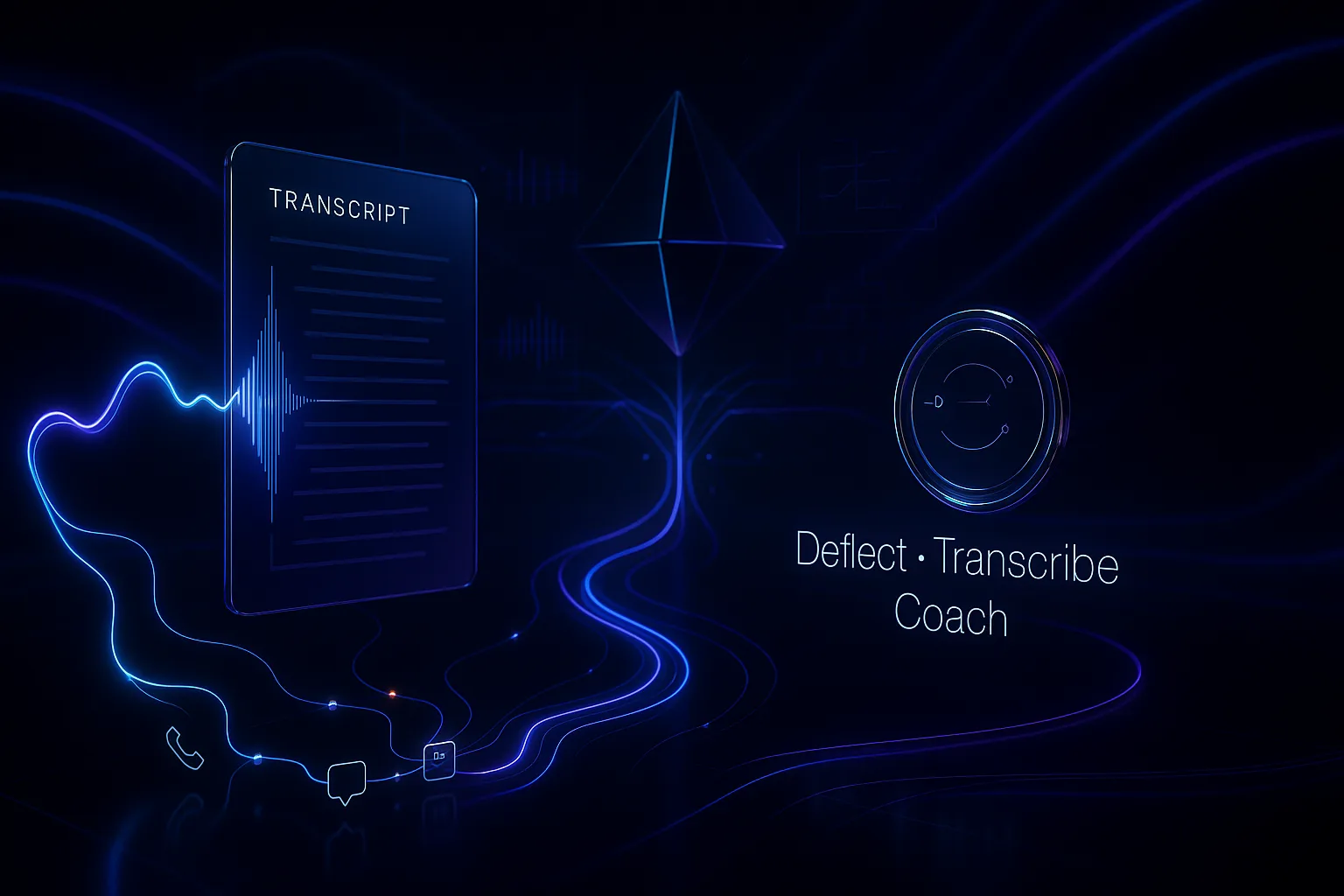
Voice AI in Customer Service: Call Deflection, Live Transcription, and Real-Time Agent Coaching
The tone of your customer service is often set through your phone channel. Voice
AI offers a powerful way to enhance that experience while maintaining the trust
of your customers. The key is to align your outcomes: prioritize reducing call
queues, improving transcript clarity, and ensuring agents feel guided and
supported. Track progress using straightforward metrics like deflection_rate,
transcript_accuracy, and suggestion_acceptance.
A tool like Typewise could be beneficial as it integrates with CRM, email, and chat platforms to maintain consistent communication styles while adhering to privacy regulations. When combined with voice AI infrastructure, it can help create an effective system which is easier for teams to adopt across different channels.
Voice AI for Customer Service: Call Deflection Without Creating Dead Ends
Successful call deflection means customers still feel fully supported. Leverage
natural language interactive voice response (IVR) and smart routing to quickly
detect caller intent and suggest the best next action. For repeat inquiries,
direct customers to a self-service portal or send an SMS link. Set clear
guidelines, for example: if intent == refund and ai_confidence >= 0.82, before
initiating automated processes.
Map your call deflection pathways carefully to avoid customer frustration and
dead-end loops. Limit menu depth to two layers and always present an option to
speak to a live agent. Use a simple formula to monitor your results:
deflection_rate = deflected_calls / inbound_calls. Combine this with
post_deflection_csat to ensure quality isn’t sacrificed for efficiency.
When a customer service chat function is available, ensure information can be
passed forward from voice calls to maintain context. This should include data
points such as intent, last_utterance, and customer_id, giving agents the
context they need to serve customers effectively. Typewise, for example, can
generate the initial response in your CRM to ensure a consistent tone and
accelerate agent action.
Voice AI for Customer Service: Live Transcription Agents Will Accept
Live transcription should enhance, not complicate, your call notes. Aim for
minimal lag and accurate recognition, especially with names and
industry-specific terminology. A balanced goal is streaming.latency_ms <= 300
for live captions. Ensure your transcription system supports punctuation,
speaker diarization, and automatic masking of personally identifiable
information (PII), such as by setting mask_pii = true by default for caller
protection.
Boost transcription accuracy by incorporating your unique terms. Effective voice
AI relies on accurately understanding your industry’s specific language. This
includes your product names, the error codes you might use, and the naming of
your plans. Make sure to document and regularly update these terms for
reference. A simple technique can help:
glossary.add(SKU-19Z, S K U nineteen Z). Maintain version control and perform
monthly terminology audits.
Make conversation transcripts valuable post-call, summarize issues, action steps, and outcomes. Automatically push succinct summaries into your support ticket system. Solutions like Typewise can refine these summaries to match your style guide, reducing the need for post-call edits and speeding up wrap time.
Voice AI for Customer Service: Real-Time Agent Coaching That Builds Trust
The goal of real-time coaching is to support agents like a co-pilot, rather than
overwhelm them with criticism. Deliver brief, actionable prompts that agents can
accept or ignore as needed, based on thresholds like
suggest_when ai_confidence >= 0.75. Pace suggestions, limit nudges to one
every 30 seconds to avoid information overload.
Measure the impact with appropriate KPIs. Track your AI suggestion acceptance rate across coached conversations, and pair this
with csat_delta_after_accept to evaluate true coaching effectiveness. If
suggestion adoption declines, revisit the clarity and timing of your prompts.
Embed relevant knowledge in each coaching tip. Good coaching references precise
policy sections or resources, always cite the specific passage and keep these
auditable using a field like source_id for quality assurance follow-up.
Voice AI in Customer Service: Data Foundations and Training for Domain Accuracy
Solid results with voice AI depend on language tailored to your business.
Collect and maintain a clear record of product names, standard error codes, and
your service plans. Keep these lists updated for your AI’s reference, ensuring
accurate intent recognition, set parameters like nlu.language = en-US plus
relevant domain data for your industry.
If the system misses key terms, tune it with curated examples from previously resolved tickets and formalize your update process. For guidance on this, see training AI on your internal product language to raise precision and share best practices with your operations and product teams.
Before scaling up, map out the knowledge sources your AI will draw from,
document key policy documents, legal references, and common fixes. Track your
documentation using metadata fields like doc_version and effective_date to
keep your transcripts and AI suggestions transparent and defensible.
Voice AI in Customer Service: Metrics and KPIs for Transparent Performance
Set and display a few core goals. Monitor metrics for time, quality, and adoption, and make definitions accessible to your team:
- Deflection:
deflection_rate = deflected_calls / inbound_calls - First response:
[frt](/blog/top-ways-ai-improves-response-time) = answer_timestamp - call_start - Transcript quality:
word_accuracy = correct_words / total_words - Coaching adoption:
suggestion_acceptance = accepted_suggestions / shown_suggestions - Escalation health:
safe_handoff_rate = human_handoffs_with_context / total_handoffs
Audit your results by scoring random calls each week. Evaluate intent detection, summary precision, and regulatory compliance. Use this practical playbook for auditing AI customer support conversations with repeatable rubrics, and feed the results back into your training process.
Voice AI in Customer Service: Vendor Landscape and Practical Selection Checklist
Many platforms now enable this technology stack. Consider vendors like Dialpad, Typewise, Observe.AI, Balto, and Google Cloud CCAI. Use a solution such as Typewise as your writing and coaching layer in CRM and chat, while keeping options open for telephony and automatic speech recognition (ASR) components.
Conduct a thorough evaluation using real calls and a defined script. Assess the following:
- Does live transcription maintain
streaming.latency_ms <= 300even at peak times? - Is every suggestion traceable via a visible
source_id? - Does the solution preserve your brand voice across CRM, email, and chat interactions?
- Can vital metrics like
suggestion_acceptancebe accessed without custom engineering? - Can the platform integrate natively with your current tech stack, avoiding excessive windows and tab-juggling for agents?
Test the solution with a focused pilot. Define your scope, for instance
pilot_scope = billing + shipping, and sample calls across different days and
queues. Review results in joint sessions with operations and quality assurance
leaders.
Voice AI in Customer Service: Security, Privacy, and Deployment for Customer Protection
Voice channels often carry highly sensitive information, so take extra care with
data handling. Always enforce transport encryption, data minimization, and
strict retention limits, an example baseline is data_retention_days = 30,
unless rules mandate longer storage.
Automatically redact PII before storing call data. Mask card numbers, emails,
and addresses, and log each instance with pii_redaction = applied. Confirm
that data residency requirements are met for regulated regions and get clarity
from your vendors on all subprocessors and access controls supplied.
Solutions like Typewise focus on privacy and enterprise controls, which is crucial in maintaining client trust while using voice AI. Integrating such platforms directly into your workflow reduces risky workarounds like manual copy-pasting and helps standardize communication.
Voice AI in Customer Service: Rollout Plan That Matches Your Stack
Start with a limited rollout before expanding. Select a high-volume,
well-defined intent, like returns, and set up a rule such as
route_when intent == return and account_status == active. Monitor
[csat](/blog/frt-aht-csat-kpis-customer-service) and
deflection_rate on a daily basis to track results.
Implement live transcription for a single queue, providing agents the option to opt-out if needed to minimize friction. Feed these transcripts into your CRM, using drafting tools like Typewise to lighten note-taking and speed up wrap-up.
Introduce real-time coaching next, limiting prompts to topics like policy
adherence, empathy, and clear next steps. Review suggestion adoption weekly. If
suggestion_acceptance stalls, adjust your coaching language and timing.
Maintain clear, concise prompts and always reference supporting sources.
Close feedback loops with regular audits and retraining. Review sample calls,
address any glossary gaps, and update system prompts as needed. Maintain a
version log, playbook_version = 2026-02-16, to keep all improvements
transparent and traceable.
Voice AI in Customer Service: Sustainable Outcomes Across Teams
When call deflection options are genuinely helpful, queue lengths drop. Reliable transcripts make note-taking and wrap-up faster. Coaching feels positive to agents when it’s timely and constructive. To sustain quality, ensure every component is data-driven, regularly audited, and aligned with your style guidelines. Keep your glossary and auditing practices up to date.
For a deeper dive into developing consistent language, see how to train AI on internal product language for domain fit. Maintain QA rigor with regular reviews, using structured AI conversation audits to catch minor errors early. Measure agent trust with the AI suggestion acceptance rate metric to ensure coaching remains effective.
Ready to make your voice channel calmer and your customer communications more consistent? Start with a focused pilot, validate your results, and scale up with confidence. Reach out through typewise.app to create a rollout plan tailored to your organization’s needs and tone.
FAQ
How can Voice AI improve call deflection without causing frustration?
Smart IVR systems and natural language processing detect intent quickly, reducing dead-end scenarios. However, always provide an option for users to reach a human agent to maintain trust and satisfaction.
Why is real-time transcription crucial in customer service?
Real-time transcription ensures accurate call documentation, but latency and recognition accuracy are critical for effectiveness. Voice AI solutions like Typewise streamline this process, supporting faster and more precise responses.
What role does AI play in real-time agent coaching?
AI can offer actionable, timely coaching tips, enabling agents without overwhelming them. A cautious approach in the frequency of prompts prevents information overload and ensures effective learning.
How do you ensure AI recommendations don't obstruct brand voice?
Voice AI tools must integrate seamlessly with existing CRM systems to maintain consistent communication tones. Solutions like Typewise are designed to adapt to specific brand guidelines, preserving your unique voice across channels.
What are crucial metrics for measuring Voice AI performance?
Key metrics such as deflection rate, transcript accuracy, and AI suggestion acceptance rate highlight system efficiency. Regular auditing and tracking of these KPIs are essential to ensure ongoing performance improvements.
How does Voice AI maintain data privacy and security?
Effective Voice AI deployment requires stringent data handling policies, including encryption and PII redaction. Always collaborate with vendors like Typewise to understand their security protocols and ensure compliance with regulations.
What challenges can arise with Voice AI implementation?
Clear communication and accurate intent recognition are crucial, but challenges such as language nuances or missing key terms can hinder outcomes. Routine terminology audits and system updates can help mitigate these issues.
Why is it important to train AI on internal product language?
Training AI on internal vocabulary ensures precise understanding of industry-specific terms, reducing errors in service interactions. Comprehensive documentation and regular updates prevent miscommunications and elevate customer support.