
RAG vs Fine-Tuning in B2B SaaS Customer Support: The Tradeoffs That Decide Outcomes
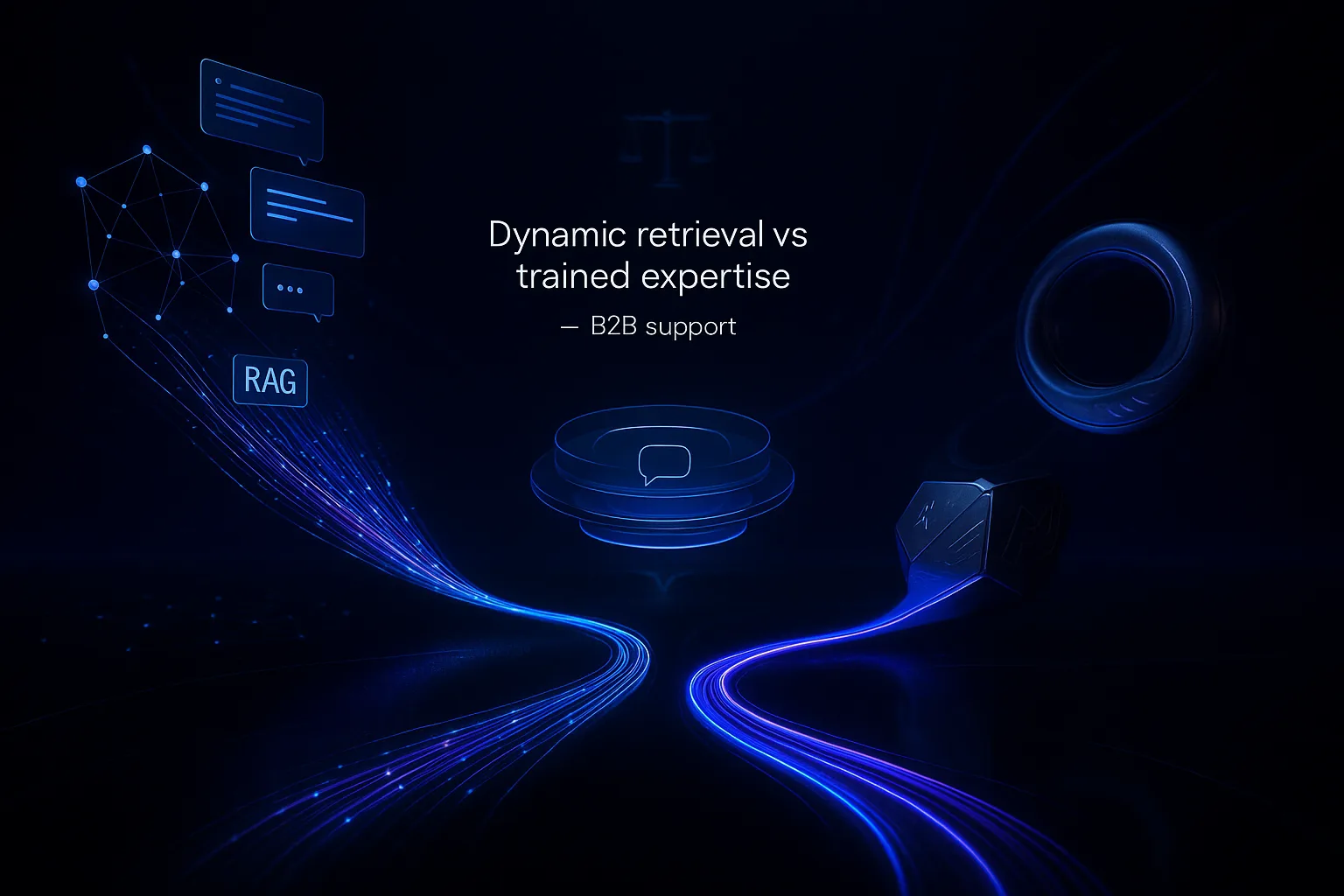
Your customers frequently ask questions about version differences, user roles, and unusual edge cases. Some answers live in documentation that changes weekly, while others deal with issues that come up again and again. Retrieval Augmented Generation (RAG) fetches the latest facts straight from your documentation. Fine-tuning, in contrast, equips a model to mirror your team’s style and follow internal playbooks. The right strategy depends on how fast your product changes, the variety of your support tickets, and your appetite for risk.
Let’s illustrate this with a hypothetical ticket: Suppose a customer is struggling to rotate a Security Assertion Markup Language (SAML) certificate, a common identity and access management task, especially for a European Union-based client. With RAG, the model quickly accesses the most up-to-date guide or runbook to diagnose and solve the problem. Using fine-tuning, the model instead draws from previously learned processes and keeps responses aligned with your brand’s voice and style. One method prioritizes information freshness, while the other ensures consistent communication. In practice, most teams will need a combination of both approaches.
How Retrieval Augmented Generation Applies to B2B SaaS Customer Support Workflows
RAG combines a language model with a search system that indexes your product docs, release notes, and operational runbooks. When it’s time to respond, the model retrieves the most relevant information and generates answers with direct citations, helping keep responses accurate and tied to current knowledge.
- Strengths: Delivers current, factual answers; provides traceable sources; supports compliance reviews.
- Caveats: Relies on well-maintained content structures; can occasionally miss key facts; may slow down under heavy loads.
RAG stands out when your software changes frequently or your offerings differ by region or user role. Another benefit? It makes support interactions more transparent, agents can review and audit the source links before sending replies.
Before indexing, map out all your information sources. Start with architecture guides, admin manuals, and live status pages to reduce irrelevant retrievals. Review this hands-on guide to mapping AI information sources for effective scope alignment and access management.
For example, when creating a searchable index to support RAG, you specify settings such as the size of each information chunk (say, 512 words), how much overlap to permit between search segments (e.g., 64 words), and filters to focus on relevant products (like “enterprise” only).
Techniques like reranking and query rewriting can improve the accuracy of information retrieval, while caching frequently used answers can help reduce response times. Always restrict retrieved content based on each customer’s subscription plan and region to maintain relevance and compliance.
How Fine-Tuning Applies to B2B SaaS Customer Support Workflows
Fine-tuning involves customizing a language model to speak your company’s language, adhere to your specific templates, and use your internal terminology. This approach reduces the need for tricky prompting, responses will sound like your support team and naturally follow established procedures.
- Strengths: Ensures responses are always on-brand and follow desired formats; helps cut down prompt complexity; uses fewer tokens per prompt.
- Caveats: Can become outdated after new releases; requires well-labeled and curated data to train; may fall back on obsolete habits over time.
Fine-tuning is ideal for repetitive and structured workflows, such as multi-factor authentication password resets, invoice lookups, or routine quota support. It’s also useful for handling tricky interactions, like outage communications or billing issues, where tone sensitivity matters most.
To get started, collect high-quality historic tickets and agent notes. Tag each example for intent, product, and resolution steps. Use this foundation to teach the model your team’s voice and product-specific language. See this practical primer on training AI with internal product language to encode your jargon effectively without risking overfitting.
When to Choose RAG or Fine-Tuning for B2B SaaS Support Tickets
- Select RAG when features or policies are changing rapidly, and you must deliver answers reflecting the latest information with clear citations.
- Select fine-tuning when support workflows repeat and style guides are strict; crisp, consistent templates become essential.
- For mixed tickets, where factual accuracy and tone both matter, combine both: use RAG for the most up-to-date details and a tuned adapter for response structure.
Here’s a simple principle to remember in B2B SaaS customer support: Facts or factual information come from retrieval methods like RAG, while the voice or the style and tone of responses comes from fine-tuning the model. Keeping this rule in mind can help avoid most common failures in managing customer support workflows.
How to Build a Hybrid RAG Plus Fine-Tuning Stack for B2B SaaS Support
- Scope your knowledge graph: Decide which documentation and pages will be indexed. Remove sources of noise and obsolete wikis.
- Define metadata schemas: Tag all indexed chunks by product, version, customer plan, and region to tailor search results.
- Curate a golden set: Gather examples of resolved tickets that showcase ideal support tone and detailed steps.
- Train a lightweight adapter: Keep your fine-tuned adapter models small so you can update them quickly after support policy changes.
- Compose responses at runtime: Retrieve up-to-date facts from your documentation, then generate answers using your tuned style and templating.
- Escalate when uncertain: Route low-confidence or ambiguous responses to human support agents for review.
Always be ready for quick updates. Keep refreshing the indexed data after each product release to maintain up-to-date information. Regularly schedule smaller, minor adjustments (mini-tunes) designed for optimizing tone consistency rather than for updating product facts.
How to Evaluate RAG and Fine-Tuning in B2B SaaS Customer Support Operations
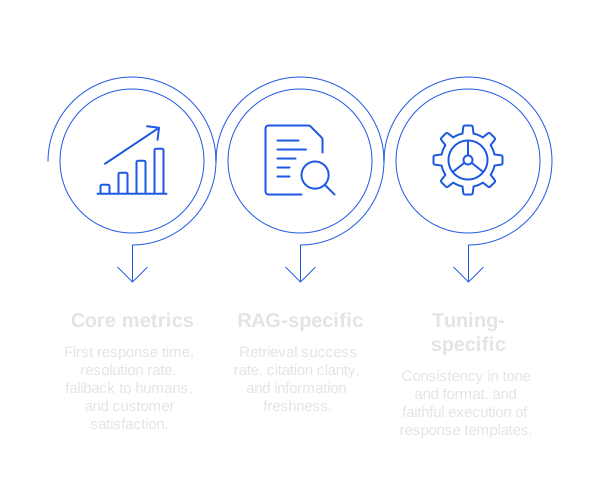
Assess your AI’s performance both in test environments and in live customer interactions. Offline, measure citation accuracy, step-by-step instruction following, and how well the system adheres to style guides. Online, track the impact on support metrics such as speed and customer satisfaction.
- Core metrics: First response time, resolution rate, fallback to humans, and customer satisfaction (CSAT).
- RAG-specific: Retrieval success rate, citation clarity, and information freshness.
- Tuning-specific: Consistency in tone and format, and faithful execution of response templates.
Consider running A/B tests by rotating a subset of tickets to a challenger system, keeping human reviewers involved for continuous feedback and improvement.
Complex B2B issues require robust tools. Explore this overview of leading AI customer support tools to help you find a solution that matches your needs.
Which Vendors Support RAG and Fine-Tuning for B2B SaaS Support Teams
- Intercom: Offers strong native chat with integrated document retrieval for rapid iteration.
- Typewise: Delivers AI-powered writing support directly within your CRM and email tools. Their hybrid system combines RAG and detailed style controls, with privacy as a core feature.
- Zendesk: Serves large, distributed teams with workspace macros and broad support workflows.
- Forethought: Automates support with both retrieval and intelligent routing capabilities.
- Build-it-yourself: Assemble your solution using vector search, orchestration tools, and observability platforms, for maximum flexibility, but with higher maintenance demands.
Prioritize your operational requirements over vendor name recognition. If auditability and language control are critical, shortlist platforms that offer both retrieval and adaptable style controls. Test their escalation mechanisms and citation user experience using live ticket scenarios.
Risk, Privacy, and Maintenance for RAG and Fine-Tuning in B2B SaaS Support
Protect customer data at every step. Redact personally identifiable information (PII) before adding records to your indexes. Limit access to sensitive documents by customer tenant and subscription plan. For auditability, log only the specific retrieved information, not entire support tickets.
Continuously monitor for model drift. Reevaluate model performance after each major release or shift in support policies. Keep human review and escalation pathways clear and accessible for your team.
Product and language change over time, adjust your glossaries and training datasets to keep pace. For structured approaches to keeping terminology aligned across teams, reference this how-to on keeping internal product language up to date.
RAG systems require ongoing content hygiene. Appoint owners to prune outdated sources, remove obsolete pages, and clearly document content migrations. Maintain an updated map of customer support information sources to avoid retrieving and returning outdated or inaccurate information.
A Simple Decision Checklist for RAG vs. Fine-Tuning in B2B SaaS Customer Support
- If an answer depends on facts that change monthly, use RAG for that topic.
- If a reply must always match a particular template or tone, rely on fine-tuning.
- If both requirements apply, combine the two approaches: retrieve fresh facts, then format the answer using your tuned style.
- Always escalate when confidence drops or when documentation contains conflicting citations.
Choose the smallest system that safely answers today’s tickets and can adapt as your needs change tomorrow.
Next Step
If you’d like to test a pragmatic path to hybrid support in your environment, the Typewise team can help you set up pilot evaluations using your real tickets. Reach out to Typewise for a short discovery chat. They’ll share proven patterns, not just slides.
FAQ
What is the main difference between RAG and fine-tuning in customer support?
RAG focuses on retrieving and providing the freshest, most accurate information from updated documentation, while fine-tuning aligns responses with your brand's tone and internal procedures. Both methods have unique strengths and trade-offs.
When should a B2B SaaS company prioritize RAG over fine-tuning?
Prioritize RAG when product features or policies frequently change, necessitating answers with up-to-date information. It's critical for maintaining accuracy in dynamic environments.
How can Typewise support a hybrid approach in customer support?
Typewise offers tools that blend RAG's fresh content retrieval with fine-tuning for maintaining brand tone, enabling a balanced response strategy. Their solutions integrate within CRM and email systems for seamless support.
What are the risks of relying solely on fine-tuning?
Relying solely on fine-tuning can result in outdated responses if product changes aren't frequently updated in training data. It risks submitting incorrect solutions, damaging trust and compliance.
How do you maintain information accuracy in a RAG model?
Continuous content hygiene and proactive updates are essential. Assign dedicated content curators to prune obsolete data and ensure retrieved facts are always accurate.
Why is a hybrid RAG and fine-tuning approach recommended?
A hybrid approach allows for leveraging the strengths of both systems—using RAG for factual accuracy and fine-tuning for tone consistency. It ensures comprehensive, reliable support.
How can a B2B SaaS company test the effectiveness of an AI support system?
Conduct A/B tests with a subset of support tickets to compare against a control group. Monitor metrics like response accuracy, customer satisfaction, and adherence to style guides in real scenarios.