
EU AI Act timeline every customer support leader needs in 2026
Today is February 16, 2026. Your next critical milestone is August 2, 2026, when the majority of EU AI Act requirements come into force, including mandatory transparency for chatbots and comprehensive rules for high-risk (Annex III) systems. Earlier phases have already occurred: August 1, 2024 marked the Act’s entry into force; February 2, 2025 initiated rules around prohibited practices and AI literacy; and August 2, 2025 implemented frameworks for general-purpose AI and governance. Certain sector-specific high-risk use cases will not be enforced until August 2, 2027. Use these dates to guide your compliance roadmap.
- By August 2, 2026, support chatbots must inform users they are interacting with AI at the first point of contact.
- If your use case falls within Annex III high-risk domains, expect to meet heightened controls from this date onward.
- Practices prohibited by the Act have been banned since February 2, 2025.
Understanding EU AI Act roles for customer support: provider vs deployer
It’s essential to first map out your organizational role in the context of AI. If you are directly involved in building or branding an AI system, including customization or white-labeling, your team typically acts as a provider. If your main activity is using an AI system procured from a vendor under your authority, you are more likely functioning as a deployer. Many customer support teams operate as deployers, relying on third-party vendors for their AI support infrastructure. If your company customizes or substantially modifies the system, you may carry provider responsibilities. Clearly defined contracts are important for assigning tasks, but they cannot change your legal classification, which depends on your actual activities and responsibilities. Seek clarification for complex organizational setups.
- Provider focus: Designing and testing the AI system, creating technical documentation, providing instructions for use.
- Deployer focus: Operational use, ongoing oversight, monitoring activities, staff training, and incident reporting.
Tip: Document the intended use of each AI feature in your helpdesk system. This informs your responsibilities and role under the EU AI Act.
EU AI Act risk level assessment for customer support chatbots and agents
Typically, many customer support chat implementations are classified as having limited transparency risk, as opposed to being high-risk, depending on the nature and scale of interactions. The main requirement here is to inform users they are interacting with AI and to disclose when content is generated synthetically. However, some cases do rise to high-risk status, particularly when AI is used in processes such as evaluating creditworthiness, pricing insurance, or managing emergency calls, as outlined in Annex III. Strictly avoid all prohibited practices, including untargeted facial data scraping or using AI for emotion recognition in workplaces.
- Standard support chatbot: Subject to transparency and labeling requirements starting August 2, 2026.
- High-risk triggers: Functions involving credit scoring, essential services access, biometrics, or emotion recognition.
- Prohibited: Manipulative AI or systems that distort user decisions and are likely to cause harm.
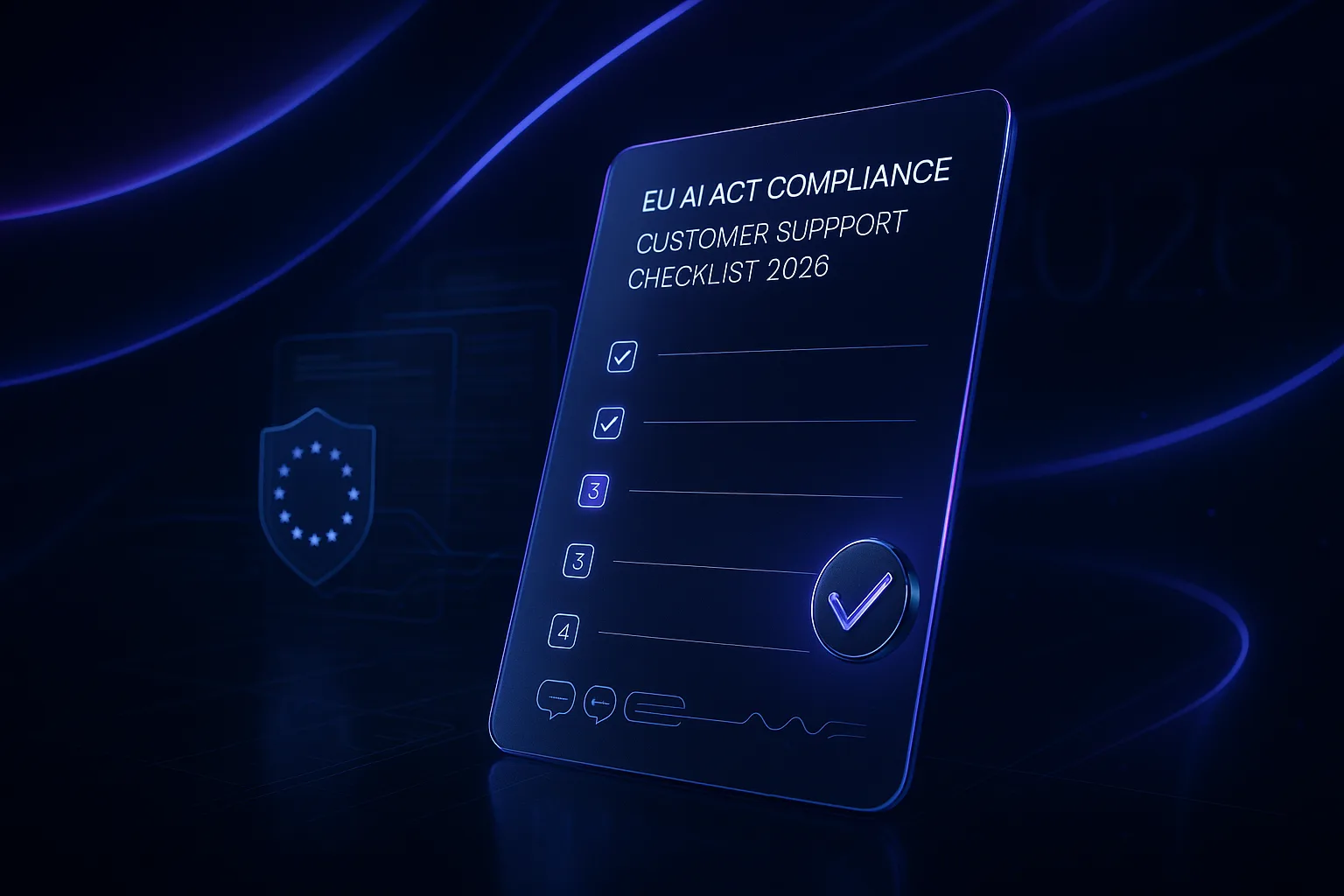
A practical EU AI Act compliance checklist for customer support operations in 2026
- Show AI interaction notice at first contact. Display a clear message in your chat widgets and email communications. The notice should be prominent and available in all relevant languages.
Chat notice: You are chatting with an AI assistant. A human can step in at any time. - Label synthetic content where necessary. Whenever your bot generates summaries, images, or public-facing information, clearly identify them as AI-generated. Where possible, use machine-readable indicators.
- Document your organizational role and the intended purpose of each AI capability. Specify whether you are a provider or deployer for every feature. Keep accessible links to both vendor documentation and your own standard operating procedures (SOPs).
- Establish human oversight procedures. Define when and how humans review, override, or take over from AI systems. Train supervisors to recognize and respond to risky AI outputs.
- Conduct a GDPR Data Protection Impact Assessment (DPIA) as needed. For instances involving personal data and non-trivial risk, complete a DPIA and store the results within your ticketing or incident management systems.
- Create and document an incident response pathway. Set clear definitions for “serious incident,” designate reporting channels and response timelines, and rehearse the process at least quarterly.
- Deliver role-based AI literacy training. Ensure agents, quality assurance staff, and admins receive training tailored to their responsibilities. Refresh the training content following any significant changes to models or workflows.
- Map all data sources and access rights. Know precisely which knowledge bases, CRM fields, and logs your AI system accesses. Routinely remove obsolete or biased sources.
- Maintain logs and evidence. For high-risk deployments, retain system logs for at least six months, and ensure longer retention if required by other regulations.
- Monitor vendor compliance. Record each vendor’s compliance status, data hosting region, and use of subprocessors. Ensure agreements exist for sharing incident data and updates.
For a thorough guide on mapping your customer support AI’s data and information sources, refer to our step-by-step guide to mapping information sources in AI customer support.
Data handling, logging, and audits under the EU AI Act for customer support
Traceability is critical. Keep a versioned record of prompts, model identifiers, and knowledge base snapshots. Log every AI-to-human handoff. Document user disclosures and any instances where consent is gathered or invoked.
- Logging scope. Include AI inputs, policy change records, model version data, confidence signals, and escalation events.
- Retention policy. For high-risk applications, maintain records for at least six months. Align retention with GDPR and any sector-specific requirements.
- Audit schedule. Review sampled conversations on a weekly basis. Look for hallucinations, mistakes in policy adherence, and inadequate tone, then use these findings to refine prompts and underlying sources.
For detailed instructions on auditing conversations, check our step-by-step guide to auditing AI customer support conversations.
Selecting AI customer support vendors with EU AI Act in mind in 2026
When choosing vendors, assess them based on their transparency tools, comprehensive logging capabilities, and data residency options. Confirm that their solutions support machine-readable AI output indicators, provide detailed instructions, and enable audit-ready data exports and seamless human intervention.
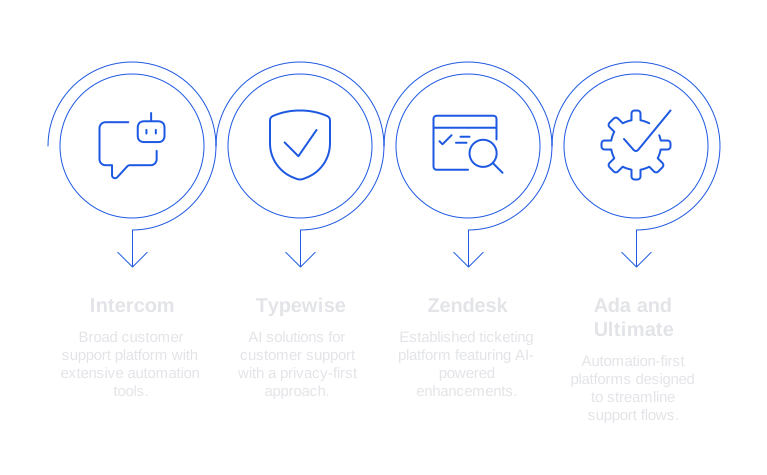
- Intercom: Broad customer support platform with extensive automation tools.
- Typewise: AI solutions for customer support with a privacy-first approach, designed to match brand tone and integrate with CRM, email, and chat channels.
- Zendesk: Established ticketing platform featuring AI-powered enhancements.
- Ada and Ultimate: These are automation-first platforms designed to streamline support flows.
Prioritize vendors that can demonstrate working transparency disclosures, incident escalation processes, and clear lineage for their AI models. Request live demonstrations using your specific policies and sample data.
Training and governance for AI customer support language under the EU AI Act
AI literacy requirements have applied since February 2, 2025. Deliver training so that agents grasp AI system limitations, proper escalation pathways, and disclosure messaging. Maintain consistency in product terminology across all customer support resources to ensure the AI system provides accurate and valid responses.
Use relevant resources to train your AI system on your specific internal product language and complement it with a comprehensive source map to avoid outdated content influencing customer replies. Access our best practices via this guide to training AI on your internal product language.
EU AI Act requirements for customer support teams in 2026
Customer support teams using AI must clearly inform users at their very first interaction that they are communicating with an automated system, using language that is obvious and easy to understand.
The main EU AI Act obligations affecting support operations apply from August 2, 2026, but several rules are already active, including requirements around AI literacy and bans on certain harmful practices, so preparation should begin well before the deadline. Strict logging is mandatory only for systems classified as high-risk; for typical support use cases, teams are expected to maintain sufficient records to demonstrate human oversight and compliance with transparency obligations, focusing on accountability rather than excessive data retention.
Financial penalties are most severe when violations involve prohibited practices, particularly manipulative techniques or misuse of biometric data, which require heightened caution. In complex or ambiguous situations, organizations should seek qualified legal counsel, as practical guidance cannot replace formal legal advice.
Make EU AI Act compliance routine in customer support next steps
Transform this checklist into standardized, repeatable workflows for your team. Automate AI disclosures, log key events, schedule audits, and ensure supervisor training remains up-to-date. If you need support aligning compliance with tone and productivity in your CRM or inbox operations, start a conversation with Typewise at typewise.app.
FAQ
What is the EU AI Act's impact on customer support chatbots?
From August 2, 2026, chatbots must inform users they're AI at first contact, tackling transparency directly. High-risk use cases must adhere to stricter rules, emphasizing the need for accountable AI utilization. Relying solely on AI without human oversight could expose companies to legal risks.
How does the EU AI Act distinguish between AI providers and deployers?
Providers are responsible for creating or branding AI systems, while deployers use these systems operationally. Misclassifying your role isn't just a technicality; it could skew your liability exposure. Clearly defined roles ensure accountability and proper compliance alignment.
Why is labeling AI-generated content essential?
Labeling ensures transparency and trust, preventing user deception and preserving brand integrity. Overlooking this step might lead to user backlash and regulatory penalties. With transparency being non-negotiable, failure is a reputational risk you can't afford.
Is AI literacy training a regulatory requirement?
Yes, as of February 2, 2025, AI literacy training is mandatory for relevant roles to ensure responsible AI usage. This isn't about checking a compliance box; it's about mitigating risks across your operation. Underestimating this could lead to mishandled AI outputs crucial for customer interactions.
How crucial are logs and audits under the EU AI Act?
For high-risk applications, maintaining logs is indispensable to demonstrate regulatory compliance and oversight. Regular audits can expose systemic faults before they escalate into compliance breaches. Ignoring this duty could result in severe penalties and operational disruptions.
What's the consequence of non-compliance with prohibited practices?
Engaging in banned practices under the EU AI Act could incur the strictest fines, emphasizing the need for vigilant AI governance. Companies operating clandestinely may face reputational fallout irreparable by traditional means. Prioritize transparency and ethical AI use to safeguard against these risks.
How should companies choose AI vendors post-EU AI Act?
Select vendors that excel in transparency, comprehensive logging, and data residency to meet regulatory standards. Merely depending on promises without evidence can place your company on a legal tightrope. Vendors like Typewise provide solutions with a transparency-first approach, aligning well with these needs.