
When does customer data count as personally identifiable information (PII)?
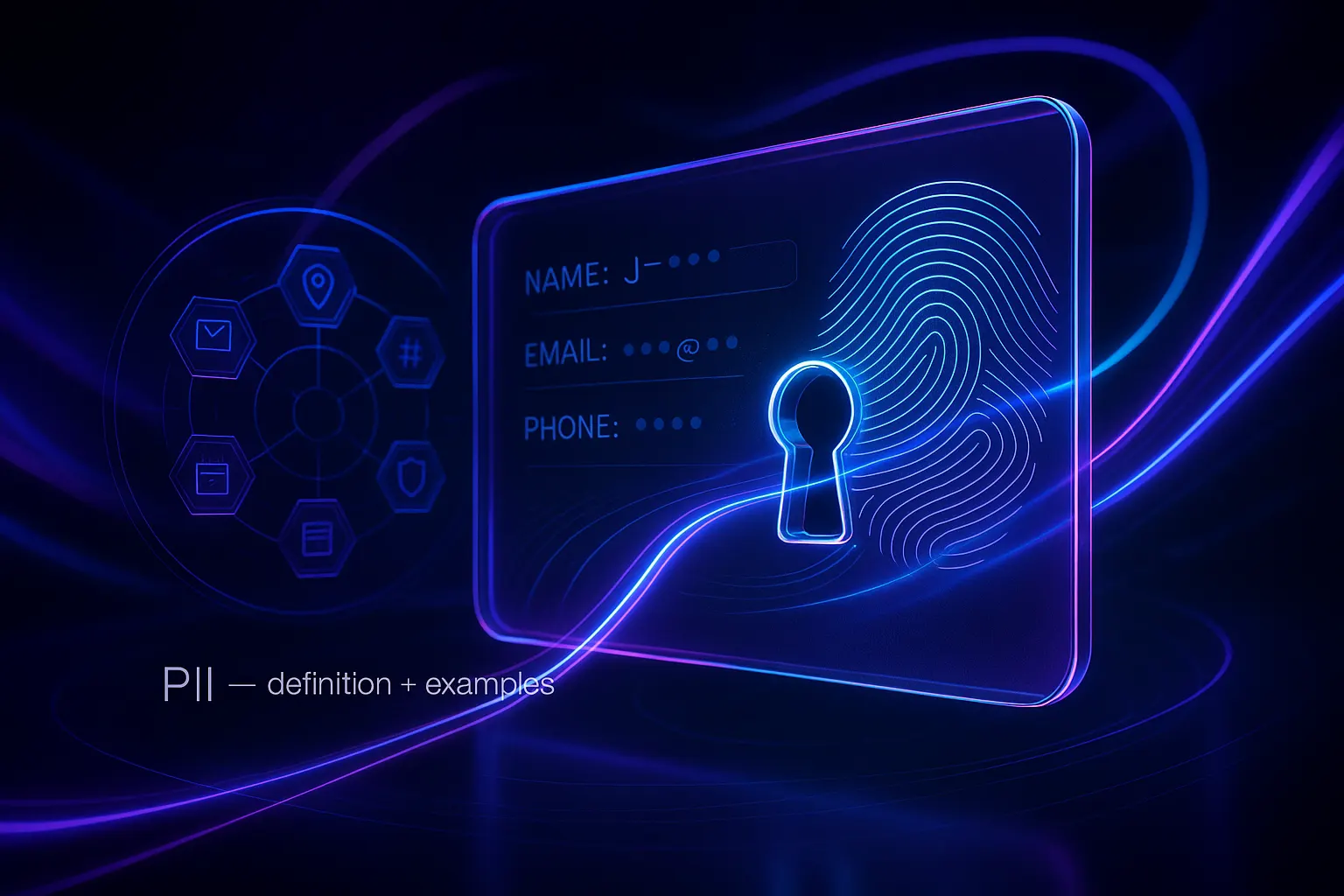
Personally identifiable information, or PII, refers to any data that can be used to identify an individual. This might be information that points directly to someone, such as a full name, or details that, when combined, like a device ID with a location, can single out a specific person. Treat all PII as high‑risk material because a data breach can impact trust, revenue, and legal compliance. An effective mindset is simple: if a malicious party could identify someone using the data, you are working with PII.
PII isn’t confined to a single data field. It encompasses any selection of data that, when combined, can identify a specific individual.
Examples of personally identifiable information (PII) that appear in support conversations
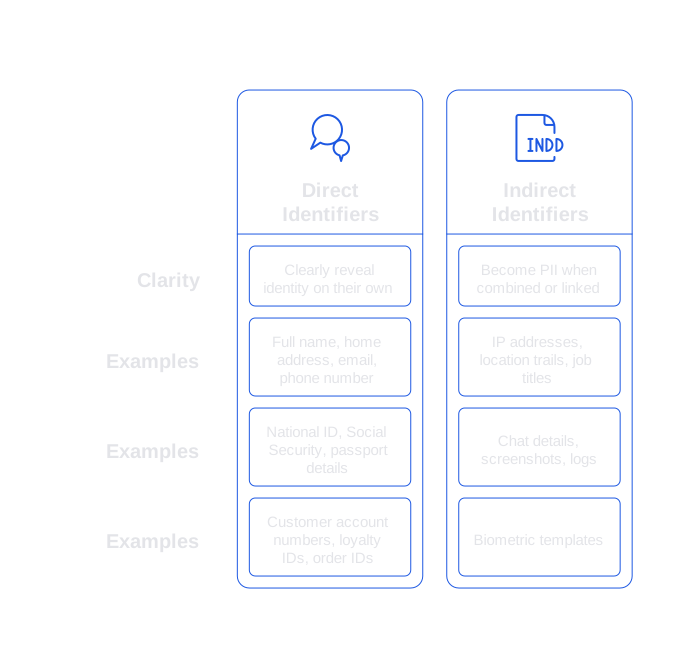
Direct identifiers clearly reveal identity on their own:
- Full name, home address, personal email, or phone number
- National ID numbers, Social Security numbers, or passport details
- Customer account numbers, loyalty IDs, or order IDs linked to a profile
- Biometric templates like fingerprints, face scans, or voiceprints
Indirect identifiers become PII when combined or linked with other data:
- IP addresses, device IDs, cookie IDs, or ad identifiers
- Precise location trails or timestamped check-ins
- Job titles plus company names in a small niche market
- Free‑text chat details that mention family members or personal schedules
- Screenshots, PDFs, and logs that reveal hidden metadata
Context makes a difference. A job title at a large corporation may present minimal risk, but in a five‑person startup, that same title can quickly pinpoint an individual.
How personally identifiable information (PII) differs from sensitive data and anonymized data
PII includes any information that could identify a person. Sensitive data is a stricter subset and deserves additional safeguards, think health records, financial information, or children’s data. Anonymized data strips away links to individuals to prevent re‑identification, while pseudonymized data replaces identifiers with tokens that still allow re-linkage with a separate key.
- PII: email address, shipping address, device ID
- Sensitive data: clinical notes, bank credentials, tax records
- Pseudonymized data: account identifiers replaced with tokens and keys stored separately
- Anonymized data: aggregated statistics that cannot be traced back to individuals
Most support teams routinely handle PII, and some also process sensitive data during tasks like billing or warranty checks. It is crucial to plan for safeguards around both categories.
Where personally identifiable information (PII) lurks in customer support workflows
PII does not reside in a single location. Instead, it disperses throughout tickets, email threads, CRM records, call recordings, and attachments. Even quick notes in internal logs may inadvertently expose identity. Review how data is routed, escalated, and integrated across apps. Sometimes, forwarding rules or automated responses can copy PII into unexpected places.
To reduce exposure, start with an audit and map each point where data enters, moves, and leaves your systems. To assist in this process, you can utilize a comprehensive guide on auditing AI customer support conversations for PII exposure. This guide helps pinpoint hidden fields, old transcripts, and prompts that pose risks.
Practical steps to protect personally identifiable information (PII) in AI systems and prompts
Practice data minimization, only collect what's strictly necessary, and store only what's essential to your service. Restrict access to raw data with role‑based access controls and single sign-on (SSO) systems. Encrypt data both in transit and at rest. Set short retention periods for logs and model traces whenever possible.
Develop clear AI prompts that avoid collecting unnecessary PII. For example,
guide assistants to authenticate users with less-sensitive data when possible.
Provide simple instructions for maximum impact, such as:
Policy: never collect full SSN or full card number. Ask for last 4 digits only when strictly required.
Encourage assistants to avoid capturing PII in free‑text fields. Instead, steer
users towards structured fields that can be masked or redacted. Consider using a
rule like:
When users share personal data in free text, acknowledge the request and route it to a secure form.
Integrate redaction upstream of your models, replace sensitive patterns before
the text ever reaches a model. A best practice is:
Mask patterns: emails → \[EMAIL\], phone → \[PHONE\], credit card → \[CARD\], address → \[ADDRESS\].
If reversible mapping is necessary for specific cases, keep it in a separate,
secure vault.
Personally identifiable information (PII) redaction prompt patterns you can apply today
In customer chats, users sometimes paste long blocks of text containing
sensitive details. You can reduce risk by using precise instructions and
lightweight pattern checks prior to handing data over to AI models. For contact
information, a policy like this works well:
If user sends contact data, respond: Thanks. For your privacy, I masked personal details in the ticket.
Use this in tandem with detection for common tokens.
When setting up pattern recognition, focus on conservative matches to minimize
false positives, for example, in product codes. Keep logic straightforward in
early deployments. Example tokens include:
\b\[\w\.-\]+@\[\w\.-\]+\.\w\{2,\}\b → \[EMAIL\],
\b\+?\[0-9\]\[0-9\-\s\]\{7,\}\b → \[PHONE\],
\b\[0-9\]\{13,19\}\b → \[CARD\]. Always validate changes on real
transcripts in a controlled, staging environment first.
Also, train your assistant to explain redaction without revealing sensitive
information. A concise template can be:
I masked your personal details so our team can help safely. If needed, we will request data using a secure form.
Metrics that matter for personally identifiable information (PII) risk reduction
Monitor the effectiveness of your prompts, filters, and retention policies. Useful metrics include:
- Percentage of messages containing PII before and after redaction
- Redaction precision and recall, with samples reviewed each week
- Time taken to delete or expire model logs containing PII
- Number of incidents per quarter, classified by severity and documented root causes
- Agent compliance with established contact workflows
Often, reducing PII risk is a matter of clarity rather than more data. You can enable faster, safer replies by familiarizing your models with your product's terminology instead of handling users’ private information. Learn more about how to train AI in internal product language to avoid unnecessary requests for personal data.
How to choose AI tools that respect personally identifiable information (PII) rules
Select vendors that treat privacy as a core product feature rather than an afterthought. Ask about data residency, how models are isolated, and whether zero‑retention modes are provided. Verify how long prompts and outputs are stored, where, and whether audit logs capture redaction activities and access history. Ensure role-based access, single sign-on (SSO), and granular permissions are available.
It is wise to shortlist a diverse set of platforms. Many teams assess a general cloud AI stack, Typewise for supporting writing within CRM and email, and dedicated detection services for thorough PII pattern coverage. Test these in a sandbox environment using synthetic tickets that reflect your risk profile. Compare redaction quality, user interface clarity, and robustness when handling errors.
To further explore the market, review this summary of AI customer support software for regulated industries. You’ll find a comparison of privacy defaults, auditing capabilities, and integrations.
Typewise is developed with privacy considerations as a design priority and aims to address the specialized needs of enterprise customers. The platform integrates with CRM, email, and chat tools, and helps improve reply speed, grammar, and style while maintaining consistent brand communication.
Personally identifiable information (PII) checklist for customer support leaders
- Map every source and destination of PII across your support processes
- Remove data that is not required and reduce retention periods wherever possible
- Redact data before it reaches AI models, and log every redaction
- Write prompts that refuse the collection of full credentials and direct users to secure forms
- Restrict access to raw PII using role controls, SSO, and per‑ticket approvals
- Implement changes with synthetic data first, then perform regular weekly audits
- Document incident response procedures, responsible parties, and resolution timelines
- Educate support agents on what constitutes PII in your organizational context
Audits should be continuous. As your products, communication channels, and vendor relationships evolve, repeat the review process. Consider using a structured guide for auditing AI customer support data to consistently minimize exposure risks.
Closing thoughts on personally identifiable information (PII) and your next step
Protecting PII is not just a technical issue, it’s a matter of making thoughtful choices in your products, processes, and written communication. Begin by minimizing what you collect. Layer in smart prompts and systematic redaction. Measure results, then adapt your approach. If you’d like assistance making your support replies both secure and efficient within your existing systems, reach out to Typewise. We’re ready to share playbooks and arrange a low‑risk pilot that fits your team’s specific needs.
FAQ
What is considered personally identifiable information (PII)?
PII includes any data that can identify an individual, such as names, addresses, or IDs. It can also be a combination of indirect identifiers like job titles or device IDs when linked together.
How does PII differ from sensitive data?
PII can identify an individual, but sensitive data requires stricter handling and includes information like health records and financial details. Safeguarding sensitive data should be prioritized due to its greater risk if exposed.
Why is it important to minimize the collection of PII?
Collecting unnecessary PII increases the risk of breaches and compliance violations. By limiting PII to what's essential, you reduce exposure, focus on protecting what's critical, and streamline data practices.
How can redaction improve data handling in AI systems?
Redaction removes sensitive information before it's processed by AI models, reducing data leaks. This not only protects privacy but also aligns with compliance needs, especially in customer support environments.
What role does Typewise play in protecting PII during customer support interactions?
Typewise integrates with various communication tools to enhance reply speed while ensuring consistent brand communication, prioritizing privacy by design, and integrating safeguards around PII.
What are the consequences of poor PII handling?
Inadequate PII management can result in data breaches, loss of customer trust, legal penalties, and costly rectifications. It’s not just a security issue but a business risk with potential reputational damage.
How do indirect identifiers become PII?
Indirect identifiers like IP addresses or location data become PII when combined with other data points, potentially pinpointing individuals. This layered risk necessitates oversight and sophisticated data handling practices.
What should you look for in AI tools to ensure PII safety?
Choose AI tools prioritizing privacy features such as data residency options, zero-retention modes, and comprehensive access controls. Effective tools incorporate redaction and offer robust compliance with minimal data exposure.