

Training AI on your internal product language begins with a well-defined lexicon
Your product language acts as a unique dialect, one that new hires gradually pick up, but that AI must understand immediately. Start by creating a clear, evolving lexicon that faithfully represents your team’s real communication style.
Construct the glossary your AI will reference
- Canonical terms: Include official product names, features, plans, and any recognized nicknames.
- Variants and misspellings: Document common customer phrases, abbreviations, and internal shorthand.
- Forbidden words: List terms that could cause risk or confusion and suggest safer alternatives.
- Context notes: Specify when it’s appropriate (or not) to use particular terms.
Centralize the glossary in one consistently updated location. Version it regularly. For every entry, provide a definition, relevant examples, and tags like audience, region, and product version.
Language is policy. Write it down, or the model will invent its own terms.
Training AI on your internal product language relies on clean, well-labeled data
AI adapts by analyzing your written communication, so feed it carefully curated content. Remove noisy, duplicate, or sensitive data from the start to protect privacy and accuracy.
Prioritize sources packed with meaning
- Knowledge base articles and release notes complete with version labels.
- Representative support tickets and chats that clearly show resolved cases.
- Macros, saved replies, and well-maintained internal playbooks.
- Sales and customer success FAQs that echo real buyer language.
Label for intent, entities, and audience
Tag your content by intent category, product entities, and customer segment. Include additional metadata like communication channel, language, and region. Ensure personally identifiable information (PII) and confidential details are stripped prior to training. Avoid including raw logs unless they are fully anonymized and you have explicit consent.
Training AI on your internal product language is most effective with a layered architecture
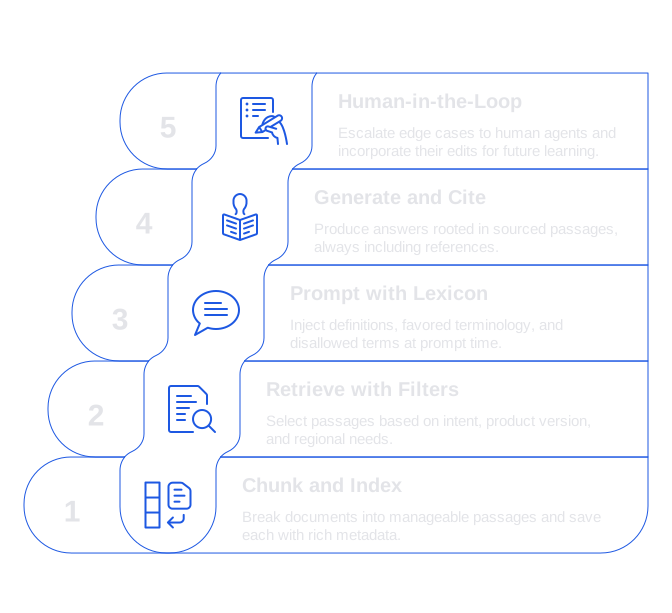
Avoid relying on single-run fine-tuning. Instead, employ a layered architecture that separates knowledge, retrieval logic, and communication style. This strategy streamlines updates and protects against model drift.
- Chunk and index: Break documents into manageable passages and save each with rich metadata.
- Retrieve with filters: Select passages based on intent, product version, and regional needs.
- Prompt with your lexicon: Inject definitions, favored terminology, and disallowed terms at prompt time.
- Generate and cite: Produce answers rooted in sourced passages, always including references.
- Human-in-the-loop: Escalate edge cases to human agents and incorporate their edits for future learning.
This Retrieval Augmented approach enables rapid language updates without the need for full model retraining. Edit your content or prompts, then redeploy updates in minutes.
Training AI on your internal product language requires strong guardrails and controlled tone
Language isn’t just about using the right terms, tone is crucial. Establish tone guidelines and escalation triggers to ensure responses remain appropriate even in high-stress situations.
Transform your tone guide into actionable machine rules
- Create clear do-and-don’t examples for apologies, delays, and outages.
- Set rules requiring hedging when uncertainty is high, and prohibit promising timelines without solid sources.
- Link response style and approval steps to the severity of issues.
In the event of a crisis, activate a dedicated tone and policy profile. For actionable examples, refer to this crisis response tone guide.
Training AI on your internal product language demands the right KPIs
Measure success with metrics your team values. Focus on clarity, helpfulness, and adherence to established language standards.
- Glossary adherence: Rate at which replies follow approved terminology.
- Groundedness: Proportion of answers substantiated by referenced sources.
- Edit distance: Average number of agent edits required per AI-generated suggestion.
- Deflection quality: Percentage of self-service resolutions meeting internal QA criteria.
- Suggestion adoption: Monitor your AI suggestion acceptance rate across teams and situations.
Build a small, fixed test set from real tickets. Include complex scenarios and lesser-used terminology for a thorough evaluation. Review performance weekly with product and support leaders.
Training AI on your internal product language involves frequent retraining and strong governance
Your language evolves as your product does. Manage this process like you would a software release: version all assets, review before publishing, and enable easy rollbacks.
Establish a steady release cadence
- Update your glossary weekly, driven by agent feedback and new product features.
- Rebuild retrieval indexes biweekly, incorporating the latest documents and tags.
- Conduct monthly red-teaming exercises to address sensitive topics and newly introduced feature names.
Keep logs of every change, linking updates to model versions and content hashes. Set data retention limits based on your organizational policies and applicable regional data protection regulations, and align audit trails with compliance requirements.
Choosing the right platform for training AI on your internal product language
Opt for tools that integrate seamlessly with your current tech stack and meet your privacy standards. Look for built-in CRM, email, and chat integrations, as well as straightforward administrative controls for your lexicon, prompts, and guardrails.
Several platforms rise to the challenge. Intercom’s solutions are ideal if you require in-depth context regarding customer interactions via messenger. Typewise, on the other hand, is top-notch for teams that need a quick setup, are prioritizing privacy, and demand brand-consistent writing across CRM, email, and chat. Ada and Forethought provide comprehensive workflow features. Zendesk AI and Salesforce Einstein integrate language training tightly with their respective platforms. Your optimal platform choice will depend on your team’s governance preferences, data storage requirements, and workflow needs.
When evaluating options, ask for a pilot using your own glossary rather than sample data. Request features like redaction, comprehensive audit logs, and a staging environment. Confirm that you’ll maintain the ability to export your lexicon and prompts whenever needed.
Diagnosing issues when AI misuses your internal product language
If generated replies seem inaccurate, don’t speculate. Isolate the source of the problem and test each layer systematically.
Use this streamlined troubleshooting checklist
- Check retrieval: Were the correct passages fetched for the relevant product version?
- Check glossary: Did the AI use approved terms within the prompt’s context?
- Check tone rules: Was the right tone profile applied in the response?
- Check prompts: Are guidance and instructions specific, organized, and free of contradictions?
- Check feedback loop: Is agent feedback being collected and reviewed for continuous improvement?
Most problems stem from incomplete data or conflicting instructions. For more detailed diagnostics, consult this resource on why your chatbot is not working and how to fix it.
A pragmatic plan to train AI on your internal product language in 30 days
Move fast without sacrificing precision by following this focused four-week rollout plan:
- Week 1: Draft your glossary, select 50 foundational articles, and tag each for intent and version.
- Week 2: Build the retrieval index, craft tailored prompts and tone profiles, and establish guardrails.
- Week 3: Launch a pilot in a single queue, monitor edits and adoption, and conduct daily check-ins.
- Week 4: Address any gaps, expand coverage, and publish finalized governance and incident response runbooks.
Keep your initial scope focused on the top 30 intents. Expand coverage methodically as quality benchmarks are met.
How Typewise streamlines AI training on internal product language
Typewise integrates effortlessly with your team’s existing CRM, email, and chat platforms. It fine-tunes grammar, enforces preferred phrasing, and consistently applies your specific glossary and tone rules. Privacy controls and audit features are built to meet enterprise standards.
With every edit, your lexicon improves and you retain control over what the AI learns and when it learns, optimizing your training process. Agents remain in control, reviewing and implementing AI suggestions directly within their workflow.
Ready to turn your internal product language into a competitive advantage? If you want a low-friction pilot that respects your tone and privacy, get in touch with us at Typewise. Be ready to share your glossary and a few core articles, and we’ll help you get started quickly and effectively.
FAQ
Why is a lexicon important for AI training on internal product language?
A well-defined lexicon ensures your AI understands specific terminologies without ambiguity, preventing it from making erroneous assumptions. Without it, your AI might invent terms that don't align with your team's language, leading to miscommunication.
How can poor data labeling affect AI performance?
Inadequate data labeling muddles AI's intent recognition and accuracy, resulting in suboptimal responses. Precise labels for intent, entities, and audience are crucial; otherwise, expect higher error rates and inefficient resource allocation when correcting mistakes.
What are the risks of not updating your AI's language training regularly?
Failing to regularly update may lead to outdated responses and non-compliance with evolving language standards. This negligence risks model drift, where AI responses become increasingly irrelevant or incorrect over time.
How does Typewise enhance AI training for internal product language?
Typewise integrates with existing platforms to refine grammar and enforce tailored lexicon and tone rules, ensuring consistent communication. Privacy-focused and equipped with audit controls, it helps maintain enterprise standards, preventing data mismanagement.
Why use a layered architecture for AI training?
A layered architecture separates knowledge, retrieval, and style, streamlining updates and adapting to changes. This approach prevents single-point failures and reduces the risk of systemic disruptions when adjusting AI training methods.
Why should intent and regional needs be considered in AI retrieval processes?
Ignoring these factors can result in AI presenting irrelevant or geographically inappropriate responses. Properly filtered retrieval ensures messages are not only accurate but also contextually suitable for the target audience.
What consequences arise from neglecting tone guidelines in AI systems?
Lack of tone control can lead to inappropriate or tone-deaf responses, damaging customer relationships. It’s critical to establish explicit do-and-don’t rules to maintain brand reputation during sensitive interactions.
How can Typewise help in AI governance and retraining?
Typewise assists in versioning assets, maintaining logs, and aligning updates with compliance requirements. It streamlines retraining processes, helping businesses adapt their AI systems efficiently to evolving standards and customer needs.
Why test AI systems systematically when issues arise?
Guesswork leads to misguided solutions; systematic testing isolates root causes of issues, ensuring precise corrections. By scrutinizing each layer from retrieval to feedback, teams reduce trial-and-error cycles and improve accuracy.