

What Changes in Practice When RAG and Fine-Tuning Drive Customer Success AI Agents
Customer success teams deciding how to enhance their AI agents face two core technologies: Retrieval Augmented Generation (RAG) and fine-tuning. Each serves a distinct function, but their true power emerges when used together. The differentiation comes down to how they update knowledge, maintain the desired tone, and enable performance measurement.
- RAG acts as a dynamic source of up-to-date, verifiable information by retrieving content before generating responses.
- Fine-tuning instills long-term communication patterns such as brand tone, intent handling, and response structure.
- Hybrid solutions combine RAG’s grounded facts with fine-tuned style to deliver answers that are both accurate and brand-consistent.
RAG serves as a dynamic source of factual information, functioning like a frequently updated library. Fine-tuning, on the other hand, is akin to a writing school that imprints consistent communication habits. The optimal configuration for your stack should reflect your ticket mix, release cadence, and compliance requirements.
RAG for Customer Success AI Agents: Strengths, Tradeoffs, and Use Cases
RAG excels in environments where facts are constantly evolving. It queries a vector index, retrieves relevant snippets, and composes responses with citations. This makes RAG ideal for scenarios such as new product release notes, policy adjustments, fluctuating pricing, or region-specific compliance rules. You can impose gates for response confidence or require direct source citations.
- Strengths: Rapid knowledge updates, transparent grounding, lower risk of outdated or incorrect information.
- Tradeoffs: Depends on quality search and retrieval systems, requires ongoing index maintenance, and context windows can be limiting.
- Best use cases: Handling complex B2B FAQs, checking entitlements, and managing compliance-driven inquiries.
Effective prompts and system rules are crucial. Always require source attribution with clear instructions like:
system: You are a customer success AI. Answer using the provided context only. Cite sources.
And for precise information retrieval:
query: refund policy for annual plan cancellation in Germany, version 2026-02
RAG accelerates onboarding for junior staff and helps avoid unnecessary case escalations by uncovering facts buried deep within documentation.
Fine-Tuning for Customer Success AI Agents: Strengths, Tradeoffs, and Use Cases
Fine-tuning focuses on shaping the AI’s long-term behavior by enforcing brand tone, macro response structure, and domain-specific phrasing. It is particularly useful for establishing required formats for CRM entries, composing case summaries, or executing structured tool calls. Because updates to the model must be planned and tested before deployment, reserve fine-tuning for stable, enduring patterns, not for rapidly shifting facts.
- Strengths: Uniform voice and style, tighter control of instructions, more compact prompts, and faster inference.
- Tradeoffs: Requires time-intensive dataset curation, risk of “overfitting” to specific examples, and less agility with factual changes.
- Best use cases: Mapping user intents, generating safe escalation language, honoring template fidelity, or enforcing action schema compliance.
Invest in high-quality training data covering key case elements like greetings, empathy, solution steps, and closing statements. For clarity, pair input queries with model-approved outputs:
\{input: Where is my invoice?, context: B2B annual plan, output: \[Steps\] 1) Verify billing email ... \[CTA\] ...\}
In industries with unique terminology, early alignment is essential. To see how to train your AI in your internal company language and prevent boilerplate responses, check out our dedicated guide.
Combining RAG and Fine-Tuning for Customer Success AI Agents: A Layered Strategy
Mature customer success operations harness both RAG and fine-tuning. RAG delivers timely, well-grounded facts, while fine-tuning ensures every response matches your company’s voice and structure. Introducing a policy checker minimises the probability of risky responses. A typical workflow might look like this:
retriever → draft_with_context → policy_checker → fine_tuned_styler → final
Maintain transparency at every stage. Monitor which passages are retrieved, their confidence levels, and their influence on the draft. When drafts fail review, use those cases to either enhance your fine-tune set or refine your retrieval strategy. This way, your agent delivers up-to-date information in a consistently branded style.
Evaluation and Rollout of RAG and Fine-Tuning for Customer Success AI Agents: KPIs and Workflow
Clear definition of success is essential before deployment. Benchmark both the model’s accuracy with and without retrieved context, and monitor response times, source citation rates, and correct refusal instances. Integrate human feedback to accelerate ongoing learning. Two KPIs are especially valuable during live operations:
- Grounded accuracy: Does the response rely on retrieved, validated information?
- Suggestion outcomes: Are human agents accepting the drafts or choosing to edit?
These acceptance indicators help you iteratively improve quality and efficiency. Learn practical ways to measure performance using the AI suggestion acceptance rate and eliminate guesswork from quality improvements.
Maintain strong quality control. Regularly sample AI-generated conversations to identify and address any inaccurate statements or tone mismatches. For best practices on audit trails and feedback loops, reference our guide on auditing AI customer support conversations.
To enforce consistent output, use prompts that match your QA expectations:
system: Write in the assure-then-action style. Never guess. Ask one clarifying question if context is thin.
Cost, Data Governance, and Lifecycle Choices for RAG and Fine-Tuning in Customer Success
Keeping track of all costs involved is vital. With RAG, costs may emerge from embedding the retrieved content, storing the vector representations for retrieval, refreshing the library of content, and the actual process of retrieving relevant content. For fine-tuning, costs come from labeling your data set, carrying out experiments for model training, and evaluative practices. There are also inference costs which can vary according to the model size and the length of the context required for the model to operate. Hybrid architectures distribute expenses across systems but require additional orchestration and oversight.
Address governance needs from the outset. Prevent exposure of personally identifiable information (PII) during indexing and redact sensitive content before saving it. Clearly distinguish between public documents and confidential internal runbooks. Institutes robust data lineage, version control, and retention schedules, especially important for customers under regulatory constraints.
Vendor and Approach Archetypes for Customer Success AI Agents
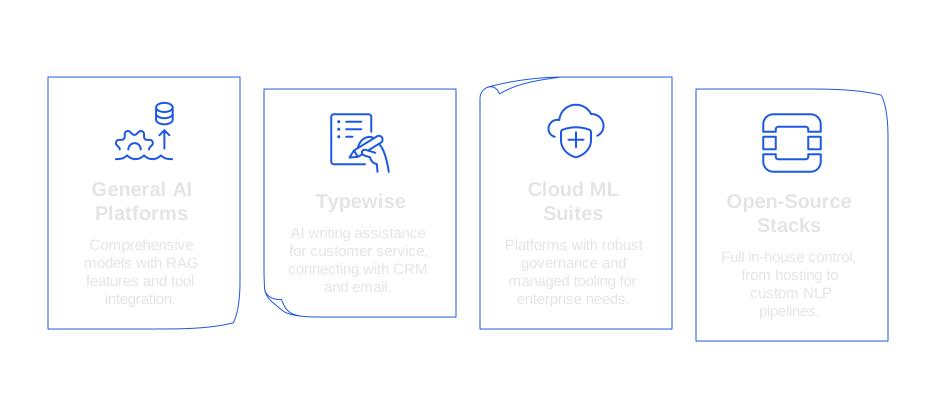
- General AI platforms: Comprehensive models with RAG features and support for tool integration.
- Typewise: AI-powered writing assistance tailored for customer service and business teams. Seamlessly connects with CRM, email, and chat; excels at maintaining brand voice and data privacy while measurably increasing productivity.
- Cloud ML suites: Platforms with robust governance and managed tooling for enterprise needs.
- Open-source stacks: Full in-house control, from hosting to custom NLP pipelines.
Choose the strategy that meets your security, latency, and change-management requirements, keeping in mind that RAG and fine-tuning are typically most effective when implemented together. Always align your approach with projected ticket volumes and the frequency of needed updates to ensure smooth scalability.
Decision Checklist Comparing RAG and Fine-Tuning for Customer Success AI Agents
- Are policies updated weekly or even more frequently? Prioritize RAG or a hybrid method.
- Is tone and structural consistency your primary challenge? Prioritize fine-tuning.
- Do every agent’s replies require citations? Use RAG with strict grounding controls.
- Do workflows demand rigid formats or tool integrations? Combine fine-tuning with a validation layer.
- Is safeguarding data privacy essential? Choose vendors with strong isolation and precise retention capabilities.
- Is your team prepared to label training data? If yes, invest in a fine-tuning dataset. If not, implement RAG first.
- Do you need flexibility for ongoing experimentation? Use a hybrid model: Lock in preferred style and structure with fine-tuning, while updating domain information with RAG.
Ground facts with RAG. Shape judgment with fine-tuning. Keep your eye on key performance indicators like grounded accuracy and suggestion outcomes to guide the balance.
Keep your experimentation iterative and focused. Test changes one at a time, maintaining a core set of high-value sample cases (golden tickets), and rerun evaluations after each update to catch regressions quickly.
Implementation Tips for RAG and Fine-Tuning Within Customer Success Workflows
Begin where impact is tangible and risk is minimal. Start with automated summaries, expand to structured templates, and then progress to full reply automation. Use prompts that align with your QA standards:
assistant: Summarize the customer goal, blockers, and next step in 60 words.
Tag every auto-generated suggestion with source links, version identifiers, and confidence ratings. Escalate higher-risk queries to human agents and retain these edits for retraining. Over time, your AI will draft clear, accurate, and contextually appropriate responses, as well as recognize when to request human help.
Continuously refine your training data. Retire outdated expressions, add coverage for new contract stipulations, and keep the training library organized and versioned. Your customers will benefit from greater clarity and faster, more reliable answers.
Curious how this might transform your customer success operations? If you want grounded, on-brand answers in every channel, let’s connect. Discover how Typewise offers a privacy-conscious, workflow-ready approach to customer success AI agents. Explore Typewise and start a conversation.
FAQ
What is Retrieval Augmented Generation (RAG) and why is it important?
RAG combines search and generation, pulling in current data to inform AI responses. This ensures answers are grounded in verifiable facts, critical in rapidly changing environments.
How does fine-tuning differ from RAG in the context of AI agents?
Fine-tuning adjusts AI to reflect a brand's tone and preferred structures, unlike RAG which focuses on factual accuracy. The challenge lies in maintaining flexibility amidst frequent data changes.
Why should companies consider hybrid RAG and fine-tuning approaches?
Combining RAG’s fact verification with fine-tuning’s consistency offers balanced and reliable output. Neglecting this balance risks either factual inaccuracies or inconsistent brand messaging.
What are the cost implications of implementing RAG and fine-tuning?
RAG incurs costs in retrieval and storage, while fine-tuning demands investment in data curation and training. Overloading one side might lead to either unsustainable expenses or inefficiencies.
How can Typewise enhance customer success operations with AI?
Typewise integrates seamlessly with existing systems, maintaining brand voice while improving productivity. Ignoring integration and data privacy can result in inconsistent outputs and compliance risks.
What KPIs are critical when deploying RAG and fine-tuning in AI agents?
Grounded accuracy and suggestion acceptance rates are key; they reveal reliance on verified information and the practicality of AI suggestions. Overlooking these metrics can mask poor performance.
What governance measures should accompany RAG and fine-tuning implementation?
Robust governance prevents sensitive information exposure and ensures compliance. Failing to establish clear guidelines could lead to significant data breaches and regulatory penalties.