

What happens when your customers stop visiting your website — and send their AI assistant instead?
This isn’t a hypothetical question. It’s the new reality of customer experience. With over 1.5 billion people using AI assistants like ChatGPT, Gemini, and Claude every week, a structural shift is already underway . These are not just chatbots; they are agentic AI systems tasked by consumers to research, negotiate, purchase, and resolve service issues on their behalf.
During the 2025 holiday season, AI-influenced purchases accounted for over $67 billion in sales . Startups like Pine AI are raising millions to act as a consumer’s representative in canceling subscriptions and filing complaints . Google’s “Ask for Me” feature is already calling businesses to book appointments.
The AI customer is here. The question is no longer if your business will interact with them, but how.
Service, Not Shopping, Is the Real Disruption
While early examples have focused on shopping, the most significant disruption will be in customer service. Shopping is often discretionary. Service is a task to be completed.
When a flight is canceled or a product is broken, the modern consumer doesn’t want to navigate a complex website. They want the problem solved. This is the perfect use case for delegation to a personal AI assistant.
"The spike [in contact volumes] won’t come because more is going wrong. It will come because asking for help becomes effortless." — CX Today
This creates a fundamental challenge. Decades of customer service infrastructure were built around the limitations of human patience. An AI agent does not get frustrated. It will methodically find the contact form, fill it out, and follow up relentlessly until the task is complete.
The C-Level Mandate: A New Strategic Reality
Our primary research with 25 C-level executives reveals a stark contrast: while 96% would embrace AI agents interacting with their business, the average “agentic readiness” score is a mere 2.9 out of 5. A staggering 43% cite organizational resistance as the number one barrier to progress.
"Without this, it will be impossible to compete in 2026. I'm not talking midterm. I'm talking this year." — Regional CFO, EssilorLuxottica
This readiness gap creates both a threat and an opportunity. Companies that fail to adapt will find themselves bypassed. Those that prepare will unlock unprecedented efficiency.
Three Paths Forward: Your Strategic Options
For leadership teams, the path forward can be simplified into three strategic choices:
1. Agent-to-Site (Do Nothing)
-
Rely on existing public websites and contact forms.
-
Not a strategy. You have zero control over the experience.
2. Create a Brand App
-
Build a dedicated app within a major AI ecosystem (e.g., a ChatGPT GPT).
-
Only viable for a handful of high-frequency brands (e.g., Uber, DoorDash).
3. Agent-to-Agent (The MCP Layer)
-
Expose services through machine-readable interfaces (APIs, MCP, structured text).
-
The only scalable, long-term strategy for the vast majority of businesses.
The “Do Nothing” approach is a recipe for obsolescence. The “Brand App” strategy is irrelevant for most brands due to app fatigue. For everyone else, the only scalable, long-term solution is to become machine-readable.
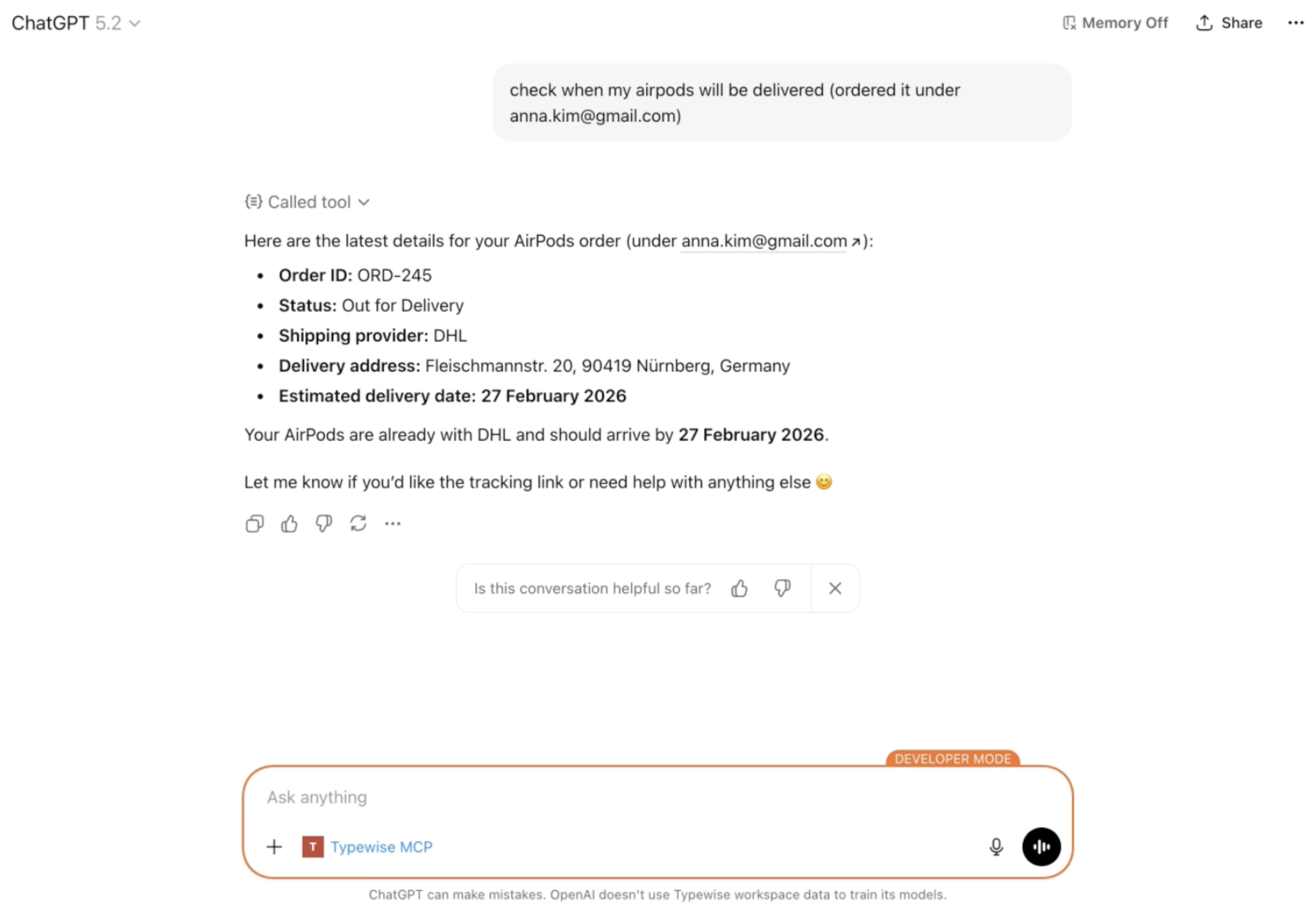
Example for MCP Integration:
The Playbook: A Five-Step Plan for Agentic Readiness
Becoming a machine-readable, agent-ready organization is a strategic transformation. Here is a five-step playbook to guide the journey.
-
Establish Your Agent-Facing Service LayerCreate a clear, efficient, and reliable channel for AI agents to interact with your business. This means moving beyond human-facing websites to machine-readable interfaces like APIs and structured text channels.
-
Implement an AI Orchestration PlatformAn agent-facing API is only the front door. Behind it, you need an intelligent layer that can route the agent’s request, connect to your backend systems (CRM, ERP), execute the transaction, and return a structured response. This is the role of an AI orchestration platform.
-
Embrace Public DiscoverabilityYour agent-facing services must be easily discoverable. This means registering them with emerging public directories like the Model Context Protocol (MCP) Registry and implementing standards like llms.txt.
-
Redesign Processes for AI, Not HumansSimply automating existing human workflows is a common pitfall. As BCG notes, leaders must “reinvent processes from scratch” for a world where AI drives outcomes .
-
Elevate the Human ConnectionWith transactional tasks handled by AI, human agents are freed up to focus on what they do best: empathy, complex problem-solving, and relationship-building.
Conclusion: The Choice Is Yours
The rise of the AI customer is the most significant structural change in the history of customer experience. The technology is ready. The customers are ready. The question is, are you?
By embracing a strategy of controlled, API-driven engagement and investing in a flexible orchestration layer, you can not only meet the demands of your new AI customers but also unlock new levels of efficiency and build a more resilient, future-proof business.