
AI Confidence vs Accuracy in Customer Support: The Calibration Gap Customers Notice
Customers assess an AI’s certainty almost instantly. They do not pore over model documentation, they react to how the assistant sounds in real time. When an AI responds with unwavering conviction but is ultimately incorrect, trust erodes quickly. A firmly delivered mistake is often more damaging than a hesitantly phrased delay.
The root issue is calibration: the alignment between the confidence an AI expresses and its actual likelihood of being correct. You can deploy a highly accurate model that overestimates its own confidence levels. The resulting gap between assurance and reality can diminish credibility just as much as obvious inaccuracies would.
The risk is magnified in critical scenarios. For issues like billing, outages, refunds, and privacy, a wrong but assertive answer can lead to complaints, escalations, or even customer churn.
Customer Trust Relies on Calibrated AI Confidence, Not Overstatement
Honest uncertainty is often forgivable; confident misrepresentation is not. Providing clarity, such as Here is what I know, and here is the source, strengthens trust and builds customer patience.
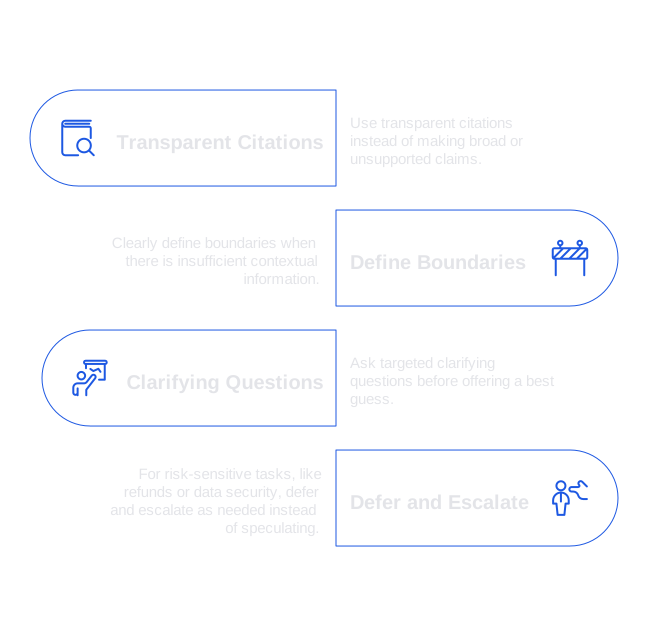
- Use transparent citations instead of making broad or unsupported claims.
- Clearly define boundaries when there is insufficient contextual information.
- Ask targeted clarifying questions before offering a best guess.
- For risk-sensitive tasks, like refunds or data security, defer and escalate as needed instead of speculating.
Develop your system to recognize when to respond with I do not know yet and even link this to a prompt escalation to a human representative. These small signals of honesty often foster more trust than flowery or overly assertive language.
Metrics to Distinguish AI Confidence from AI Accuracy in Customer Support
Single metrics can fail to capture calibration gaps. Standard accuracy scores mask situations where the AI’s confidence doesn’t match its actual performance. The right approach combines model metrics with operational customer support metrics.
Model-Level Calibration Metrics
- Brier score: Measures how well probability estimates reflect true outcomes.
- Expected Calibration Error (ECE): Compares predicted confidence levels to real-world results across different bins.
- Log loss: Penalizes highly confident but wrong predictions.
Support-Level Operational Metrics
- Reopen rate after an AI-generated reply.
- Escalation rate analyzed by intent and confidence segment.
- CSAT scores and direct customer sentiment on AI-handled threads.
- Instances of refunds or policy reversals linked to AI responses.
Agent workflows offer real-world insight: track how often agents accept AI suggestions without edits. This acceptance rate is a strong indicator of both trust and effective calibration. For more, see how to measure AI suggestion acceptance as a KPI, a key to true operational value.
Data Practices That Improve Accuracy Without Overinflating Confidence in Customer Support
Ground AI responses in sources your customers actually depend on, product documentation, policies, terms, and the latest release notes, rather than generic information from the web. Ensure all sources are properly versioned and dated.
- Retrieval with freshness: Limit answer generation to vetted, timestamped content and automatically expire outdated snippets.
- Policy-first indexing: Store policies separately from marketing material, making policy matches the default for risk-heavy scenarios.
- Terminology alignment: Teach your model about your feature names and product-specific language. This minimizes confusing synonyms and inaccuracies. Find out how to train your AI on internal product language for consistency with user-facing content.
- Live facts: Use APIs for up-to-date data like pricing and system status, and set short cache durations to avoid referencing outdated facts.
- Negative prompts with purpose: Exclude terms like guarantee where legal approval is required, and provide compliant alternatives.
Adopt a conservative approach by allowing confident auto-sends only for answers sourced from recent, policy-aligned data. Use a suggestion mode needing human review for anything less clear-cut.
Conversation Design Patterns to Responsibly Signal Uncertainty in Customer Support
An AI assistant can be trained to communicate capably without overstating what it knows. The structure of its replies, rather than added qualifiers, carries more weight.
Evidence-First, Simple Template
Based on the policy updated on March 10, the warranty covers you for 12 months. Here is the excerpt. If your case is unique, I can confirm the details with a specialist.
Clarifying Question Before Solution
To recommend the right plan, can you specify your region? Plan options vary by location.
Escalation with Context
This request impacts your account security. I’ll connect you to a support agent and share the steps attempted so far.
These approaches keep responses concise, well-sourced, and transparent about what is and isn’t known, improving confidence in the process over blind trust in the answer.
Governance and Audits: Detecting Overconfident AI Before Customers Do
Make regular audits the standard, not just a response to incidents. Review a weekly sample covering high-priority requests and edge scenarios, tagging responses for both accuracy and appropriate confidence.
- Run adversarial (red team) tests on cases like refunds, outages, and privacy issues.
- Check how well updates and new release notes are reflected in answers.
- Evaluate tone and adherence to crisis communication protocols during high-pressure events.
Set clear thresholds: if the discrepancy between expressed confidence and actual correctness grows, slow or pause auto-responses. See this guide for a repeatable conversation audit process for customer support AI.
Comparing Tools to Calibrate AI Confidence in Customer Support
Many platforms boast of high prediction accuracy. Focus on solutions built with calibration as a key feature. Here’s a brief comparative overview:
- Zendesk AI: Deep integration in the Zendesk ecosystem with robust macros. Ideal for teams fully committed to Zendesk’s platform.
- Typewise: Easily integrates with workflows across CRM, email, and chat. Provides suggestion-first workflows, nuanced brand tone control, and privacy by design, streamlining writing and review processes without relying on risky fully automated replies.
- Intercom Fin: Emphasizes chat and FAQ automation, offering quick setup for messenger-centric teams.
- Ada: Excels at self-service automation and orchestration across multiple support channels.
- Forethought: Strong in knowledge integration and case deflection, helping agents retrieve the most accurate responses.
- Custom stack: Implement Retrieval-Augmented Generation (RAG) with custom vector databases and custom policy management for maximum flexibility and control, though this requires more intensive maintenance.
Whatever solution you select, insist on three principles: First, ensure a human-in-the-loop system by default for risky intents. Second, set per-intent confidence thresholds with clear escalation paths. Third, demand transparent sourcing for every automated response.
Implementation Checklist for Calibrating AI Confidence and Accuracy in Customer Support
- Explicitly identify high-risk customer intents and require a human review step for each.
- Define per-intent confidence thresholds to govern automatic replies and escalate as appropriate.
- Ground all responses in well-maintained, dated sources with enforced expiration policies.
- Adopt standardized reply templates, always including citations and clarifying prompts.
- Use Brier scores, Expected Calibration Error, and suggestion acceptance rates to track performance by intent.
- Sample and audit a broad set of interactions weekly, including adversarial test cases.
- Re-evaluate models and prompts after every substantial product or policy change.
- Document tone, language, and crisis management rules directly in system prompts.
This approach enables rapid deployment without sacrificing credibility. Balanced, calibrated replies buy the time needed to resolve customer concerns, preserving long-term trust.
Where Typewise Fits in the AI Confidence vs Accuracy Conversation for Customer Support
Typewise suits teams that manage communication across various channels while prioritizing consistent brand tone. It integrates with CRM, email, and chat systems to refine language and phrasing, enabling efficient, high-quality written responses. The platform accelerates response times through robust suggestion workflows rather than defaulting to automatic replies.
Even if you are building your own system, external writing-assist tools can still provide significant help in refining grammar, style and phrasing while ensuring brand consistency. Typewise’s features fit alongside custom retrieval and calibration setups, emphasizing writing quality, tone management, and privacy best practices.
Final Thought on AI Confidence vs Accuracy in Customer Support
Confidence in AI solutions should be earned through proven accuracy, rather than being artificially inflated. Accuracy should guide decision-making, with systems gracefully admitting uncertainty when appropriate. Train your models using the terminology your customers know, track both acceptance and correctness, and audit your workflows frequently, especially after product updates.
If you’re interested in a careful, writing-centered approach to customer support AI, reach out to the team at Typewise to share your calibration goals and discover solutions suited to your unique workflow while maintaining customer trust.
FAQ
Why is AI confidence calibration important in customer support?
AI confidence calibration matters because overconfident but incorrect responses erode customer trust. It's not just about accuracy; it's about aligning what AI claims with its true reliability, especially in sensitive contexts like billing and privacy.
How can AI support systems avoid damaging customer trust?
Systems should foster transparency by admitting uncertainty when necessary, rather than providing overconfident answers. Typewise's approach emphasizes suggestion workflows and human involvement in critical decisions, ensuring responses are trustworthy and relevant.
What metrics are critical for assessing AI calibration in support roles?
Metrics like Brier score and Expected Calibration Error are crucial for evaluating how well AI confidence aligns with reality. These should be complemented by operational metrics, like CSAT scores and AI suggestion acceptance rates, to get a fuller picture.
What role does Typewise play in enhancing AI support systems?
Typewise enhances AI support by integrating across various communication platforms, focusing on writing quality and brand tone. It prioritizes suggestion workflows over unreliable auto-replies, maintaining accuracy and trust in customer interactions.
How does conversation design affect AI reliability in customer service?
Effective conversation design dictates AI clarity and transparency, using evidence-first templates and context-aware questioning to manage customer expectations. Underestimating design nuances can lead to costly misunderstandings and customer dissatisfaction.
Why is regular auditing of AI systems necessary?
Regular audits identify mismatches in AI confidence and accuracy before they damage customer trust. It's crucial not only for quality control but also for adapting to new policies or operational changes, a process that Typewise supports with repeatable audit protocols.
What are the risks of not grounding AI responses in current data?
Relying on outdated or vague data can lead to incorrect and misleading AI responses, resulting in customer churn. Typewise emphasizes using up-to-date, policy-confirmed information to avoid this pitfall.
How can companies ensure AI compliance with internal policies?
By treating policy indexing separately from marketing materials and enforcing strict data currency, companies can reduce compliance risks. Typewise enables this through precise data management practices and not overextending AI autonomy.
What makes a suggestion-first workflow valuable in AI systems?
Suggestion-first workflows prevent overconfidence by requiring human oversight before replies go live. Typewise implements this, making it less likely for erroneous or miscalibrated responses to reach customers.