

AI Customer Service and GDPR: A Compliance Checklist for European Teams
AI is now woven into your support inbox, chat tools, and CRM systems, but GDPR continues to shape the boundaries. Today’s customers expect responses that are not only fast and accurate, but also private. Regulators, meanwhile, demand robust evidence of your compliance. This practical checklist provides actionable steps your team can implement immediately.
Use this guide to align your legal, security, and support teams while focusing on real-world workflows, steering clear of empty promises or superficial fixes.
Map Personal Data Flows in AI Customer Service Workflows under GDPR
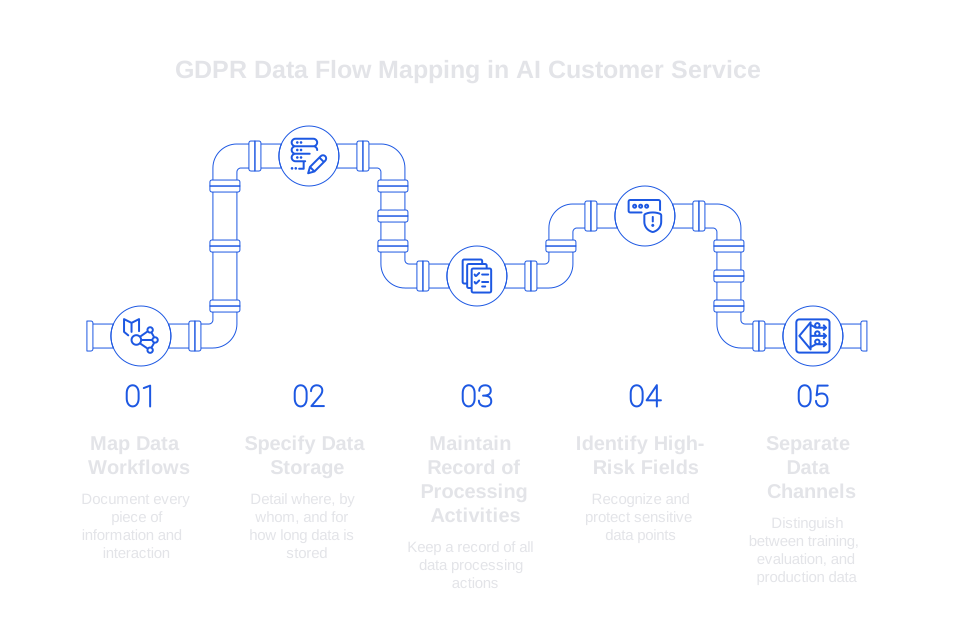
Begin with an exact map of data workflows. Document every piece of information, every input, prompt, model interaction, and output. Specify where, by whom, and for how long data is stored, including usage in analytics, caches, and search indexes.
- Maintain a Record of Processing Activities for all data processing actions involved in customer support workflows.
- Identify high-risk fields such as email addresses, phone numbers, payment tokens, and IDs, and implement necessary security measures to protect these sensitive data points.
- Clearly separate training, evaluation, and production data channels.
Update this data map after vendor changes or workflow modifications. Treat it as your definitive reference document.
Select and Document Your GDPR Legal Bases for AI Customer Service
Link each customer support workflow to an appropriate legal basis. The most common options are Contract, Legitimate Interests, or Consent. Record a concise justification for each choice for future reference.
- Contract: managing support tickets for existing customers.
- Legitimate Interests: conducting quality checks, with an explicit balancing test.
- Consent: using optional transcripts or user-uploaded content for training.
Establish definitive and brief retention periods for each legal basis and document them clearly.
Manage Roles and Contracts for Controllers, Processors, and Sub-Processors in AI Customer Service
Clearly define who determines the purposes of processing (controllers) and who processes data on their behalf (processors). Ensure every processor signs a Data Processing Agreement (DPA), and maintain an updated list of all sub-processors with their change notification windows.
- Include detailed instructions covering model training and fine-tuning in all agreements.
- Require data deletion on contract termination and ensure tested data export procedures exist.
- Request information about data location, residency, and regional failover provisions.
Run DPIAs for AI Customer Service and Define Risk Mitigations
Whenever your AI solution profiles users or handles sensitive data, perform a Data Protection Impact Assessment (DPIA). Involve your Data Protection Officer (DPO) and security lead to ensure a comprehensive review. Assess and address risks such as data leakage, bias, or excessive data collection.
- Adopt pseudonymization or redaction methods before making model calls.
- Restrict prompts strictly to ticket context, never the full account dataset.
- Plan for human review in ambiguous or edge cases.
Apply Data Minimization, Anonymization, and Retention Controls in AI Customer Service
Only provide models with the minimum data necessary. Redact direct identifiers upstream, keeping AI prompts focused and concise.
When tailoring models, avoid using raw user content whenever feasible. Instead, train AI on your organization’s internal product language to ensure clear, on-brand communication without exposing customer PII to training datasets.
Establish specific data retention policies for each purpose of data usage. Promptly delete or aggregate data once its purpose is served to ensure compliance with data minimization principles. Additionally, maintain detailed logs with timestamps and job statuses to provide proof of successful data deletion when needed.
Handle Data Subject Rights for AI Customer Service with Repeatable Playbooks
Prepare procedures (playbooks) for responding to data subject requests, including requests for data access, data deletion, data rectification, data restriction, data portability, and objections to data processing. Track deadlines closely: all requests must be handled within one month. Always verify the identity of the requester before taking action.
Use AI prompts that guide safe data exports, ensuring all outputs are structured and sensitive details are redacted. For example:
system: You are a [privacy](/blog/ai-data-privacy-support)‑first support AI. Redact emails, phones, card tokens. user: Compile this customer’s ticket history by date. Include subject and resolution only.
Store records of DSAR steps, evidence, and associated timestamps. Maintain a dedicated contact channel for all data rights requests.
Address Automated Decision-Making and Profiling in AI Customer Service under GDPR Article 22
Evaluate whether your AI system makes decisions that significantly affect individuals. If it does, supply meaningful explanations of the logic used and provide a human intervention channel for users to contest these decisions.
- Record every instance where automation influences outcomes or priorities.
- Offer clear, simple explanations for any scoring or routing logic.
- Document measures and safeguards in place for compliance with Article 22 of the GDPR, including processes for human review and the right to contest automated decisions.
- Require human approval for sensitive processes, such as customer churn flags.
Secure AI Customer Service Systems with Encryption, Access Controls, and Logging
Encrypt data in transit and at rest. Implement least-privilege, role-based access controls, and rotate cryptographic keys regularly.
- Segment storage of training data from live customer ticket data.
- Ensure PII does not appear in debug logs or analytics outputs.
- Log prompt usage and user activity, including who initiated which prompt and when.
Apply verification steps before replies are sent out. See self-checking AI workflows that add verifiers to catch bad support answers for effective ways to reduce the risk of inappropriate outputs before customers receive them.
Manage Cross-Border Transfers for AI Customer Service Data and Models
Verify where data processing and storage actually take place. If any personal data leaves the EEA, implement lawful transfer mechanisms such as Standard Contractual Clauses (SCCs) and conduct Transfer Impact Assessments (TIAs). Use regional inference endpoints whenever they are offered.
- Retain PII within the EEA wherever possible.
- Prefer encryption using customer-controlled keys for any exported data.
- Document all third-party vendors and sub-processors with access to unencrypted information.
Set Up Incident Response for AI Customer Service Aligned with GDPR Timelines
Not every security incident is a data breach, but rapid triage is essential. In the event of a personal data breach, aim to notify your supervisory authority within 72 hours.
- Define, document, and clarify the roles and responsibilities of legal consultants, security personnel, and support managers in ensuring GDPR compliance in your AI customer service protocols.
- Maintain up-to-date contact lists and pre-written notification templates.
- Conduct quarterly incident response drills using realistic chat data.
Find detailed procedures in AI incident response playbooks for support teams, which will help your team manage containment, communication, and recovery during high-pressure events.
Create an Audit Trail for AI Customer Service Outputs and Prompts
Ensure every AI-generated response can be linked to its prompt, the specific model and its version, and the relevant dataset. Record all model providers and feature flags, as well as any reviewer decisions and their rationale.
Review a random sample of outputs each week, aligning reviews with both policy and quality objectives. For in-depth strategies, see how to audit AI customer support conversations using structured rubrics and evidence gathering.
Select an AI Customer Service Vendor with GDPR in Mind: A Practical Shortlist
Choose solutions that seamlessly integrate with your CRM, email, and chat platforms. Request a privacy review tailored to your support data, and prioritize vendors offering consistent, in-region inference.
- Zendesk AI: Native add-on for Zendesk, supporting ticket routing and macros.
- Typewise: Privacy-focused AI writing and workflow automation across CRM, email, and chat; offers robust brand voice control and a productivity-first approach.
- Salesforce Service Cloud Einstein: Deep CRM data context within the Salesforce ecosystem.
- Intercom Fin: Conversational AI that boosts Help Center engagement.
- Ada: Automated chatbot for handling high-frequency FAQ scenarios.
- Ultimate: Provides multilingual automation for standard support flows.
Weigh privacy features, audit capabilities, and support quality. Stay alert for vendors with restrictive contracts that obscure prompt or log access.
Your GDPR AI Customer Service Compliance Checklist You Can Start Today
- Publish a comprehensive data map and Record of Processing Activities for all support workflows.
- Assign legal bases and retention periods to each support process.
- Sign DPAs, list all sub-processors with required notice periods.
- Run DPIAs for workflows involving profiling or sensitive data.
- Apply upstream redaction and strict, purpose-limited prompt fields.
- Implement data subject rights playbooks with clear identification procedures.
- Document measures ensuring Article 22 compliance and human intervention options.
- Strengthen encryption, access controls, and monitoring for AI-related data paths.
- Manage cross-border data transfers with SCCs and thorough Transfer Impact Assessments.
- Regularly drill incident response plans to meet the 72-hour notification requirement.
- Establish comprehensive audit trails capturing prompt inputs, model versions, and reviewer comments.
- Conduct weekly objective reviews of outputs, supported by actionable rubrics.
Compliance is a moving verb. Ship changes, then prove them.
Where Typewise Fits into Your GDPR-Ready AI Customer Service Workflow
Typewise offers integration with your existing support tools, enabling rapid, accurate replies in your distinct brand voice. Prioritizing privacy and enterprise-grade controls, it eliminates the need for disruptive technology overhauls.
Enjoy AI-assisted replies, workflow checkpoints, and verification gates, helping your team consistently deliver on privacy, quality, and recordkeeping that satisfies regulators and auditors alike.
Final Thought for European Teams Building AI Customer Service with GDPR in Mind
To ensure GDPR-compliance in AI customer service, it is vital to incorporate privacy within the very core of your product, right from the prompts and workflows to your contracts. Furthermore, the organization and accessibility of evidence are key long-term strategies for maintaining compliance.
If you want an expert review of your existing workflows and data flows, the Typewise team is ready to help, start a conversation today.
FAQ
How can mapping personal data flows benefit GDPR compliance?
Mapping data flows is crucial for identifying vulnerabilities in your data handling processes and ensuring each step adheres to GDPR principles. This practice provides a definitive roadmap for responsible data management, making you better prepared for audits and legal scrutiny.
Why is it important to choose the right legal basis for AI customer service?
The chosen legal basis dictates what is lawful and what isn't in handling customer data, directly influencing compliance risks. Incorrect choices can lead to hefty fines, making a clear, justified rationale vital for each decision.
What risks do automated decision-making and profiling pose under GDPR?
Automated decision-making can infringe on individual rights if not managed properly, risking severe penalties. GDPR demands transparency and human oversight to prevent misuse of AI that can affect users significantly.
How does Typewise ensure GDPR compliance in AI customer service?
Typewise integrates seamlessly with existing systems while emphasizing privacy and providing robust control features. It helps maintain compliance by supporting data minimization, strict access controls, and proper recordkeeping tailored for regulatory satisfaction.
What are the implications of poor incident response management under GDPR?
Failing to manage incidents promptly can exacerbate breaches and invite severe sanctions, as GDPR dictates a 72-hour notification window. Preparedness with tested response plans is non-negotiable to mitigate damages and compliance risks.
Why is data minimization critical in AI customer service?
Data minimization limits the exposure and misuse of customer data, a principle central to GDPR compliance. Excessive or unnecessary data retention invites risk and possible legal challenges, making prudent data usage indispensable.
How do encryption and access controls contribute to a secure AI customer service system?
Encryption and stringent access controls protect data integrity and prevent unauthorized access, critical for maintaining GDPR compliance. Without these measures, organizations expose themselves to data breaches and regulatory penalties.
What should organizations consider when choosing an AI customer service vendor?
Organizations must prioritize GDPR-compatible vendors, focusing on privacy, audit capabilities, and transparent practices. Typewise, for example, ensures privacy without overhauls, facilitating risk management and regulatory compliance seamlessly.
How can detailed audit trails enhance GDPR compliance?
Audit trails provide a comprehensive record of data interactions, ensuring accountability and transparency in AI processes. They help mitigate compliance risks by offering evidence of responsible data handling for audits and investigations.
Why are data subject rights playbooks essential under GDPR?
Playbooks for data subject rights ensure consistent and swift responses to requests like data access and deletion. Neglecting these legal obligations can lead to complaints, investigations, and costly penalties, making preparedness essential.