

Regulated B2B customer support requires AI that respects rules and context
Your support tickets often carry risk, one misworded sentence can result in audits, fines, or client churn. In many regulated B2B markets, safety and accuracy are often given higher priority than novelty. AI should be implemented in a way that reinforces and respects strict processes, rather than causing disruption.
Consider industries like financial services, healthcare, energy, or the public sector. Here, organizations must manage sensitive data, meet rigorous SLAs, and navigate complex approval chains. The right AI solution reduces handling time, maintains consistent tone, and documents each decision point. A poorly chosen platform, on the other hand, can introduce opaque decision logic and compromise traceability, increasing operational risk.
Key selection criteria for AI customer support in regulated B2B markets
Begin by shortlisting vendors whose compliance approach aligns with your sector and jurisdiction. Rigorously test these solutions using real workflows. Apply a structured evaluation rubric that rewards control, context, and completeness.
Security and compliance checklist for AI customer support platforms
- SOC 2 Type II and ISO 27001 certifications, with up-to-date external audit reports.
- Regional data residency agreements and data processing addendums that address each jurisdiction’s requirements.
- Encryption both during data transmission and when stored, plus options to use personally-supplied encryption keys for increased security control.
- Single sign-on (SSO) support with SAML or OpenID Connect and granular, role-based access controls.
- PII redaction, enforced data loss prevention (DLP) policies, and configurable data retention windows.
- Comprehensive audit logs with exportable conversation histories for traceability.
- Clear model governance, including robust prompt controls and output filtering systems.
- Provisions for vendor security reviews and clearly outlined incident response obligations.
Language quality and domain accuracy requirements
- AI should reference trusted internal knowledge bases, avoiding default reliance on public web sources.
- Source citations should be provided for sensitive information and any policy-related references.
- Organizations need terminology control and brand tone settings, configurable for each queue or region.
- Agent assist tools should focus on improving clarity rather than adding generic embellishments.
- Test for consistently low hallucination rates, even under stress and adversarial prompts.
Complex B2B products demand deep familiarity with internal terminology. For more insights on how to handle complex language requirements without exposing sensitive data, refer to this practical framework on training AI on internal product language.
Top AI customer support solutions for regulated B2B markets
- Salesforce Service Cloud with Einstein. An excellent choice for teams embedded in Salesforce. Native records, case macros, and strong reporting simplify governance tasks. Always verify data residency, model routing, and compliance guardrails specific to your industry.
- Typewise. Agent assist for email, chat, and CRM workflows, with a privacy-first approach. Our users often find that it helps them write faster and reduce errors in complex replies. Typewise seamlessly integrates with existing systems and upholds enterprise-grade data controls.
- Microsoft Copilot for Service. Deep integration with Microsoft 365 and Dynamics. Azure’s security features offer strong support for identity, logging, and regional data governance. Always confirm your retention policies and scopes for knowledge access.
- IBM watsonx Assistant. Sophisticated dialog design and enterprise-grade governance make it ideal for scripted flows and rigorous audit trails. Ensure deployment is aligned with your organization’s data isolation needs.
- Genesys Cloud CX. Designed for contact centers with robust controls and customer journey context. Handles both voice and digital channels under a unified platform. Review support for custom models and detailed transcript handling policies.
- Kore.ai. Offers deep automation and advanced enterprise features. Effective for intent routing and structured workflow automation. Check how PII redaction and analytics export pipelines operate within your compliance boundaries.
- Zendesk with Advanced AI. Highly practical for teams relying on knowledge-centric workflows in Zendesk. Assess the effectiveness of macro suggestions and tone controls for regulated replies. Validate regional data handling and audit trail export options.
- Google Contact Center AI. Useful for voice, search, and knowledge-based use cases. Governance quality depends on your cloud configuration, validate logging scopes and data boundaries in your data lake.
- Intercom with Fin. Excels at product-led support and ticket deflection. For regulated companies, ensure escalation routes to human review are in place, and vet data sharing and retention configurations.
Managing complex B2B support tickets is fundamentally different than handling retail-style chats. Deep context, layered approvals, and contractual language prevail. For a thorough comparison, consult these AI customer support tools for complex B2B tickets and review how each option performs under pressure.
Implementation playbook to deploy AI customer support in regulated B2B markets
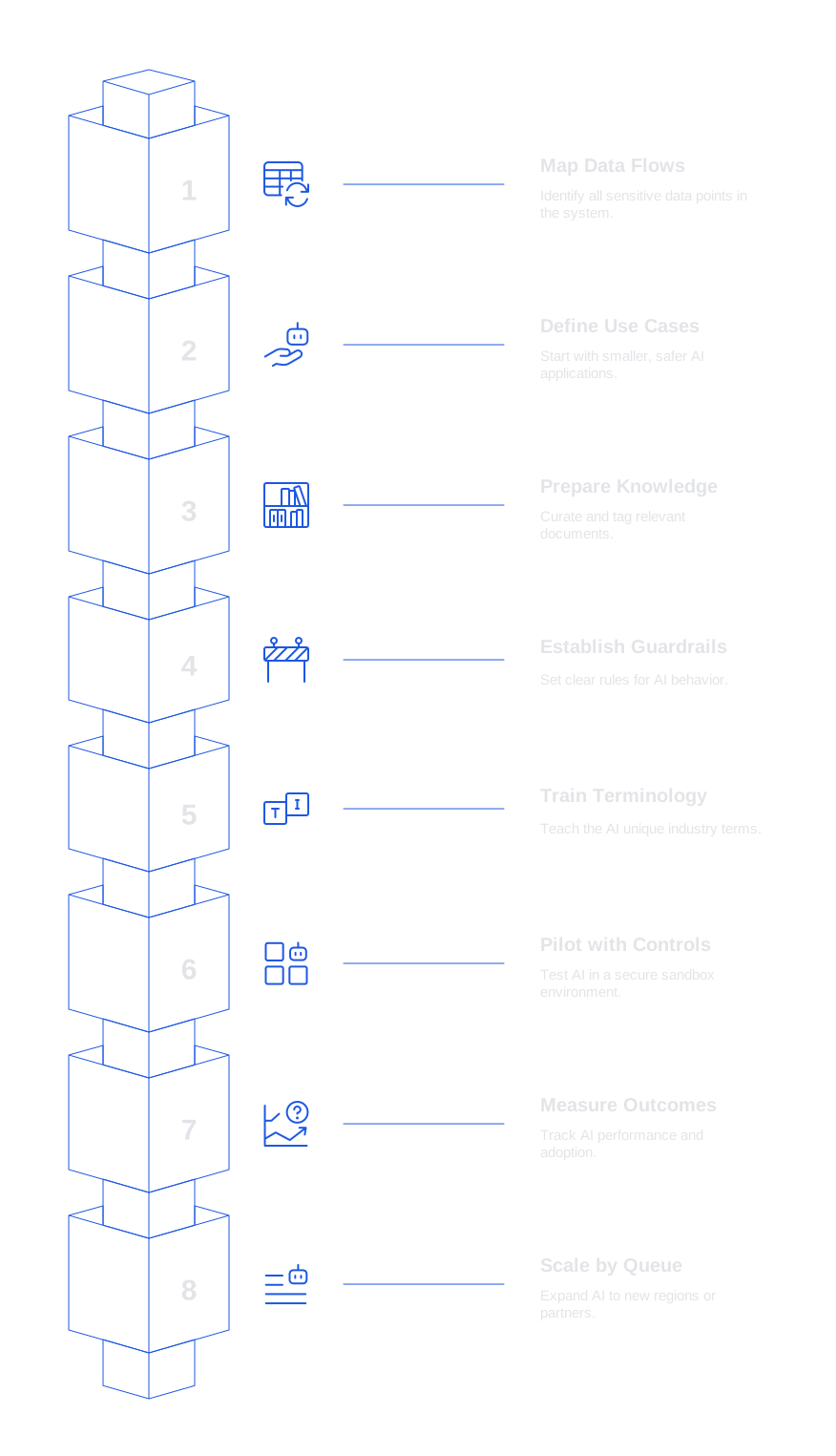
- Map sensitive data flows. Identify every point where PII, PHI, financial, or export-controlled data appears.
- Define use cases. Start small, agent assist for drafting and summarizing is often safer than full-blown automation.
- Prepare knowledge. Curate policy documents, product manuals, and contract templates, tagging all sources for future reference.
- Establish guardrails. Set clear tone rules, citation mandates, and requirements for fallback to human review.
- Train terminology. Teach the AI your unique lexicon, version controls, and deprecated terms, using minimal data access principles.
- Pilot with controls. Limit access to sandboxes, enabling strict logging and short retention periods.
- Measure outcomes. Track metrics like first response time, error rates, and agent adoption of AI suggestions.
- Scale by queue. Expand cautiously, to additional regions or partners only after audit approval.
During rollout, meticulously document every configuration and prompt template. Treat prompts like source code, complete with version controls and approval processes. Maintain a change log mapped to performance changes and audit reports.
Risk, compliance, and governance for AI customer support in regulated B2B markets
Risk is often embedded in the smallest details. A single misplaced clause can breach contracts. Reduce exposure by implementing layered controls spanning identity, context, and content management.
- Conduct a Data Protection Impact Assessment (DPIA) or similar review before moving into production.
- Restrict training data to authorized corpora, masking sensitive information wherever possible.
- Apply principles of least privilege across all knowledge, prompts, and generated content.
- Define legal hold and retention schedules by jurisdiction, adhere strictly to these for compliance.
- Design and run red team tests to catch misinformation or policy drift.
- Schedule quarterly configuration reviews, sampling transcripts and reviewing security settings.
If it is not auditable, it is not deployable, advises a leading compliance officer. Build your evidence from day one.
Audits should not be rare exceptions. Instead, set up routine sampling, scoring rubrics, and reviewer workflows. For practical tools and ready-to-use templates, learn how to audit AI customer support conversations and demonstrate robust controls to your stakeholders.
Metrics that prove value for AI customer support in regulated B2B markets
Choose measurable, defensible metrics. Focus on measures tied to risk and service quality, not just volume or speed.
- First response time: improvement in response speed without increasing risk levels.
- Average handle time: reduced drafting duration and fewer revisions required by legal teams or QA.
- Escalation rate: a decline in unnecessary handoffs due to clearer, more accurate replies.
- Suggestion acceptance rate: the frequency with which agents trust and adopt AI-generated edits.
- Deflection rate, when appropriate: tickets safely resolved without agent intervention, for low-risk issues only.
- Compliance exceptions: incidents tracked per thousand interactions to ensure ongoing adherence.
Evaluate results by individual queue, geographic region, and product line. Share anonymized transcripts that illustrate effective policy application, and maintain an up-to-date dashboard linking outcomes to configuration settings.
How to position Typewise within your regulated B2B support stack
Typewise serves as a precision writing layer for agents within CRM, email, and chat workflows. It accelerates clarity and ensures brand-aligned, compliant responses across channels, reducing both grammar and phrasing errors that often lead to risk.
Use Typewise in conjunction with your core ticketing or contact center platform. Leave your workflows and records in place, and let Typewise optimize drafting quality, tone, and consistency. This targeted setup offers measurable risk reduction and productivity gains, without the disruption of a full-system rebuild.
Final steps to select AI customer support solutions for regulated B2B markets
Pilot vendors on your toughest tickets, not only on basic use cases. Insist on comprehensive audit logs, reproducible prompt management, and enforceable guardrails. Engage legal, security, and operational leaders early to ensure alignment.
If your organization needs a pragmatic agent assist solution that honors your compliance posture, contact the Typewise team to design a focused pilot tailored to your workflow and sector.
FAQ
What is the importance of AI in regulated B2B customer support?
AI in regulated B2B support reduces operational risk by ensuring compliance with industry standards while enhancing efficiency. However, if not carefully implemented, AI can lead to costly mistakes and non-compliance issues.
How can companies ensure AI complies with sector-specific regulations?
Companies must rigorously test AI solutions against real workflows and apply a structured evaluation rubric focused on compliance and control. Collaboration with legal and compliance teams is essential to align AI tools with industry-specific needs.
Why is data security crucial in AI customer support platforms?
Inadequate data security can lead to data breaches, fines, and loss of customer trust. Implementing strong encryption, PII redaction, and role-based access controls are vital to mitigate these risks.
What role does Typewise play in regulated customer support?
Typewise acts as a precision writing layer that ensures clear, compliant communication without altering existing workflows. This approach helps reduce errors and compliance risks in B2B interactions.
What should be prioritized when selecting an AI customer support platform?
Prioritize platforms that offer robust governance, control over data privacy, and transparent audit trails. A misstep in these areas can lead to significant compliance issues and operational downtime.
How can companies measure the effectiveness of AI in customer support?
Metrics like first response time, average handle time, and suggestion acceptance rate indicate AI effectiveness. They should reflect improvements in compliance and service quality, not just speed or volume.
What are the biggest risks of poorly implemented AI in B2B support?
Poor implementation can introduce opaque decision-making and compromise data traceability, leading to compliance breaches and financial penalties. It can also undermine customer trust and negatively impact brand reputation.