


Transform Your AI Customer Support Information Sources from a Maze into a Map
Your AI can only deliver quality answers if it relies on well-organized and trustworthy information sources. Scattered, random documents lead to inconsistent and unreliable responses. By mapping your knowledge sources, you turn scattered information into reliable guidance. This guide will show you step-by-step how to build, maintain, and optimize that map for AI-driven customer support.
If the source is unclear, the answer will wander.
By following these steps, you’ll help align teams, reduce escalations, respond faster, and make content maintenance much easier across various tools and support channels.
Define AI Customer Support Information Sources with a Clear Taxonomy
Start by explicitly identifying the types of information your AI should use and trust. Collaborate to establish categories and gather examples for each. Be sure to document who is responsible for every category of information.
Important Source Categories
- Canonical product knowledge: Specifications, release notes, feature flags, API documentation.
- Policies and procedures: Refunds, warranties, SLAs, security practices.
- Customer context: CRM records, subscription status, entitlement data.
- Help center content: Articles, FAQs, tutorials, video transcripts.
- Operational signals: Incident pages, status feeds, backlog health.
- Conversation memory: Previous ticket histories, chat summaries, resolution notes.
List the actual systems used for each category. Specify formats, schemas, and required permissions. This detailed inventory will inform every decision you make later on.
Build a Source-of-Truth Hierarchy for AI Customer Support Information
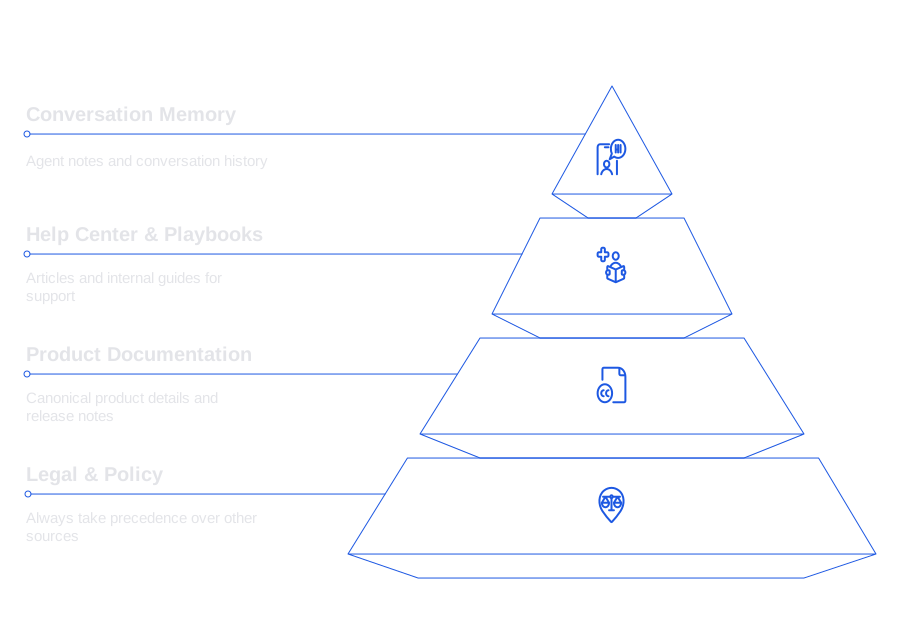
Not all information sources are equally authoritative. Your AI needs clear precedence rules in case of conflicting facts. Develop a tiered hierarchy and establish conflict resolution rules.
- Tier 0: Legal and policy documents, these always take precedence.
- Tier 1: Canonical product documentation and release notes.
- Tier 2: Help center articles and internal playbooks.
- Tier 3: Conversation memory and agent notes.
Include these rules in your metadata. Mark every information section with its tier, version, and expiry. Your AI will then be able to rank and select evidence more reliably during answer retrieval.
Map Data Flows from AI Customer Support Information Sources into Your Systems
Design exactly how each source connects to your AI systems, including update frequency, data transformations, and quality checks. Document these flows as a data lineage map.
- Ingest data using APIs, webhooks, or scheduled exports.
- Standardize formats and maintain consistent IDs during data transfers.
- Break content into structured sections, using headings and fields to define segments.
- Attach metadata: source, tier, language/locale, version, and permissions.
- Index information for retrieval-augmented generation using clear namespaces.
- Cache data carefully, setting a specific time-to-live for each source type.
Control Quality, Freshness, and Permissions Across Information Sources
Quality controls maintain trustworthiness. Freshness rules ensure timeliness. Proper permissions protect sensitive data.
- Validate all links and code samples before indexing them into your systems.
- Redact confidential information at the point of ingestion. Never index unprotected tokens or secrets.
- Version your policy documents (e.g., PDFs) and remove outdated files from active use.
- Assign clear ownership for each source category and establish service level agreements (SLAs).
- In order to ensure your AI is providing correct and useful responses, run periodic audits on retrieval and answer accuracy.
Make audits a standard practice, learn more about auditing AI customer support conversations and use your findings to improve the underlying information sources, not just the prompts.
Localize AI Customer Support Information Sources for Multilingual Audiences
Different languages add a new dimension to mapping. Plan your approach for managing localizations and translation workflows. Decide which languages are natively authored and which are translated.
- Store locale codes on every section and article.
- Use glossary-backed translations for product terminology whenever possible.
- Route customers to the best-matching language and have clear fallback options.
- Monitor content freshness by language to prevent outdated translations.
See how this strategy scales in the real world with AI-powered multilingual customer support at scale. Prioritize content sourcing and language routing at the planning stage, before selecting AI models.
Train the Language Layer to Help AI Understand Your Information Sources
Your information sources hold the facts, your language layer shapes the style and phrasing. To ensure brand consistency, share guidelines for tone and specific vocabulary with your AI systems.
- Develop a style guide that covers tone, structure, and formatting.
- Create and maintain a glossary that contains both preferred and prohibited terms.
- Offer reference answers as examples of good practice, rather than fixed scripts.
- Curate example responses for complex objections and challenging edge cases.
For step-by-step guidance, explore how to train AI on internal product language. Align the way your AI phrases answers with your well-mapped information sources.
Select Platforms That Support Effective Mapping of AI Customer Support Information Sources
Assess tools based on how well they handle data ingestion, governance, and the writing experience. Avoid platforms that lock you in with proprietary formats or rigid IDs. Opt for systems that fit into your current workflow.
- Zendesk Knowledge and AI: Widely used in service teams, offering strong ticket and macro context.
- Typewise: Embeds AI writing assistance in CRM, email, and chat tools, enabling fast, accurate, and brand-consistent writing. It’s privacy-conscious, supports enterprise needs, and works with your current knowledge structure.
- Intercom Articles and Fin: Tight integration with messenger and user-friendly content management.
- Guru: Knowledge cards with verification workflows.
- Forethought: AI-first support stack with advanced search and workflow features.
- Confluence or Notion (with connectors): Flexible content authoring with options for custom pipelines.
Document your requirements, list every connector, permission model, and governance feature before scheduling product demos. Where possible, pilot solutions using real support data rather than test sets for best results.
Measure Outcomes from Mapped AI Customer Support Information Sources with Clear KPIs
Consistent measurement is crucial for continuous improvement. Track both the quality of AI answers and their impact on operations. Connect each KPI to specific sourcing decisions.
- First response time: Assess if clear data flows are speeding up replies.
- Suggestion acceptance rate: Evaluate agent trust in AI-generated suggestions.
- Cost per resolution: Monitor to see if better information mapping is reducing escalations and costs.
- Deflection rate: Track how many customer issues are resolved by helpful articles before tickets are filed.
- Audit pass rate: Ensure periodic compliance checks confirm your governance measures are working.
- Staleness incidents: Count instances where outdated content was used in AI responses.
Review your metrics on a weekly basis. When you see outliers, trace them back to the relevant sources and data pipeline steps for targeted fixes.
Schedule a 30-Day Rollout for Mapping AI Customer Support Information Sources
Implementing a concise, well-designed plan is more effective than having a long list of unaccomplished tasks. Here’s a simple 30-day plan to help you move forward quickly:
- Week 1: Begin by compiling your information sources into an organized inventory, and assign ownership for each source, creating an ownership table so responsibilities are clear.
- Week 2: Define your tiered hierarchy and rules for resolving source conflicts.
- Week 3: Set up information ingestion, break content into sections, and apply metadata tags.
- Week 4: Audit your implementation, adjust prompts, and publish a clear playbook for your team.
Record everything in a comprehensive map, include visuals, designated owners, and SLAs. Keep this information accessible to both agents and your AI systems.
Maintain Resilient AI Customer Support Information Sources with Proactive Habits
Accurate maps require ongoing care. Treat updates to your information sources as part of your operational routine rather than an afterthought. Allocate time and responsibility to source owners for regular maintenance.
- Perform daily checks on changes to documents and reindex the differences.
- Set up content to expire automatically when new releases go live.
- Sample AI-generated answers and trace citations in every major support queue.
- Hold monthly review meetings on sources with product and support leadership.
If incidents occur, update status-related information first, then revise any macros or help articles, and finally review support conversations to capture new learnings.
Bridge the Gap Between Internal Sources and Real Customer Language
It’s important to understand the language customers use, which might differ from your internal terms. Try to find a common ground by mapping customer language to your internal sources. Enrich your glossary by including synonyms and phrasing that customers often use.
Maintain consistency across every channel. Tools like Typewise can help by sitting within your workflow to enhance grammar, style, and consistency, enabling agents to respond quickly while preserving your brand’s tone and messaging.
For more information about how to optimize your AI customer support, visit typewise.app.
FAQ
Why is organizing AI customer support information sources important?
Disorganized sources lead to inconsistent AI responses, undermining trust. By transforming scattered data into a structured map, you ensure reliable, accurate support.
What should be included in a source-of-truth hierarchy for AI support?
A successful hierarchy clarifies precedence among conflicting facts, starting with legally binding documents and descending through product and help content. Specify tiers to guide AI accurately.
How can I ensure the timeliness and accuracy of AI responses?
Regular audits and content freshness checks are critical. Outdated information leads to errors; ensure your AI's data is current and validated to maintain reliability.
How does Typewise support efficient AI customer support?
Typewise integrates AI writing assistance into your existing workflow, enhancing accuracy and brand consistency. Its robust privacy features make it ideal for maintaining trust in various support scenarios.
What is the role of localization in AI-driven support?
Localization addresses the language nuances of global audiences. Proper translations and language-specific content prevent misunderstandings and foster positive customer interactions.
How important is the language layer in AI-supported customer interactions?
The language layer shapes AI's tone and phrasing, impacting brand perception. Consistency in style and terminology is key; without it, customer communication becomes disjointed.
Why should KPIs be tied to information source decisions?
KPIs linked to sourcing decisions reveal the effectiveness of your information strategy. This connection is crucial for pinpointing inefficiencies and driving strategic improvements.