

Your AI’s Accuracy Depends on Documentation Quality: Introducing the Knowledge Freshness Index
Effective AI relies on clear, current support documentation. When your documents fall out of date or become inaccurate, the AI’s answers can decline in reliability, creating misunderstandings and confusion for your customers.
Accuracy follows freshness. Consistently align your support knowledge base with the evolving state of your product.
The Knowledge Freshness Index (KFI) provides a straightforward measure of the health of your support documentation. It evaluates how up-to-date, complete, and trustworthy your docs are. With a clear KFI, you can proactively plan updates, and prevent your AI from generating misleading or incomplete responses.
Defining the Knowledge Freshness Index for Support Docs and AI Accuracy
The KFI is a standardized score ranging from 0 to 100, calculated from several factors: how recent, correct, comprehensive, and well-used your support documentation is, as well as how consistently information is localized across languages. This score helps predict how accurate AI-generated answers will be.
Key KFI Signals and Recommended Weighting
- Recency (35%). Measures the time since the last verified update, adjusted by document type.
- Correctness (25%). Assesses open issues, flagged bugs, and edits following error resolutions.
- Coverage (20%). Evaluates how many product features and customer intents the docs address.
- Usage (10%). Tracks both AI citations and user engagement with each doc.
- Localization parity (10%). Checks whether translated versions are as up-to-date as the source documents.
Use strict scoring rules for each signal: a signal either meets the set benchmark or it doesn’t. A steadfast and unbiased scoring approach keeps your index accurate and actionable.
Adjust the rate at which scores decay based on document type, apply a faster decay for documentation covering APIs that change often, and a slower rate for more stable guides.
Reliable Data Signals Powering the Knowledge Freshness Index
- Version history: Records of edits, reviewers, and links to release changes.
- Ticket mapping: Links between customer queries, document IDs, and release features.
- AI usage: Data on which docs your assistant references when generating answers.
- Customer engagement: Page views, time-on-page metrics, and search exits.
- Quality events: Flags such as escalations, cases reopened, and corrections sourced from docs.
- Localization status: Comparing the recency of translated docs to the source, measured in days.
- Deprecations: Dates and replacements for retired documentation.
Catalog each data signal clearly, assign responsible owners, and set regular update cycles. Attach a clear Service Level Objective (SLO) to every signal.
Workflow for Keeping Support Docs Updated and AI Accurate
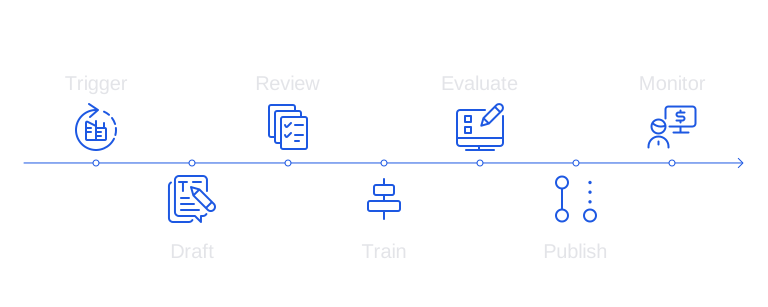
- Trigger: Events such as new releases, increased support tickets, or API changes prompt documentation updates.
- Draft: Update content to reflect the current product state and verify steps.
- Review: Pair product managers and support leads for comprehensive checks.
- Train: Align your assistant to product-specific terminology and synonyms. For detailed steps, follow this guide to training your AI on your internal product language .
- Evaluate: Conduct offline intent testing and citation reviews before publishing.
- Publish: Release the updated documentation and update relevant logs or changelogs.
- Monitor: Track KFI trends and regression warnings over the following week.
Complete the process by regularly reviewing customer conversations using a lightweight rubric and daily samples. Reference this method for auditing AI support conversations with structured criteria.
Governance: Ensuring Consistent Knowledge Freshness Across Teams
- Single owner: Assign a dedicated Knowledge Lead to manage and publish the weekly KFI.
- Definition of fresh: Clearly specify how current each document type should be.
- Quality gates: Prevent releases if essential documents do not meet standards.
- Service targets: Example: Aim for a KFI of 85+ overall and 95 on high-impact content.
- Incident playbook: Quickly flag and correct outdated or inaccurate docs within 24 hours.
- Backlog hygiene: Automatically generate tasks for any docs falling below acceptable KFI scores.
Make the KFI visible, display it on your support dashboard and product release boards.
Key Tool Features for Applying the Knowledge Freshness Index
Many existing platforms have the capacity to log versions and track document usage, but not all allow you to connect these insights directly to AI response accuracy. For maximum impact, choose a platform that ties these pieces together. Look for the following capabilities:
- Document-level metadata fields for version, owner, and scheduled next review.
- Retrieval logs showing which documents contributed to each AI response.
- APIs for exporting signals and recalculating scores frequently.
- Workflows linking documentation changes to product releases and feature flags.
- Robust privacy settings to keep customer data out of AI training datasets.
Representative Tool Examples
- Zendesk AI and Guide: Centralized knowledge management with macros and robust usage reporting.
- Typewise: In-app writing assistance for CRMs, email, and chat with robust privacy controls and customizable tone.
- Intercom Articles with Fin: Integrates the help center with messenger for AI-driven replies.
- Guru: Card-based knowledge with built-in verification workflows.
- Document360: Supports version management and structured review cycles for product teams.
For more on tools that manage unique or complex cases, see this comparison of AI support tools for B2B workflows.
Pitfalls to Avoid That Can Undermine Your Knowledge Freshness Index and AI Quality
- Overweighting recency: New information isn’t always correct. Maintain rigorous review standards.
- Neglecting low-frequency intents: Monitor low-volume topics to catch hidden issues.
- Using a single overall score: Segment KFI by product area and business impact for clarity.
- Untracked synonyms: Consistently map technical jargon to user-friendly terms in your taxonomy.
- Missing redirects: Update links whenever content moves or is archived to avoid dead ends.
- No localization standards: Freeze delivery of AI answers in languages where the source document is outdated.
Assign clearly identified owners to manage each risk. Put automated alert systems in place to provide early warnings of significant deviations.
Metrics That Show How Fresher Docs Boost AI Support Accuracy
- AI suggestion acceptance rate: As the KFI improves, agents are more likely to accept AI-generated drafts. Measure this using the AI suggestions KPI framework .
- First response time: Updated, relevant docs speed up initial response drafting.
- Containment rate: Higher quality documentation increases customer self-service resolution rates.
- Escalation rate: Outdated or missing docs cause more support cases to be escalated.
- Customer effort: Better docs reduce the back-and-forth needed for each case.
- Offline accuracy: Compare AI answer accuracy against a set of gold-standard tests and expected citations.
Track these metrics in tandem with your KFI and monitor trends over time, rather than reacting to isolated spikes.
Practical Tips for Embedding the Knowledge Freshness Index in Your AI Support Process
- Tag every doc with feature and intent identifiers.
- Use shorter review cycles for frequently-changing logs and API documentation.
- Apply longer windows for well-established setup guides.
- Store your KFI calculations in a central data warehouse and update them daily.
- Surface KFI scores directly in the agent dashboard for immediate access.
- Log which versions of docs are cited in each AI answer for accountability.
- Document your taxonomy and ensure terminology aligns with product language.
- Before AI training, make sure internal product terms are standardized, refer to this product language training guide for help.
Keep your documentation metadata streamlined and robust, a simple approach encourages consistent adoption across teams.
A Pragmatic Update Schedule for Maintaining the Knowledge Freshness Index
- Daily: Recalculate KFI based on transactional logs and update events.
- Weekly: Prioritize and address documents with the lowest KFI during regular team check-ins.
- Biweekly: Conduct offline accuracy reviews on the most important intents.
- Monthly: Audit and refresh taxonomy and synonyms with input from product teams.
- Quarterly: Revisit scoring weights and decay settings for each documentation category.
Align the rhythm of KFI maintenance with your product release schedule. Embed it into your standard workflow for efficiency and consistency.
Final Thoughts: Why the Knowledge Freshness Index Matters
The Knowledge Freshness Index offers a structured, transparent way to prioritize your documentation work and maximize your AI’s answer quality. Fewer errors and faster answers free your team to focus on solving tougher challenges.
If you’re looking for a writing assistant that adapts to your workflow and keeps your tone on-brand, we’d love to chat. See how Typewise can help you streamline KFI management and boost AI accuracy by visiting typewise.app. We’re happy to share actionable playbooks and practical strategies.
FAQ
What is the Knowledge Freshness Index (KFI)?
The Knowledge Freshness Index (KFI) is a metric ranging from 0 to 100, used to evaluate the recency, accuracy, and comprehensiveness of support documentation. High KFI scores predict more reliable AI-generated answers.
Why is documentation freshness crucial for AI accuracy?
Stale or inaccurate documentation leads to incorrect AI responses, causing customer dissatisfaction and increased support burden. Regularly updated documentation ensures that AI provides reliable and relevant information.
How can Typewise enhance KFI management?
Typewise offers tools and strategies to streamline the management of documentation freshness, ensuring AI outputs remain consistent and accurate. By integrating Typewise, organizations can maintain alignment across all documentation and AI interactions.
What are the consequences of overlooking low-frequency intents in documentation?
Neglecting documentation for low-frequency intents can lead to unexpected customer frustrations and unresolved queries. This oversight increases overall support complexity and undermines trust in automated responses.
Why should translation updates be prioritized in support documentation?
Outdated translations can mislead users and compromise AI accuracy in multilingual environments. Ensuring localization parity is vital for maintaining AI consistency across different languages and regions.
What are the risks of overemphasizing documentation recency?
While recency is important, prioritizing it too heavily can sideline legacy knowledge that's still relevant. A balanced approach ensures both current and foundational knowledge are accurately represented.
How does KFI impact the first response time in support scenarios?
A higher KFI, reflecting fresher and more accurate documentation, shortens the drafting process for initial responses, leading to quicker customer service and elevated support efficiency.
What role do metrics like escalation rate play in assessing documentation quality?
Metrics such as escalation rate reveal the effectiveness of documentation in resolving issues at the first level. Frequent escalations indicate gaps in knowledge coverage, reflecting poorly on the documentation's clarity and comprehensiveness.