
Billing and Refund Requests: The Ultimate Test for AI Customer Support Platforms
Billing inquiries strike at the core of revenue, trust, and compliance. Refund requests typically come with urgency and strong emotions. These situations reveal how adeptly your AI understands policy, language, and complex context. A single miscommunication in these moments can erode customer loyalty and affect the bottom line, while an accurate and timely response can build credibility and save valuable time.
Success often relies on key functions, including the tool’s ability to identify intent, reference policy, and act within predefined boundaries. Leading AI platforms integrate these elements into seamless workflows so that agents only need to confirm outcomes rather than rewrite exhaustive replies.
- AI intelligently classifies issues such as duplicate charges, requests for a refund within the policy window, or VAT invoice concerns.
- It references and displays the relevant policy or rule, citing the precise source.
- It drafts a suitable reply and initiates the approved workflow.
While considering various options, prioritize features like billing fluency, safe automation, and clear auditing, together with other functionalities tailored to your unique business needs.
Evaluation Criteria for Choosing AI Customer Support Platforms for Billing and Refund Requests
- Intent depth specific to billing. Choose tools that can discern nuanced scenarios such as partial refunds after an upgrade or disputes involving currency conversion.
- Policy grounding. Platforms should retrieve information from your internal policy hub or price books to ensure answers are accurate, consistent, and verifiable.
- Language fit. Train your AI to understand your brand tone, product terminology, and required legal phrasing. Start with a plan to train AI on your internal product language .
- Workflow integration. Opt for solutions that connect seamlessly to CRM, email, and chat systems, enable refunds via approval workflows, and log every step securely.
- Data protection. Ensure sensitive information, such as PAN, CVV, and bank data, is masked and that the platform meets SOC 2, ISO 27001, GDPR, and PCI standards.
- Auditability. Maintain a complete trace of sources, prompts, and actions. Routinely audit AI customer support conversations and keep scheduled reviews.
- Human handover. The ability to escalate cases rapidly for ambiguous or risky payment situations, maintaining full customer context, is crucial.
- Latency and uptime. Timely handling is essential. Track real-time response speeds instead of relying on broad averages.
- Cost model clarity. Be clear on licensing, usage, and automation limitations before implementation.
- Measurable speed gains. Monitor metrics like time to first reply and resolution. Explore ways to improve first response time with AI .
Predicting Top AI Customer Support Platforms for Handling Billing and Refund Requests
- Zendesk with generative AI
- Where it fits: Established ticketing teams leveraging macros and automated triggers.
- Strengths: Centralized ticket history and smart routing. Effective AI-generated suggestions within agent consoles.
- Watchouts: Advanced billing flows may require custom app development or significant administrative setup.
- Typewise
- Where it fits: Teams seeking advanced writing assistance integrated into existing tools.
- Strengths: Creates concise, on-brand replies for billing and refunds. Offers fast phrasing, grammar, and tone adjustment. Supports CRM, email, and chat integrations. Emphasizes privacy, meeting strict enterprise requirements.
- Watchouts: Optimal performance achieved after targeted policy training and robust guardrail configuration.
- Intercom with Fin
- Where it fits: Chat-first teams or those prioritizing web and in-app messaging.
- Strengths: Strong at conversational flows and intent-based routing. Efficient for providing quick updates on refund status.
- Watchouts: Multistep approval processes may require frequent agent intervention.
- Salesforce Service Cloud with Einstein
- Where it fits: Large enterprises deeply integrating CRM objects with billing processes.
- Strengths: Leverages extensive context from account, contract, and billing data. Superior security and governance capabilities.
- Watchouts: Excessive configuration complexity can hinder rapid iterations and adoption across multiple teams.
- Freshdesk with Freddy AI
- Where it fits: Cost-conscious teams seeking automation without sacrificing usability.
- Strengths: Simple interface and practical automated reply suggestions. Provides effective templates for common billing issues.
- Watchouts: Processing unique refund logic may require supplementary workflows outside the core platform.
- Ada
- Where it fits: Businesses aiming to maximize self-service and automate common support questions.
- Strengths: Offers guided processes for handling refunds and cancellations. Strong multilingual functionality.
- Watchouts: The depth of agent assistance can vary depending on the tech stack.
- Forethought
- Where it fits: Organizations valuing rapid information retrieval and enhanced agent support.
- Strengths: Swiftly locates the correct policy reference. Well-suited for complex billing escalations.
- Watchouts: Advanced refund processing typically relies on integrations with external systems.
These solutions collectively cover most business needs, but your platform shortlist should reflect your data sensitivity, refund workflow complexity, and current tech stack.
Best Practices for Automating Billing and Refund Requests with AI Customer Support Platforms
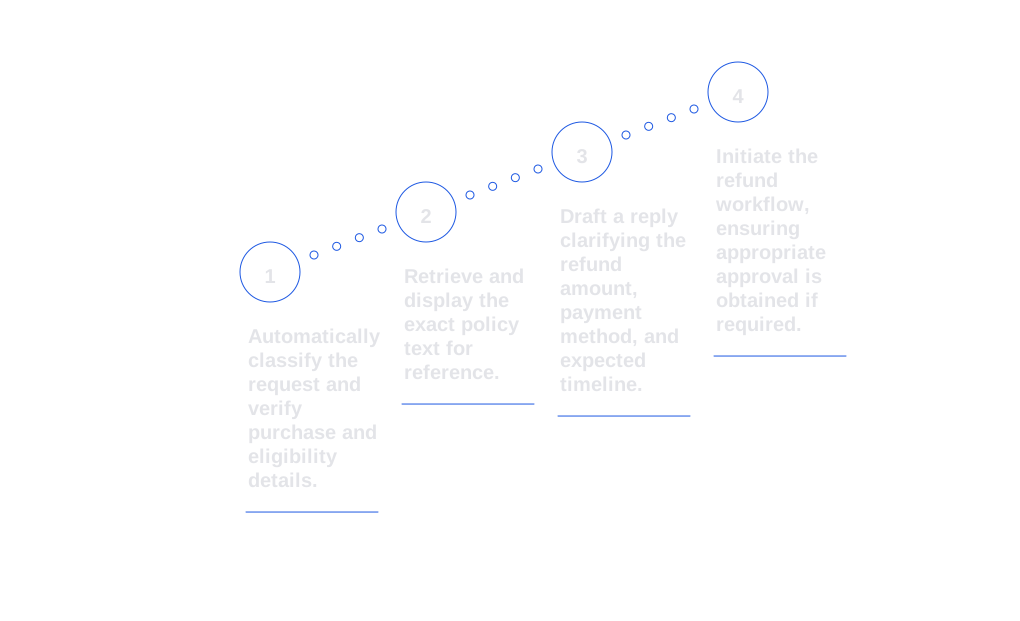
Refund Within Policy Window
- Automatically classify the request and verify purchase and eligibility details.
- Retrieve and display the exact policy text for reference.
- Draft a reply clarifying the refund amount, payment method, and expected timeline.
- Initiate the refund workflow, ensuring appropriate approval is obtained if required.
Partial Refund Following Plan Changes
- Calculate and explain prorated amounts based on the customer’s billing cycle.
- Present the calculations in clear, accessible terms with full transparency.
- If policy prefers, offer a credit instead of a cash refund where applicable.
Investigation of Duplicate Charges
- Validate using non-sensitive identifiers such as email, order ID, and last four digits of payment cards.
- Summarize findings and outline the next steps without disclosing sensitive details.
- Escalate cases to payment operations if there are risk indicators.
Tax Invoice or Receipt Correction
- Collect necessary information (e.g., legal entity, VAT/GST fields) to regenerate the invoice.
- Issue the corrected document and transmit it securely to the customer.
- Log the correction in the system to maintain compliance records.
Typically, if a request meets a company’s refund policy, it is processed within five business days, with processing confirmation sent via email upon completion.
Keep communication templates concise. Directly cite and link to the relevant rules or notes in your internal system. Aim for agents to review and approve with a single click.
Implementation Checklist and Key Metrics for AI-Driven Billing and Refund Workflows
- Guardrails: Define permitted, escalated, and prohibited actions for processing refunds and credits.
- Redaction: Automatically mask all sensitive fields in customer and system logs.
- Source of Truth: Ensure policy retrieval targets your latest documentation, price books, and regional compliance rules.
- Approvals: Mandate manager signoff for significant or unusual refund amounts.
- Fallbacks: Route out-of-policy or edge case requests to senior agents for review.
- Localization: Adapt responses to feature local currencies, language, and tax terminology as needed.
- Testing: Run simulations on past billing tickets to validate the workflow before full rollout.
Measure What Matters
- First response time for all billing-related support tickets.
- Full resolution time and frequency of ticket reopens.
- Precision of refunds versus number of corrections needed.
- Rate of successful self-service resolution for refund status checks.
- Total cost per resolved billing case.
- Frequency with which agents accept or edit AI-generated replies.
- Number of compliance or policy breaches per 1,000 billing tickets.
Institute regular weekly reviews. Analyze sample interactions. Compare initial AI-generated replies to those ultimately sent to customers. Use these insights to refine prompts, improve retrieval accuracy, and optimize workflow integration.
Final Thoughts on Selecting an AI Customer Support Platform for Billing and Refund Requests
Accuracy is key when dealing with billing and refunds, rather than extravagant features or presentation. Select a solution that is fluent in your policy language, integrates cleanly with your established workflows, and ensures clear, traceable audit trails. Zendesk, Intercom, Salesforce, Freshdesk, Ada, and Forethought each excel in different areas of this landscape. Typewise is a good fit for teams looking for advanced writing assistance and high standards of privacy within their current arsenal of tools.
For organizations seeking more consistent billing responses and fewer escalations, a targeted, phased implementation is advisable. Start by automating a single refund process, and iterate based on real data. If you’d benefit from a hands-on demonstration, reach out to the team at Typewise. Discover how Typewise integrates into your customer support workflow.
FAQ
What are the key capabilities an AI platform should have for billing and refund requests?
An AI platform should precisely identify customer intent, be fluent in policy interpretation, and integrate seamlessly into existing workflows. Without these foundational skills, even the flashiest AI tools will falter when processing financial inquiries.
Why is policy grounding essential for AI customer support?
Policy grounding ensures AI responses are accurate and consistent by sourcing answers from internal policy documents. Without it, expect errors and inconsistencies that erode trust and expose liability risks.
How does Typewise specifically support AI-driven billing inquiries?
Typewise excels in generating concise, on-brand responses and integrates smoothly with CRM, email, and chat tools. It offers superior privacy controls, making it a solid choice for handling sensitive billing data responsibly.
What should companies prioritize when considering AI solutions for billing support?
Focus on tools that offer billing fluency, automation within safe boundaries, and robust audit features. Without these, your solution risks missteps that can cost you customer trust and regulatory compliance.
How can AI improve first response time in billing inquiries?
AI platforms, like Typewise, can draft immediate responses and automate initial workflow steps, slashing the time to first contact. However, poor setup or inadequate training will negate these benefits, leading to slower resolution times.
What are the potential pitfalls of AI customer support platforms?
Over-reliance on AI without clear human escalation paths can leave complex issues unresolved. Additionally, lack of adequate privacy measures and policy alignment invites compliance breaches, damaging credibility.
How significant is the human handover capability in an AI customer support platform?
Human handover is crucial for ambiguous or high-risk billing cases, ensuring complete context transfers for effective resolution. Ignoring this can lead to dissatisfied customers and unresolved disputes.
What risks are associated with AI in billing and refund processes?
Miscommunication due to inadequate AI training or poor policy grounding can lead to costly errors and loss of customer trust. Robust safeguards and constant audits are non-negotiable to mitigate these risks.
Why is auditability important in AI-driven customer support platforms?
Auditability provides transparency and traceability of AI actions, essential for maintaining compliance and trust. Lack of audit systems can leave companies vulnerable to unchecked errors and regulatory challenges.
How does cost model clarity affect the selection of AI platforms?
A vague cost model breeds financial unpredictability and hinders effective budgeting. Clarity on licensing and usage limits helps avoid hidden costs that surprise businesses post-implementation.