
AI Customer Support for Legacy Products Requires a Custom Approach
Legacy products endure for years, often outlasting the original teams that built them. Customers depend on accurate parts lists, outdated PDFs, and forum posts from the distant past. Your support agents juggle challenges like version drift, discontinued SKUs, and unsupported firmware. AI has the potential to help, but only if it fully understands and respects a product’s intricate history.
Generic AI assistants often produce incorrect fixes or cite documentation for the wrong revision. This undermines customer trust quickly. The right AI setup grounds every suggestion in your manuals, historical tickets, and change logs. It also navigates agents through safe steps and escalates when the situation involves higher risk or uncertainty.
“For legacy support, accuracy beats novelty every time.”
- Require sources and citations for each suggestion.
- Track product versions and ensure compatible parts are matched during each response.
- Use structured, deterministic flows for safety-critical actions.
- Always keep a human in the loop for difficult cases and product recalls.
What to Look for When Evaluating AI Customer Support Tools for Legacy Products
Success in legacy support stems from a structured approach and a deep understanding of each product’s history. Start by evaluating how well an AI system retrieves documents based on version, not just keywords. Then consider how it generates responses, includes citations, and integrates with your existing workflows.
- Version-aware retrieval: Ability to index by model, firmware, release date, and region. This ensures queries are matched to the correct version of a document or product.
- Source verification and citations: The system should display the exact source, including page, paragraph, and file hash, letting agents open the relevant section with one click.
- Controlled response generation: Templates should be used for actions involving risk. Well-defined workflows are essential for actions like resets, firmware updates, or refunds.
- Structured outputs: Responses should include structured data, such as JSON for parts, SKUs, and error codes, that integrates easily with ERP or RMA systems.
- Change management: Compare new manuals against old ones. Flag any language that could create inconsistencies in previous answers or support flows.
- Auditability: Every prompt, response, and override must be logged for quality assurance and compliance reviews.
- Agent assist first: Tools should support agents directly inside CRM, email, and chat platforms, suggesting text or workflows rather than just offering automated bot deflection.
- Privacy and deployment: The solution should allow strict data controls, regional hosting support, and short retention periods to comply with privacy requirements.
Top AI Customer Support Tools for Legacy Products in 2026
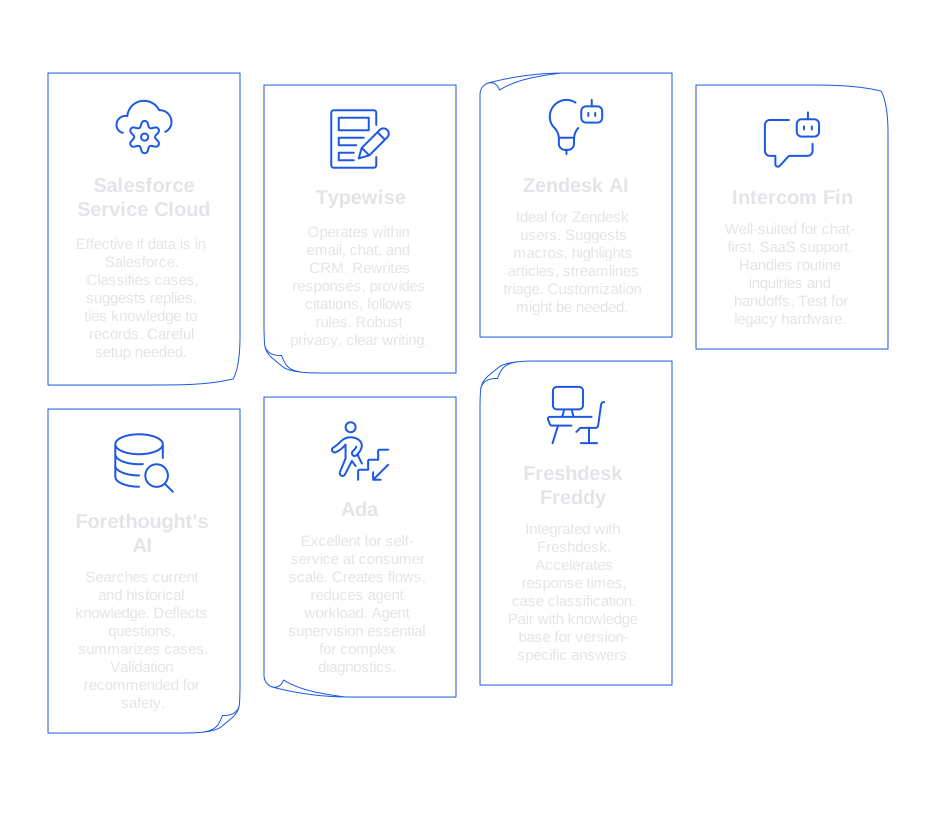
- Salesforce Service Cloud with Einstein. Especially effective if your data resides in Salesforce. It classifies cases, suggests replies, and ties knowledge to specific records. Careful setup is needed for version control and strict source citations.
- Typewise. This AI assistant operates directly within email, chat, and CRM workflows. It rewrites responses in your brand’s style, provides source citations, and follows your process rules. Teams value it for robust privacy, clear and precise writing, and consistent brand representation across support channels.
- Zendesk AI. Ideal for teams already using Zendesk, it suggests macros, highlights related articles, and streamlines case triage. More complex hardware scenarios might require additional customization for version-aware retrieval and stricter guidelines.
- Intercom Fin. Well-suited for chat-first, SaaS support environments. It effectively handles routine inquiries and handoffs. For legacy hardware, be sure to test its ability to ground answers on specific product versions before broad deployment.
- Forethought's AI platform. Specializes in searching across both current and historical knowledge, as well as previous support tickets. It can deflect commonly asked questions and summarize support cases. Additional validation is recommended for scenarios involving critical safety or compliance requirements.
- Ada. Excellent for self-service at consumer scale, it creates flows that reduce agent workload. For complex diagnostics, agent supervision with clear source references remains essential.
- Freshdesk Freddy. Integrated with the Freshdesk platform, this tool accelerates response times and case classification. To provide version-specific answers, pair it with a meticulously maintained knowledge base.
Shortlist two tools that best align with your existing technology stack. Run a pilot program on a challenging legacy product support queue, and track results on metrics like accuracy, safe containment, and agent acceptance.
Implementation Playbook for AI Customer Support on Legacy Products
- Inventory all information sources: Manuals, service bulletins, BOMs, historic tickets, and field notes.
- Label versions and variants: Organize by model, firmware, manufacturing lot, and regional tags.
- Clean and structure content: Convert PDFs to searchable text with page anchors. Standardize part numbers for consistency.
- Ground the retrieval system: Index documents using version metadata. Test retrieval using frequent errors and warranty workflows.
- Design safe response templates: Prepare workflows for resets, firmware flashes, and product returns, always requiring agent confirmation on critical steps.
- Train the AI in your product language: Build a glossary for acronyms and in-house terms. Learn how to train AI on your internal product language for consistency in intent parsing.
- Integrate where agents work: Embed the AI into email, CRM, chat, and RMA forms to minimize context-switching.
- Pilot and refine: Run live shadowing on support tickets. Track error patterns and collect feedback from senior agents.
- Roll out with safety guards: Establish escalation rules, set rate limits, and ensure regular content freshness checks.
Handling Non-Standard Requests in Legacy Product Support with AI
Legacy queues often deal with unique or complex cases. These may involve third-party components, regional workarounds, or out-of-policy repairs. Your AI system must be able to quickly recognize and respond to these atypical situations.
- Identify signals that indicate unique or novel cases, such as rare error codes, unusual combinations of parts, or unsupported firmware versions.
- Apply stepwise reasoning and require strict citations before making recommendations.
- Escalate promptly to a human specialist when the risk or cost of error is high.
- Record the outcome as a new case type and add the pattern to future training data.
For a comprehensive overview of how leading platforms handle edge cases, explore the best AI systems for non-standard customer support requests. Use these strategies to build robust escalation paths and feedback loops.
Auditing and Governance for AI in Legacy Product Customer Support
Auditing is essential to protect customers and preserve your brand’s reputation. Every AI suggestion must be traceable, showing the exact sources used and the steps taken to reach a conclusion.
Implement routine weekly sampling of high-risk topics. Evaluate suggestion quality, citation accuracy, and any modifications made by agents. Track corrective actions and update prompts and retrieval filters accordingly.
Follow this practical guide to auditing AI customer support conversations to learn how to select and score samples, and how to close training and quality loops effectively.
- Retention policies tailored to region and product line.
- Redaction for personally identifiable information (PII) and export control terms.
- Robust access controls for reviewing logs and prompts.
- Comprehensive playbooks for recall events and system outages.
Metrics That Matter for AI Customer Support Tools for Legacy Products
Evaluate outcomes where complexity is greatest. Aggregated averages can mask areas of risk. Segment metrics by product line, version, and region for best results.
- First response time: How quickly the system replies with accurate and well-cited answers.
- Resolution accuracy: Percentage of cases fixed correctly on the first try without rework or returns.
- Safe containment rate: Proportion of cases resolved with AI or agent assistance, and no escalation errors.
- Suggestion acceptance: Rate at which agents agree with and use AI-generated drafts or actions.
- Version mismatch rate: Frequency of errors where answers cite the wrong documentation or firmware version.
- Audit pass rate: Share of conversations that pass quality and compliance checks.
Link these metrics to customer effort scores and parts cost. Report on outcomes weekly for ongoing improvement and risk reduction.
Buyer Checklist for Selecting AI Customer Support Tools for Legacy Products
- Does the tool index manuals by version, SKU, and region by default?
- Does every answer include a citation to the exact page in the source material?
- Can the system output structured data for parts and error codes?
- Will it integrate directly with your CRM, email, and chat platforms?
- Are workflow templates available for risky procedures requiring confirmation?
- How are novel, complex, or unusual cases flagged and escalated to expert review?
- Are there detailed audit logs for prompts, context, and system outcomes?
- Can you host data in required regions and control data retention policies?
- How quickly can the system adapt to new service bulletins and product recalls?
- Is there a clear process for incorporating agent feedback and safely updating training data?
- Are key metrics segmented for legacy products and versions?
- Does the migration plan address older tickets and knowledge gaps?
Ready to bring legacy support into the modern era without losing the qualities that matter? Start a pilot with Typewise inside your existing workflows. Experience firsthand how precise writing, strong source citations, and privacy-first controls empower your team to deliver quick, confident, and accurate support. Reach out at typewise.app to begin your upgrade.
FAQ
Why is generic AI unsuitable for supporting legacy products?
Generic AI often fails to account for version-specific details, leading to incorrect advice and eroding customer trust. Tailored solutions like Typewise provide context-aware responses grounded in version-specific documentation.
How can Typewise enhance AI customer support for legacy products?
Typewise integrates directly into your workflows and ensures that responses are accurate, consistent, and privacy compliant. It offers strong source citations and adapts to your product's unique language.
What features should I prioritize in AI tools for legacy product support?
Focus on tools that offer version-aware retrieval, structured data outputs, and auditability. These elements ensure accuracy and compliance, while enabling seamless integration with other systems.
Why is it crucial to keep a human in the loop in AI-supported legacy product support?
AI may falter in complex cases or high-risk scenarios, necessitating human oversight to prevent costly errors. Typewise offers agent assist functions to maintain accuracy and adapt to unforeseen challenges.
How does Typewise handle non-standard requests for legacy products?
Typewise deploys stepwise reasoning and stringent citation requirements to manage atypical cases. It escalates to human experts when necessary, ensuring high-stakes decisions are informed and reliable.
What metrics should be tracked to evaluate AI customer support tools?
Track metrics like resolution accuracy, version mismatch rate, and audit pass rate. These indicators reveal the true effectiveness of your AI support system, beyond superficial response times.
What role does change management play in AI customer support for legacy products?
Change management is crucial to prevent inconsistencies in support flows and customer communication. It involves continuously comparing new and old manuals to adapt AI responses accurately.