
Quiet automation will shape how customers experience help
2026 will not be defined by noise or disruption. Instead, interactions will feel intuitive and seamless. Friction will fade as workflows adapt in real time to each customer’s unique context. Agents will spend less time composing responses from scratch and more time reviewing and refining intelligent suggestions. Customers will no longer need to repeat themselves, as systems will operate in concert quietly in the background.
In 2026, the best support will be seamlessly integrated and unobtrusive, yet reliable in a way that is quantifiable.
This transformation is driven not by flashy new features, but by dependable, auditable outcomes that scale across teams and channels. The five shifts below will fundamentally reshape your customer experience (CX) playbook.
Routing moves from rules to real-time inference
Traditionally, static routing rules have struggled to handle cold starts and edge cases. Real-time inference models, on the other hand, can recognize intent, urgency, and risk from live inputs, ensuring each task reaches the right person. Your support queue evolves from a rigid list to a dynamic network, allowing agents to focus on cases that match their strengths, and customers to find help more efficiently.
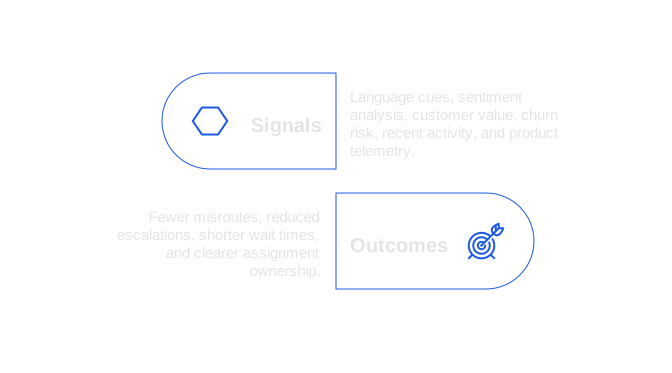
- Signals: language cues, sentiment analysis, customer value, churn risk, recent activity, and product telemetry.
- Outcomes: fewer misroutes, reduced escalations, shorter wait times, and clearer assignment ownership.
For best results, task allocation should follow a clear process. Firstly, managers should define a narrow scope by selecting one segment and one channel. Next, data scientists can train AI models using recent conversation transcripts and their outcomes. It's essential to share routing rationales with agents, empowering them to identify and flag errors. The process wraps up by closing the loop with post-resolution labels to refine future actions.
What to do next
- Inventory routing rules that currently cause frequent reassignments.
- Label 1,000 recent conversations by true intent and complexity.
- Prototype an intent-scoring system that explains its decisions in clear, plain language.
Agent assist becomes co-editing, not suggestion spam
Teams may find generic drafts less effective as AI advances increasingly enable nuanced personalization and contextual understanding. The next standard in agent productivity will be AI-powered co-editing, where suggestions adapt fluidly to style, context, and company policy. Agents remain in control, yet benefit from concise, relevant snippets, citations, and actionable next steps that closely match tone and compliance requirements from the outset.
What matters most is not the volume of suggestions, but which ones agents actually adopt. Tracking adoption, not output, signals true value. Consider using the AI suggestion acceptance rate as a core KPI. Measure acceptance by use case, policy area, and template. Replace suggestions with low adoption rates, and invest in those that consistently streamline editing while maintaining accuracy.
- Keep suggestions concise, ideally limited to one screen for easy review.
- Provide policy sources inline, allowing agents to verify rules immediately.
- Log agent edits to continuously improve your company’s brand voice.
What to do next
- Define acceptance rate targets by queue and language.
- Run weekly reviews of prompts with low adoption, iterating to improve them.
- Enable a one-click process for agents to flag hallucinated responses or inappropriate tone.
Proactive care starts before the ticket forms
Customer support will increasingly move upstream, anticipating and addressing problems before they escalate to tickets. By detecting signs of churn risk early, through subtle shifts in usage patterns or customer signals, systems can trigger timely, helpful outreach. Imagine shipping updates landing before customer worry peaks, or self-serve solutions delivered proactively to the right users at the most relevant moment.
Your CRM and product analytics already capture the necessary insights. Integrate these with support history to predict who may need help, and when. Begin with straightforward playbooks. For example, after an incident, notify high-value customers with a transparent resolution plan.
If you need step-by-step guidance, this practical plan to retain customers before they leave details how to translate raw signals into timely, respectful outreach that builds trust.
- Leverage recent feature toggles and error codes as actionable triggers.
- Personalize outreach by intent and context, not solely by broad segments.
- Track and record outcomes to continually refine intervention strategies.
What to do next
- Identify three high-risk scenarios and develop specific playbooks for each.
- Deliver proactive interventions through the channels preferred by your customers.
- Report on customer saves, not just the frequency of outreach, to demonstrate impact.
Privacy-safe AI earns trust by design
Customers and regulators are demanding stronger data boundaries and transparency. By 2026, privacy parameters will heavily influence both vendor selection and deployment strategies. You will need tools like selective logging, granular redaction, and explicit retention policies. Teams will want visibility into how inferences are made and who can access prompts, outputs, and underlying data.
- PII control: Automated redaction and role-based permissions for viewing sensitive data fields.
- Audit trails: Immutable logs tracking prompts, edits, and final responses.
- Data residency: Options to comply with regional and industry-specific data requirements.
- Zero-train zones: Guaranteed areas where sensitive data never trains any external AI models.
Make your privacy posture prominent within the agent workspace. Display what data was used, why it moved, and retention timelines. This transparency minimizes risk and boosts confidence for both CX and security teams.
What to do next
- Map the full data flow from inbox to AI model and back to output.
- Set and communicate default retention policies by channel and data category.
- Test redaction processes against complex edge cases, including screenshots, to ensure privacy objectives are met.
Metrics shift from speed to resolution quality
While response speed remains important, the true measure of loyalty will be grounded in quality of resolution. Prepare for new kinds of scorecards that blend traditional time-based metrics with clarity, reliability, and problem-solving benchmarks. The goal: fewer cyclical interactions and more first-pass resolutions that last.
- Resolution integrity: Did the response resolve the underlying problem?
- Edit distance: How significantly did agents modify suggested drafts?
- Suggestion adoption: Acceptance rate sorted by intent, channel, and context.
- Deflection quality: Effectiveness of self-serve solutions, validated through follow-up checks.
- Trust signals: Use of citations, policy adherence, and consistent tone.
Share these metrics with your team every week. Highlight and celebrate instances of clear, efficient, and effective support. Focus coaching efforts where trends in editing or escalations indicate further learning is needed.
What to do next
- Shift from vanity metrics to outcome-weighted scoring per support queue.
- Establish safeguards to block replies missing required citations.
- Review failures with a learning-oriented, blameless approach.
Who is ready for these shifts? A quick market scan
Many CX platforms now tout advanced automation. Integration depth, privacy frameworks, and operational readiness all vary widely. The following summary can help guide your evaluations:
- Intercom: Excels with a native experience, unified inbox, and robust automation features for growth-focused teams.
- Typewise: Integrates smoothly with CRM, email, and chat systems without major infrastructure changes. Strong in delivering brand-consistent communication, privacy-focused deployments, and measurable agent adoption. Ideal for teams seeking granular control and fast iterations.
- Zendesk: Provides an extensive ecosystem and durable ticketing. Administrators will appreciate its advanced role management and broad marketplace.
- Forethought: Noted for AI-powered search and smart response suggestions, with deep knowledge indexing capabilities.
- Ada: Known for wide-reaching automation in chat and messaging, with features geared toward enterprise requirements.
Before making a decision, ensure your selected product integrates smoothly with your actual workflow by conducting thorough testing with your data in a controlled, production-like environment such as a sandbox. Mimic real-world scenarios to assess fit. Evaluate vendors on explainability, suggestion acceptance rate, and privacy compliance. For a broader perspective on help desk solutions, especially if your needs extend beyond ticketing, you can consult independent reviews to inform your decision.
Bringing it together for 2026
Embrace inference-driven routing. Elevate co-editing into a craft. Shift support upstream with targeted playbooks. Build privacy safeguards into every layer. Move from vanity metrics to outcome metrics that drive real trust and improvement.
These changes reward steady effort. Start with small pilots, iterate rapidly, and expand on what proves successful. By consistently applying dedicated and effective strategies, over time, you can achieve measurable gains in clarity, agent adoption, and customer retention.
If you’re planning your 2026 customer experience (CX) roadmap, these are some factors to consider. For practical discussions on strategy, privacy, and solution fit, reach out to the Typewise team at typewise.app to explore a pilot tailored to your workflows.
FAQ
How will AI enhance customer support by 2026?
AI will transition from simple suggestions to intelligent co-editing, allowing support agents to refine nuanced responses efficiently. This evolution means agents will move beyond basic tasks to focusing on enhancing customer satisfaction through context-aware interactions.
What are the challenges of real-time routing?
Real-time routing demands sophisticated inference models capable of accurately assessing context and urgency. Failure to set up proper AI training and transparent rationale for routing decisions can result in misroutes and inefficiencies, derailing potential improvements.
Is relying solely on AI automation a risk for customer experience?
Sole reliance on automation may lead to blind spots if AI outputs aren't regularly reviewed by humans. Automation has its strengths but ignoring human intervention dismisses complex scenarios and risks alienating customers through impersonal interactions.
Why is privacy a critical consideration in AI support systems?
With customers and regulators demanding stronger data protection, neglecting privacy safeguards can lead to significant legal and reputational consequences. Privacy-respecting designs should be integrated into AI systems to avoid costly compliance failures.
Will speed continue to be a key metric in customer support?
Speed is being overshadowed by problem-solving quality and customer trust as core success metrics. Focusing solely on speed can result in superficial resolutions, leading to repeat contacts and eroding customer loyalty.
How should companies prepare for the shift towards proactive customer care?
Companies must utilize analytics and customer signals to anticipate issues before they escalate. Proactive interventions require strategic planning and robust systems to track and adapt strategies based on customer interactions and outcomes.