
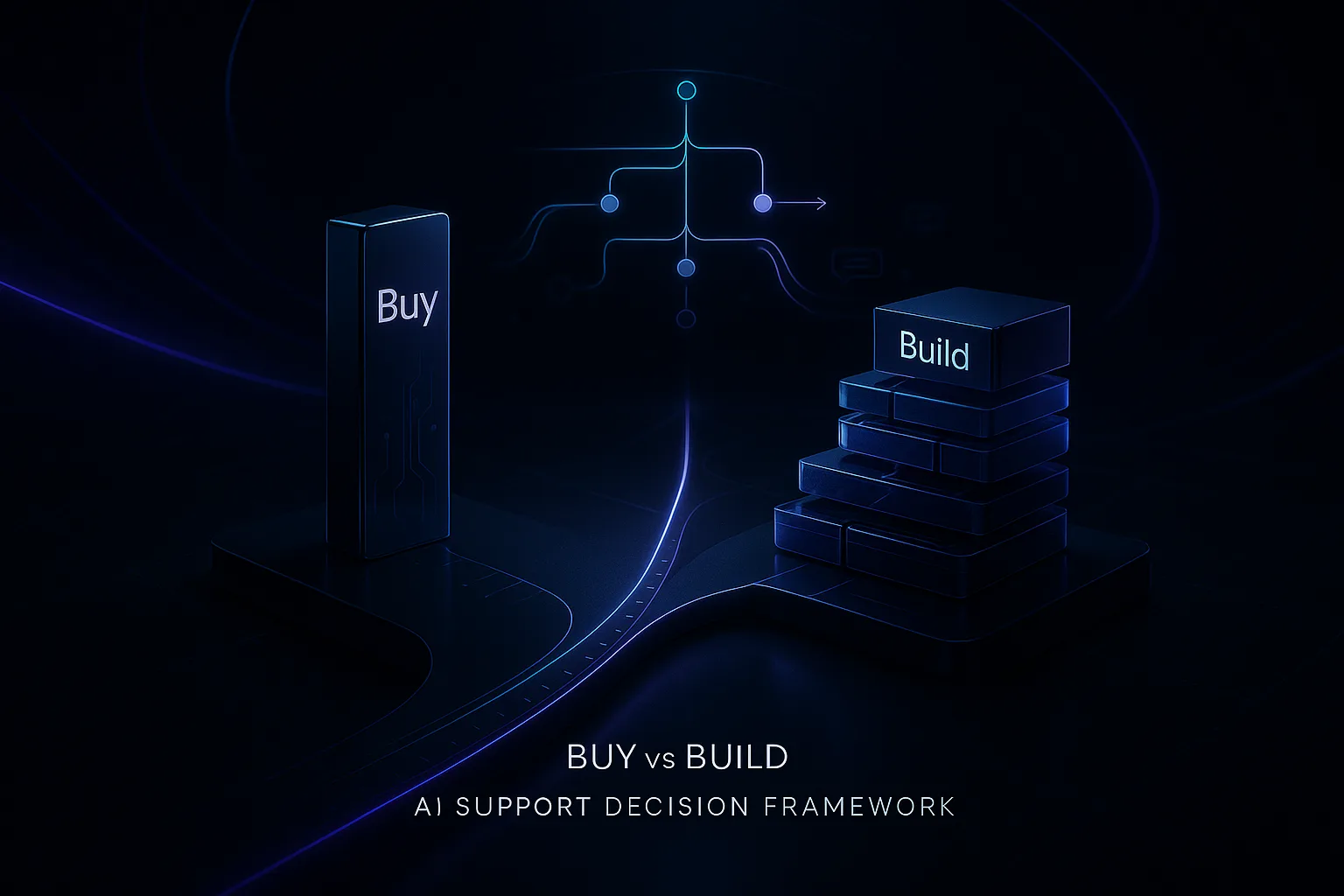
Stop Guessing: Create a Decision Framework for Buy or Build of Your AI Support Stack
Your support stack directly affects your team’s speed, customer experience, and earned trust. Choosing whether to buy or build your AI support stack is a fundamental product decision, not just a tooling task. Start by setting clear goals and constraints, and give yourself a defined time window to evaluate your options with concrete evidence.
Buying provides faster implementation and a predictable scope of features. Building offers more granular control and the opportunity to create behaviors unique to your organization. Many teams ultimately choose a hybrid approach: you might purchase orchestration services, such as routing and interface, and develop the central, proprietary logic or unique functional components in-house.
Buy for speed. Build for control. Hybrid for lasting advantage.
Map Required AI Support Stack Capabilities Before Choosing
Begin by listing the specific capabilities your support operation truly needs. Avoid chasing features for their own sake; instead, ensure each capability is connected to a measurable business outcome.
Key Capability Groups to Assess
- Classification and case routing across various communication channels and languages.
- Assistance for agents, including reply drafting, rewriting, and tone control.
- Knowledge retrieval with source citations and validation of information freshness.
- Automated workflow actions integrated with your CRM, email, and chat platforms.
- Conversation summarization to enable smooth handoffs and actionable reporting.
- Redaction, data retention enforcement, and audit trails for regulatory compliance.
- Voice capabilities such as real-time transcription and call note generation.
Score each capability based on its potential business impact and how unique it is to your organization. For features that are widely available and standardized, purchasing is often preferable. When a requirement involves proprietary logic or how you uniquely serve your customers, consider building it in-house.
Understanding the Total Cost of Ownership for Buy vs. Build in AI Support
Total cost of ownership (TCO) often drives the final decision. Model out the expected costs over both 12-month and 36-month periods. Make sure to include everything, from initial setup to undervalued tasks such as ongoing maintenance and support, along with variable usage rates.
TCO Components to Include in Your Analysis
- License and utilization fees, broken down by seat, channel, and number of interactions or tokens.
- Cloud hosting expenses for model inference, vector storage, and bandwidth.
- Engineering time dedicated to prompt engineering, retrieval adaptation, and ongoing evaluation.
- Security assessments, audits, and implementation of data protection controls.
- Resources spent on support operations, quality assurance, and vendor management.
Concrete numbers help ground the conversation. For example: Assume five agents generating a total of 50,000 monthly messages. A vendor plan at $120 per seat comes to $600 monthly for five agents. Usage-based fees for advanced features might add $0.80 per 1,000 messages, an additional $40 monthly, bringing your total monthly vendor TCO close to $640, not including implementation costs.
For a custom build, assume you'll need one machine learning engineer at 0.5 FTE and a platform engineer at 0.2 FTE. With loaded annual costs of $180,000 and $140,000 respectively, your monthly labor alone is approximately $13,333. Infrastructure costs might add $600 per month, bringing the initial monthly TCO near $13,933. While this can decrease with heavy reuse and scale, the upfront investment is significantly higher.
Data, Privacy, and Compliance Needs for AI Support Stacks
Your organization’s data, privacy, and compliance requirements may dictate your choices before you even compare features. Map how personally identifiable information (PII) moves through your stack, including redaction points, data residency, and retention limits. Ensure each vendor’s policies and regulatory certifications line up with your needs and industry expectations.
If you operate in a highly regulated industry, evaluate solutions specifically designed for compliance. For a more detailed comparison, see this guide to AI customer support software for compliance-sensitive industries.
Request SOC 2, ISO 27001, or HIPAA compliance documentation as appropriate. Review the subprocessor list and data access scope for each vendor. Clarify whether prompts or logs are used for training shared models. Look for solutions that offer configurable redaction, regional data hosting, incident response, and deletion SLAs, preferably in writing.
Knowledge and Language Preparedness for Your AI Support Stack
An AI model’s output quality is only as strong as the knowledge it can access. Weak or outdated sources generate poor responses, while authoritative material leads to clarity and accuracy.
Define your product terminology, processes for handling customer issues or concerns (objection handling), and version-controlled release notes. Use retrieval mechanisms that prioritize canonical sources and refresh knowledge indexes on a reliable schedule. Get hands-on with this tutorial on training AI with your internal product language to ensure consistent phrasing at scale.
Establish your brand style conventions before you scale your AI support stack. This reduces risk and eliminates costly rework as your operation grows.
Integration and Workflow Criteria for AI Support Stacks Across CRM, Email, and Chat
Meet your agents, and your data, where they already work. Often, seamless workflow integrations matter more than underlying model performance. Focus on time savings and agent experience over chasing novelty.
- Check for seamless, built-in integrations with your existing CRM, help desk, and email systems.
- Confirm that single sign-on (SSO), role-based permissions, and comprehensive audit logging are supported.
- Test for latency and performance under load with actual support tickets, including those with attachments.
- Ensure analytics capabilities allow exporting data to your warehouse or business intelligence platform.
Document your routing logic, SLAs, and escalation processes. Your AI support system must reliably follow these without introducing surprises or exceptions.
Quality Evaluation and Auditing When Deciding on an AI Support Stack
Manual review alone doesn’t scale. Combine human judgment with automated quality controls to monitor accuracy, safety, and resolution effectiveness.
Set up an evaluation framework using sampled tickets and gold-standard answers, including challenging edge cases. For a practical process, see this guide to auditing AI customer support conversations with structured criteria.
Keep your prompts and retrieval transparent and versioned. Use standard prompt templates to enforce tone and structure. For example:
System: You are a support copilot. Cite the top 2 sources. Refuse if
confidence is low.
User: Customer asks about plan upgrades. Provide steps, risks, and links.
Keep sentences under 20 words.
Decision Framework: Scoring Model for Buy or Build
Use a simple 5-by-5 scoring model, weighted by impact, to make your decision based on numbers, not intuition, and validate with a pilot program.
- Time to value. How quickly you need results. Weight: 25%.
- Differentiation. The extent to which unique, custom capability creates business edge. Weight: 25%.
- Data sensitivity. Requirements around data residency and auditability. Weight: 20%.
- Scale. Anticipated message volume, language coverage, and growth. Weight: 15%.
- Team capacity. Existing skills and the ability to recruit or train as needed. Weight: 15%.
Assign a score from 1 (least favorable) to 5 (most favorable) for each criterion, for both buy and build options. Multiply each score by its assigned weight, then total the results. If one option outperforms the other by 15% or more, that’s your recommended path. If the difference is within 10%, a hybrid approach may offer the best balance.
AI Support Stack Vendor Landscape Snapshot for 2026
Shortlist vendors that meet your capability and scalability needs, and compare them using real tickets and workflows. Apply the same evaluation criteria consistently so comparisons remain valid.
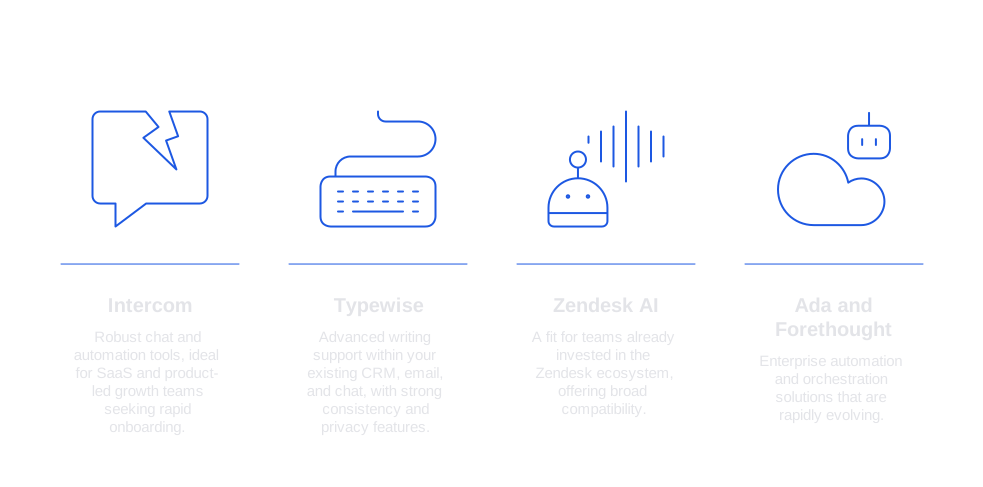
- Intercom: Robust chat and automation tools, ideal for SaaS and product-led growth teams seeking rapid onboarding.
- Typewise: Advanced writing support within your existing CRM, email, and chat, with strong consistency and privacy features.
- Zendesk AI: A fit for teams already invested in the Zendesk ecosystem, offering broad compatibility.
- Ada and Forethought: Enterprise automation and orchestration solutions that are rapidly evolving.
If writing quality and privacy are crucial, consider Typewise among your top choices. Always validate vendors by running identical pilot tests, using the same tickets, prompts, and KPIs for each.
Pilot Strategy and Measurement Plan for Your AI Support Solution
Pilots reduce risk when treated as structured experiments. Define the pilot’s scope and set explicit success criteria before you begin.
- Select 300 to 1,000 recently closed tickets with unambiguous labels.
- Track key metrics such as acceptance rate, first response time, and handle time.
- Expect source citations and set standards for how models should refuse answers when confidence is low.
- Conduct A/B tests with a control group to measure impact fairly.
- Share weekly progress reports with both agents and management.
Carefully document every prompt and any changes made during the pilot. Lock model or workflow versions to keep results comparable. Store the prompts used for evaluation as well. Example:
Evaluator: Score factual accuracy from 1-5. Deduct points if steps are
missing. Each claim must be covered by source citation.
Practical Paths to Buy, Build, or Hybrid AI Support Stacks
If You Buy First
- Start with reply drafting and conversation summarization for rapid improvements.
- Enable information retrieval from your pre-approved, authoritative sources.
- Set up data redaction and robust logging protocols from the beginning.
- Schedule regular audits and model evaluations each month.
If You Build First
- Develop your own embeddings, retrieval pipelines, and prompt template libraries.
- Automate continuous integration for updating prompts, tests, and evaluations.
- Connect to CRM systems via reliable APIs.
- Bring in external vendors for advanced voice or analytics as needed.
If You Choose Hybrid
- Purchase orchestration and agent user interface layers as a foundation.
- Develop custom business policies, tools, or intelligent planners in-house.
- Retain ownership of your own vector stores and log data within your cloud infrastructure.
- Design the system to swap AI models easily without disrupting workflows.
Where Typewise Fits in a Balanced AI Support Stack
Typewise excels in writing assistance, tone control, and seamless workflow integration across CRM, email, and chat platforms, all while prioritizing privacy. It’s a strong fit for teams seeking high-quality drafting and consistent responses inside tools they already use.
Adopt Typewise for quick deployment and dependably consistent replies. Pair it with custom retrieval engines or business rules if you require tailored logic. Even after adopting, you retain the flexibility to build unique AI capabilities around it as your operation scales.
Making the Decision: Use Evidence and Maintain Momentum
Start by mapping required capabilities. Build your TCO model with realistic, transparent estimates. Nail down your evaluation framework, then run a focused two-week pilot to gather meaningful results. Decide decisively, but revisit your choice each quarter as new data arrives.
Looking for a clear, low-friction starting point for your AI support stack that respects your current setup? Connect with Typewise to discuss your goals and constraints. We’ll help you design a pilot tailored to your timelines and workflows, then let your results lead the way.
FAQ
What are the primary benefits of buying an AI support stack?
Buying offers rapid deployment and a fixed set of features, reducing immediate pressure on your team. However, the long-term reliance on the vendor's roadmap can stifle unique business needs.
What are the risks of building your own AI support stack?
Building in-house provides control but requires significant initial investment in expertise and resources. It risks locking your team into a messy codebase if not meticulously planned and maintained.
How does a hybrid approach provide an advantage?
A hybrid model lets you leverage the strengths of both buying and building. You gain flexibility but must manage integration and ensure proprietary parts don't become isolated silos.
How should you decide between buying or building AI capabilities?
Evaluate based on business impact, data sensitivity, and team capacity through a weighted scoring model. Avoid decisions based solely on initial costs; consider scalability and control.
Why is it crucial to consider data privacy and compliance in AI support?
Data mishandling can lead to legal consequences and loss of customer trust. It's non-negotiable to map data flows and align with regulatory standards. Typewise, for instance, emphasizes privacy in its tools.
Why is integration with existing workflows important for AI support systems?
Seamless integration prevents disruptions and increases system adoption among users. Prioritize solutions that require minimal change to existing processes, as Typewise offers.
How should total cost of ownership be calculated for AI support stacks?
Include all factors, from initial setup and licenses to maintenance and unexpected costs. A superficial financial analysis can overlook long-term resource drain.
What is the role of pilots in implementing AI support stacks?
Pilots act as controlled trials to assess real-world effectiveness and user adaptation. They expose hidden flaws and help fine-tune systems before a full rollout.
Why is it critical to update AI knowledge regularly?
AI thrives on the latest information; outdated data leads to poor decision-making. Regularly refresh sources to maintain response quality and boost customer satisfaction.