

Policy-Heavy Support Requests: How AI Can Tackle the Challenge
Support requests involving policies, such as refund periods, warranties, KYC checks, and privacy regulations, can stretch teams thin. An unclear response leads to more back-and-forth, while an incorrect reply risks regulatory violations and fines. That’s why your AI solution must ground answers in specific policy clauses and precise dates, clearly explain exceptions, and document its decision-making process every step of the way.
Effective AI support looks like this: it pinpoints the relevant clause, cites the policy and source, states the version, highlights missing customer data, suggests compliant next steps, and logs its reasoning for audits. This transparency drives confidence for both customers and compliance teams.
Essential Capabilities AI Tools Need for Policy-Heavy Support
Accurate Retrieval with Detailed Citation
Your AI solution should reference every claim with a verifiable source, be it a clause, paragraph, or page, and display the version and last review date. Summarization alone isn’t enough; citation is vital for accountability.
Policy Hierarchies and Handling Exceptions
Conflicts between policies are common. For instance, local regulations may override global company policies, and premium tiers often have rules distinct from standard ones. The AI must identify which source takes precedence and clearly explain its reasoning to ensure compliant outcomes.
Trustworthy, Structured Outputs for Agents
- Present numbered, step-by-step instructions, including required documentation or forms.
- Deliver eligibility decisions with explicit references to rules.
- Clearly separate customer-facing text from internal notes for safe handling.
Privacy and Safety by Default
- Automatically detect and redact personal identifiable information (PII) in drafts.
- Restrict output generation to policy-compliant actions and refuse unsafe requests.
- Create tamper-proof logs for compliance and regulatory reviews.
High-Fidelity, Multilingual Policy Support
Legal terminology must retain its meaning across languages. AI should accurately align policy terms between translations and avoid creating non-existent local exceptions.
Reliable Prompting Practices for Policy-Heavy Scenarios
Provide your AI assistant with specific instructions and demand strict citation formats. Minute adjustments in this area can prevent significant errors down the line.
system: You are a support specialist. Cite every rule you apply. Include policy_id, section, and version_date. Refuse answers without a matching clause. user: Customer asks about a late return after 35 days. assistant: Produce: 1) Eligibility verdict, 2) Steps, 3) Customer message, 4) Citations \[policy_id, section, version_date, url\].
Best AI Tools for Policy-Heavy Support Requests in 2026
Look for AI tools that integrate smoothly into your workflows and uphold standards for source accuracy, privacy, and tone. The options below offer a range of tech stack compatibility. Always test with your own policies before making a final decision.
Intercom Fin
Fin is built directly into Intercom, reliably answering questions by drawing on your policy documentation and internal knowledge. Its strong ability to deflect simple inquiries while escalating complex ones makes it ideal for chat-focused support portals.
Typewise
Typewise fits into your existing CRM, email, and chat platforms. It drafts consistent, brand-aligned responses that cite internal policy sources and improve language and style. With a sharp focus on privacy, it’s a solid option for regulated industries and integrates inside your current workflows.
Zendesk Advanced AI
Zendesk offers advanced features like ticket classification, automated suggestions, macros, and intent detection for faster triage. Its deep integration makes it an excellent choice for teams already extensively using Zendesk, especially those with policy documentation stored in the help center.
Salesforce Einstein for Service
Einstein leverages your Salesforce data, learning from past cases and your policy library to improve routing, summarization, and response suggestions. If your policy management resides within Salesforce, this tool is highly effective.
Forethought
Forethought specializes in policy retrieval and action suggestions. Its robust search capabilities across multiple information sources make it particularly valuable when you need comprehensive coverage of varied policies.
Ada
Ada excels at building guided, rule-based flows. It is adept at eligibility checks and capturing necessary data, making it a good fit when your support processes can be mapped into clear decision trees.
Shortlist two options, design a robust test set with high-risk scenarios, and thoroughly evaluate citation accuracy, refusal reliability, and agent confidence before committing to a solution.
How to Evaluate AI Tools for Policy-Heavy Support Requests: Repeatable Methods
Build a Gold-Standard Testing Dataset
Collect your most complex or challenging support tickets, ensuring you include edge cases and exceptions. Compose correct responses with proper citations and document which version of the policy applies in each instance.
Map Knowledge Sources Before Training or Deployment
List every source your AI might access, such as legal pages, internal wikis, rate cards, and playbooks. Then determine the order in which the AI should access these resources. For a step-by-step guide, see mapping your support knowledge and policy sources end-to-end.
Train Using Your Product and Policy Language
Your organization’s terminology for policies, products, and exceptions is unique. Utilize a curated glossary while refining or deploying prompts in your AI tools for a better understanding of your policy terms. Read practical guidance at training AI on internal product language and policy terms.
Audit Conversations Frequently
Regularly review AI conversations for accuracy of citations, proper refusal when needed, and sensitive handling of tone. Evaluate both resolved and escalated issues, and institute a structured review process as described in how to audit AI customer support conversations.
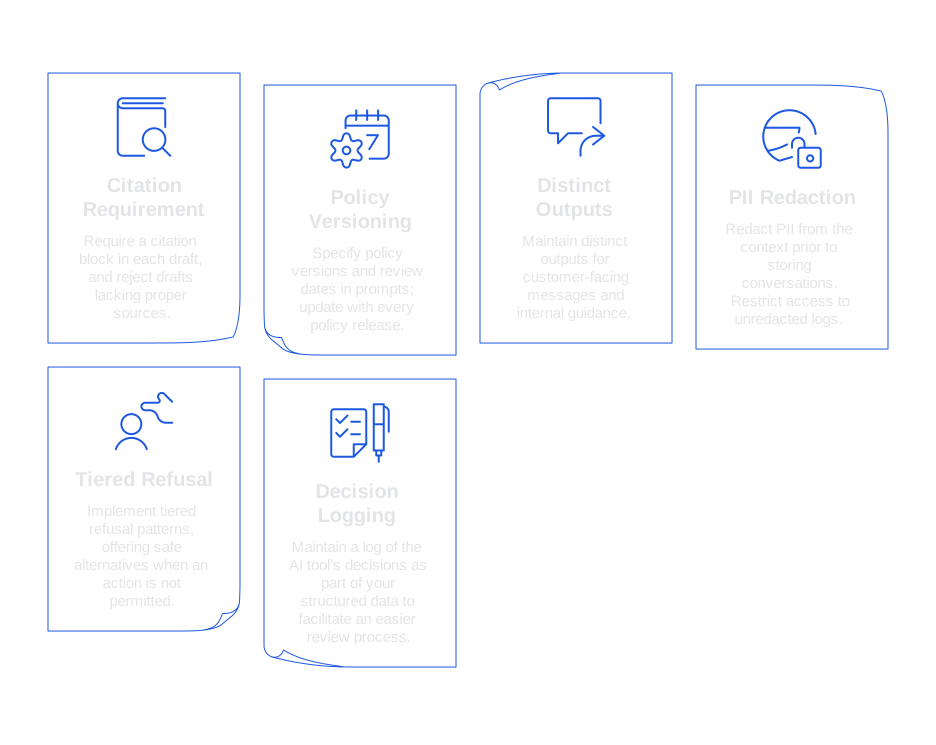
Operational Design Patterns for AI in Policy-Heavy Support
- Require a citation block in each draft, and reject drafts lacking proper sources.
- Specify policy versions and review dates in prompts; update with every policy release.
- Maintain distinct outputs for customer-facing messages and internal guidance.
- Redact PII from the context prior to storing conversations. Restrict access to unredacted logs.
- Implement tiered refusal patterns, offering safe alternatives when an action is not permitted.
- Maintain a log of the AI tool’s decisions as part of your structured data to facilitate an easier review process.
Human in the Loop: Essential by Design
Enable agents with quick access controls to approve, request new sources, or escalate issues as required. Capture these interactions to enhance subsequent AI prompts and retrieval accuracy.
Ensuring Policy Freshness Without Disruption
As policies evolve, automate the process of new policy ingestion and keep previous versions archived but accessible. This safeguards your audit trail and maintains compliance.
Key Metrics to Prove Your AI Handles Policy-Heavy Requests
- Policy citation coverage: proportion of responses including valid policy citations.
- Citation precision: whether the cited clause directly supports the action taken.
- Refusal correctness: accurate and safe declines in the absence of a compliant solution.
- Average time to resolve policy-related tickets.
- Reopen rate for policy cases within 14 days.
- Rate of agent acceptance of AI-generated policy recommendations.
- Rate of escalation to legal or compliance departments.
- Customer sentiment scores on policy-related replies, broken down by outcome.
Monitor these benchmarks together. Quick responses are only valuable if they’re supported with accurate citations and clear communication, reliability and transparency are the real drivers of trust.
The Future of AI Tools for Policy-Heavy Support
Regulatory demands keep changing, but your support processes must always be clear, well-cited, and up-to-date with version tracking and appropriate tone. Select tools that mesh with your agents’ existing workflows and boost their efficiency, never compromising on compliance or accuracy.
If you’re ready to see how an AI assistant can elevate your policy-heavy support, run a focused pilot. Integrate the AI into your CRM, email, and chat setup. For practical guidance, reach out to Typewise to explore the best path forward.
FAQ
What integration capabilities should AI tools offer for policy-heavy support?
AI tools should seamlessly integrate with existing CRM, email, and chat systems to ensure smooth workflow transitions. This integration is crucial for maintaining response continuity and leveraging existing support infrastructure without unnecessary disruptions.
What are key capabilities AI tools need to handle policy-heavy support requests?
The core capabilities include precise policy citation, exception handling, structured outputs, privacy safeguards, and multilingual support. Without these, AI risks delivering unreliable, non-compliant responses.
How do AI tools ensure compliance and accuracy?
Compliance is ensured through verifiable citations and decision logs, while accuracy demands aligning AI outputs closely with existing policy documents, as seen in Typewise's integration with CRM systems.
Why are policy hierarchies crucial in AI solutions for support?
Different policies may conflict, such as local rules overriding global ones. AI must navigate these conflicts to maintain compliance, or risk costly missteps in regulatory adherence.
What should companies prioritize when selecting an AI tool for policy-heavy support?
Focus on tools that seamlessly integrate into current workflows and ensure precise policy interpretation and compliance, like those featured in Typewise, which prioritize privacy and structured guidance.
How critical is it to adapt AI training to company-specific terminology?
Extremely; using tailored prompts and glossaries avoids misinterpretation of policy terms, ensuring AI solutions respond in a way that aligns with company standards, reducing error risks.
What metrics should be tracked to evaluate AI effectiveness in handling policy-heavy requests?
Monitor policy citation coverage, accuracy in refusals, agent adoption rates, and customer sentiment. These metrics ensure responses are not just fast, but accurate and trustworthy.
Why is human oversight still necessary in AI-driven support processes?
AI isn't infallible and complex situations may still require human judgment. Implementing a 'human in the loop' system safeguards against costly errors and supports AI learning.