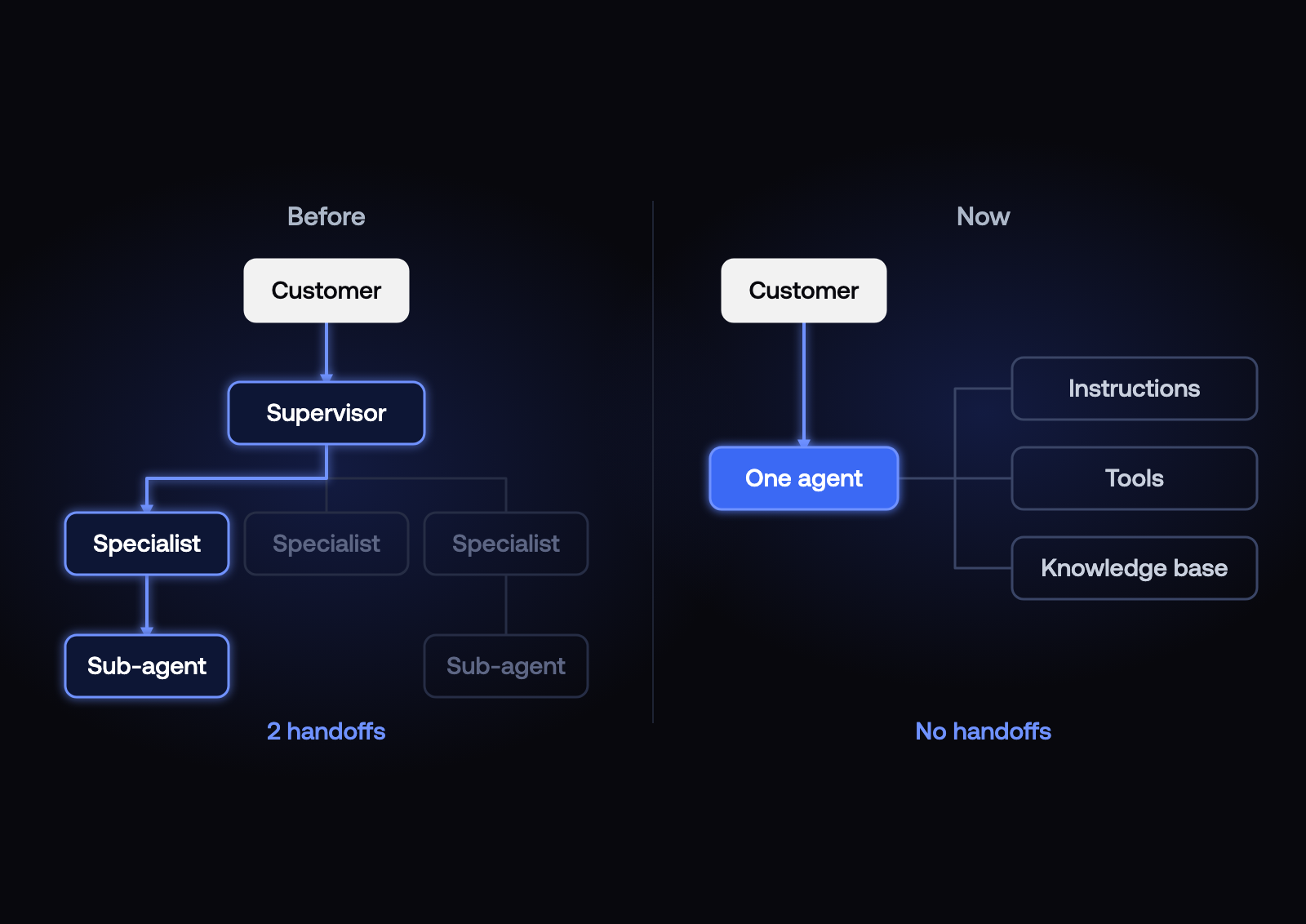


When automation should step aside
Your chatbot is adept at handling routine inquiries. But sometimes, a message comes through that feels different, vague intent, heightened emotion, or increasing urgency. In those moments, AI should immediately escalate the issue to a human agent. The transition needs to be swift, informed, and handled with empathy.
Great service isn’t about deploying automation without consideration; it’s about employing automation intelligently, recognizing its strengths, and acknowledging its limits. What you need is a detection system that can confidently determine when human intervention is necessary and do so with clear justification.
The signals that say handoff now
Indicators for escalation fall into four main categories. Combining them leads to more reliable handoff decisions:
- Understanding gaps. Low intent confidence across leading intentions, conflicting data points, repeated clarification requests, or messages so lengthy and unstructured the true purpose is obscured.
- Conversation friction. Patterns where the chatbot repeats itself, a spike in phrases such as why or not working, and users who attempt self-service but fail in two tries or more.
- Risk and value flags. Keywords like legal, outage, chargeback, cancel, breach, refund now, customers identified as VIP or high-value accounts, and situations involving multiple linked contracts.
- Emotion and safety. Strong negative sentiment, use of all caps, expletives, or urgent punctuation, mentions of personal harm or discrimination, or accessibility requirements and language mismatches.
These signals are most effective when considered collectively. Isolated signals shouldn’t prompt escalation, but a cluster should trigger escalation to a human agent.
How the detector works under the hood
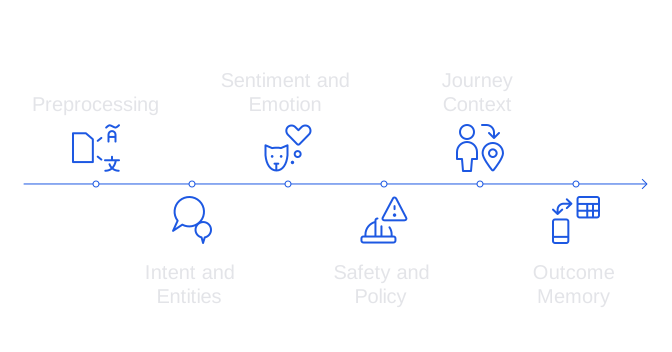
The decision process can be modeled as a series of layered scores, with each layer analyzing a different dimension:
- Preprocessing. Clean and normalize text, correct typos, detect language, and mask personal data before further analysis.
- Intent and entities. Evaluate intent confidence and extract key identifiers like account IDs, product names, dates, and amounts.
- Sentiment and emotion. Assess polarity and intensity of emotional content and track sudden emotional shifts through the conversation.
- Safety and policy. Detect signs of self-harm, hate, or abuse, and enforce strict rules for situations involving KYC or sensitive financial transactions.
- Journey context. Reference previous tickets, unresolved cases, and current customer segments or SLA tiers.
- Outcome memory. Draw upon patterns identified in past escalations that resulted in efficient resolutions.
Each layer generates either a score or a binary indication. These are weighted according to the strength of the supporting evidence. Start with a conservative approach; for instance, escalate only when two or more critical indicators align, or when the aggregate score exceeds a predetermined threshold. Review false positives on a weekly basis, and lower thresholds only when agents confirm these handoffs add value.
Deflection with dignity
When escalating, the handoff should be seamless and respectful, not a sign of technological defeat. The chatbot must acknowledge its limitations, inform the customer of the next steps, and transfer a concise, informative summary to the agent.
- A short summary. A focused paragraph outlining the customer’s intent, main constraints, and attempted resolutions.
- Key entities. Details such as customer ID, order reference, device model, time zone, and plan information.
- What the bot tried. Articles provided, forms sent, workflows executed, and any error messages encountered.
- Suggested replies. Draft response options aligned with brand voice and company policy.
Monitor how often agents use these suggested replies. An increasing suggestion acceptance rate indicates that the bot is successfully equipping agents with context they find valuable. Learn more about how to track AI suggestion acceptance rate as a core support KPI.
Rules that prevent costly mistakes
Certain cases call for automatic escalation, regardless of machine learning models:
- Authentication gaps. Failure to pass verification checks or detection of shared account usage.
- Payments and legal. Refund disputes, chargeback requests, or any potential legal threats.
- Regulated data. Handling of health, financial, or student records, these should always be routed to a human agent.
- Complex outages. Wide-reaching incidents affecting many users, particularly when official statements are required.
Document these rules, test them in staging, then log every trigger event in production. Pair these rules with model scores. While rules carry more weight, scores are used to support decision-making when situations aren’t explicitly covered by the rules.
Training data that actually works
The foundation of reliable detection is high-quality labeling. Collect transcripts across all communication channels, and annotate each conversation turn for intent, sentiment, frustration, and resolution outcomes. Mark exactly where human involvement resolved the issue.
Avoid overfitting to rare phrasing. Prioritize analyzing multi-turn patterns, such as repeated verification failures or repeated attempts at form submission, over rare keyword triggers. Refresh your training set every month. Language adapts with new products and campaigns, and archiving seasonal surges prevents bias.
Metrics that prove the handoff is right
Select a concise set of metrics designed to measure outcomes that matter to your customers and business, not just vanity figures:
- Escalation precision. The number of escalated chats that actually required intervention from a human agent.
- Missed escalations. Instances where escalation should have occurred, but did not.
- Time to human. The time in seconds from when escalation is triggered to when an agent responds.
- Resolution speed after handoff. The average time required for human agents to resolve issues following handoff.
- One touch resolution rate. The percentage of cases resolved by the agent in a single message.
- CSAT after handoff. Customer satisfaction scores specifically for cases that were escalated.
Continuously use these metrics to calibrate handoff thresholds and inform model training. If recurring loops or bottlenecks emerge, revisit your bot design. For practical fixes, see this guide on why chatbots fail and how to repair broken journeys.
Where this fits in your stack
Typically, you will route escalations through an existing CRM or help desk platform. The detection system integrates into this workflow, tagging priority, adding context, and submitting summaries to each new support ticket.
Several vendors provide solutions that address aspects of this escalation detection and handoff process. Intercom offers routing tools connected to its messaging platform. Typewise specializes in AI writing assistance, brand tone consistency, and improving agent productivity within your current tools. Zendesk and Salesforce extend routing capabilities through custom rules and integrations. Ada, Ultimate, and Forethought focus on automation and knowledge retrieval. When choosing a solution, evaluate privacy controls, model transparency, and traceability. Your agents must be able to trust and verify the AI’s outputs.
A 30 day rollout plan
- Week 1. Define escalation rules, collect and label 300 to 500 conversation turns, and prepare your agent summary template.
- Week 2. Develop the scoring pipeline and integrate it in a staging environment. Start with high thresholds and rule-based overrides to ensure safety.
- Week 3. Implement a Shadow mode, in which the detector scores live chats without acting on them. This provides an opportunity to compare these scores with agent decisions, for accuracy checks.
- Week 4. Gradually enable controlled routing for about 10% of chat volume. Conduct daily reviews of any missed escalations, and fine-tune weights and summaries as needed.
Maintain clear logs, recording each score, rule application, and escalation decision, to support audits and ongoing model improvements.
Make the human experience great
Escalation shouldn’t reset the customer’s journey. Customers should see clear progress, and agents should receive actionable, concise briefs rather than overwhelming transcripts.
Escalate early when harm is possible. Escalate intelligently as frustration increases. Escalate with context every time.
This approach safeguards customer trust and ensures your team remains focused on tasks requiring true human judgment.
Closing thoughts
AI can accurately gauge the situation, quantitatively assess the risk, and transition the customer to a human agent with care. The result: faster assistance, fewer dead ends, and customers who feel genuinely supported. Agents benefit from richer context and a more efficient workflow.
If you’re seeking practical, context-aware handoff detection with agent-ready summaries and brand-consistent messaging, reach out to Typewise. We integrate seamlessly with your CRM, email, and chat tools, always with privacy at the forefront. Let’s map your signals and deliver a pilot solution in just a few weeks.
FAQ
Why should automation step aside in certain scenarios?
Automation isn't a panacea; its limitations become stark when handling emotionally charged or multi-faceted issues. Poor handoffs damage trust, making human intervention a strategic necessity to ensure customer satisfaction and problem resolution.
What are the key indicators for escalating a conversation?
Clusters of signals like understanding gaps, conversation friction, risk, and emotion demands a handoff. Relying on isolated signals can either result in unnecessary escalations or missed opportunities for timely human intervention.
How can a chatbot ensure a seamless transition to a human agent?
A seamless transition respects the customer's time and the nature of the issue, handing off a concise, relevant, and context-rich summary. Ignoring this can reset the customer's journey, failing to leverage valuable chat history insights.
What are non-negotiable rules for automatic support ticket escalation?
Some situations like authentication failures, payment disputes, and legal concerns demand immediate human intervention. Overlooking these rules can result in significant legal exposure or financial loss.
Why is high-quality training data essential for escalation detection?
High-quality labeling ensures that the escalation detection system adapts to evolving language trends and user behaviors. Without it, systems risk becoming obsolete or biased, undermining their effectiveness.
How can businesses measure the effectiveness of their escalation process?
Metrics like escalation precision, missed escalations, and time to human indicate how well the system performs. Neglecting these metrics can lead to misplaced resources and unsatisfied customers.
What role do existing CRM systems play in the escalation process?
An integrated detection system within a CRM streamlines handoffs, enhancing context accuracy and agent responsiveness. Failure to integrate can result in fragmented customer experiences and reduced operational efficiency.