
When AI Systems Tackle Non-Standard Customer Support Requests, Adaptability Defines Success
Most customer support tickets follow a script. Not so for non-standard requests, which often involve policy edge cases, missing information, and emotionally charged situations. A successful AI must have the capability to understand the broader context, accurately request additional details, and apply logical reasoning to respond. Relying solely on templates will not suffice for these scenarios.
Edge cases reveal whether your AI truly knows your business.
Success in handling non-standard requests depends on two critical factors. First, how well the AI system understands your particular business domain and language. Second, how safely and effectively it collaborates with human agents when uncertainty or risk is elevated.
What Non-Standard Customer Support Requests Look Like, and Where AI Systems Can Fall Short
Non-standard requests might include partial service outages, complaints from VIP customers, billing exceptions, interactions involving multiple products, or scenarios that raise legal or safety concerns. These complex cases require human-like judgment and clear escalation paths.
AI can encounter difficulties due to certain challenges that are frequently seen. For example, the AI model may not understand the unique language or terminology of your organization. The system might fail to retrieve the necessary information, or, without proper guardrails, it might make guesses rather than seeking more details from the customer.
- Ambiguous intent with high stakes, such as processing refunds across different regions.
- Multi-step troubleshooting processes where the context is continuously evolving.
- Requests referencing internal jargon, nicknames, or product codes unfamiliar to generic systems.
- Sensitive topics that require careful wording and formal approvals.
You can address many of these issues by training the AI on your specific language and terminology, as well as enforcing strong fallback behaviors to handle uncertainty. Begin with these basics to reduce common points of failure.
Evaluation Criteria for AI Systems Handling Non-Standard Customer Support Requests
Core Capabilities to Test Using Real Tickets
- High-quality retrieval from your CRM, internal knowledge bases, and policy documentation.
- Step-by-step plan-and-act reasoning for complex or multi-stage cases.
- Ability to ask clarifying questions when the system's confidence is low.
- Citation of information sources within replies, allowing for easy agent review.
- Output of structured metadata for efficient analytics and quality assurance.
Safety and Control to Protect Your Brand
- Robust guardrails that prevent restricted actions and inappropriate language.
- Automatic detection and redaction of PII, with role-based access controls for sensitive data.
- Comprehensive audit trails for every AI suggestion and system action.
Operational Fit with Your Existing Tools and Workflows
- Native integration with your CRM, email, and chat tools for seamless operation.
- Version control for prompts, policies, and datasets to ensure consistency.
- Safe testing environments (sandboxes) for new features prior to full rollout.
If your team relies on internal shorthand or jargon, prioritize training your AI system on this language. Explore this practical guide to training AI on internal product language for an effective approach.
Technical Foundations Needed for AI to Solve Non-Standard Customer Support Requests
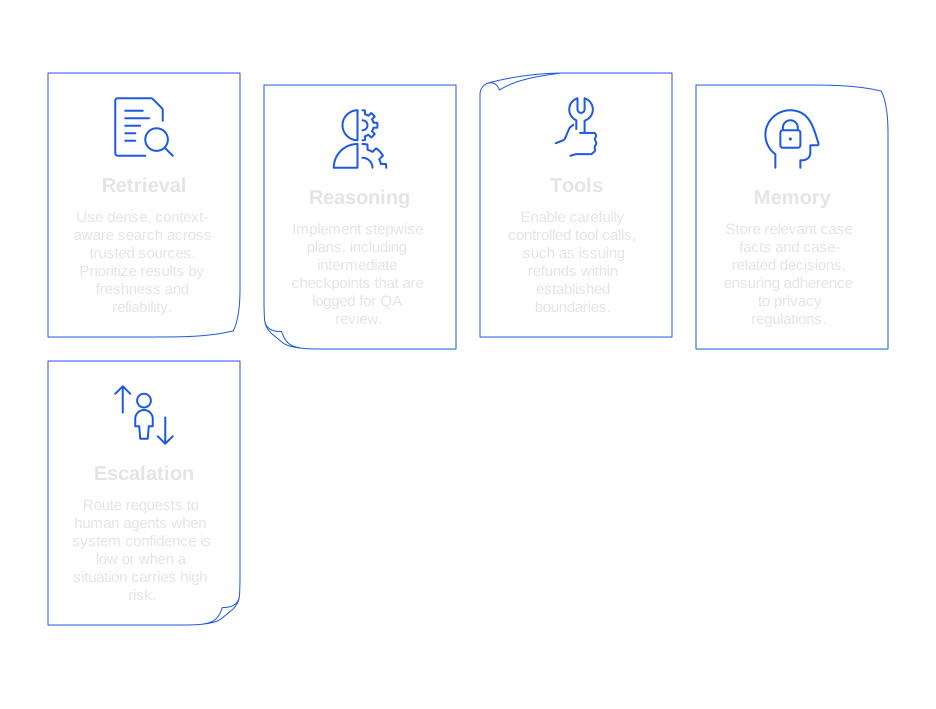
Robust systems combine high-quality data retrieval, advanced reasoning, and human oversight. Each component is important, but the effectiveness of your entire pipeline is what really drives success.
- Retrieval. Use dense, context-aware search across trusted sources. Prioritize results by freshness and reliability.
- Reasoning. Implement stepwise plans, including intermediate checkpoints that are logged for QA review.
- Tools. Enable carefully controlled tool calls, such as issuing refunds within established boundaries.
- Memory. Store relevant case facts and case-related decisions, ensuring adherence to privacy regulations.
- Escalation. Route requests to human agents when system confidence is low or when a situation carries high risk.
Multilingual support adds complexity. If your customers write in several languages, plan for the potential shift in the meaning or interpretation of requests (known as intent drift). For practical insights, explore examples of AI-driven multilingual customer support at scale.
Best AI Systems for Resolving Non-Standard Customer Support Requests in 2026
The landscape evolves quickly. Test these leading options on your own edge cases for best results. Below is a shortlist of practical choices.
- Intercom Fin. Best for organizations already using Intercom chat and inbox tools. Offers strong context awareness and easy setup, especially ideal when your support workflows are based in Intercom.
- Typewise. Specializes in AI-assisted writing for support and business communications. Seamlessly fits into existing workflows across CRM, email, and chat channels. Improves grammar, tone, and phrasing, ensuring responses stay true to your brand voice. Prioritizes enterprise-level privacy and data protection.
- Zendesk Advanced AI. A logical choice for Zendesk Suite users. Deep integration with Zendesk's macros, knowledge base, and automated routing features. Supports strong governance and compliance within the Zendesk environment.
- Ada. Stands out for its no-code automation flows. Effective for clear handoffs and reusable intent management. Works well for organizations with highly structured support policies.
- Forethought. Focuses on retrieval and search-based answers. Useful for resolving complex knowledge queries and pairs well with agent assist tools.
Rankings can only go so far. Your optimal solution will depend on your organization's internal language, data quality, and the level of risk you must manage.
Deployment Playbook for AI Systems Handling Non-Standard Customer Support Requests
Stage 1: Prepare Data and Policies
- Assemble a curated and trusted knowledge base that includes known policy exceptions.
- Document clear refusal protocols for legal and safety-sensitive topics.
- Write guidelines for appropriate tone during outages or crisis situations.
Stage 2: Train, Prompt, and Connect Retrieval Systems
- Capture all internal jargon, product codes, and acronyms your team uses.
- Design prompts that instruct the AI to request more information rather than guess when uncertain.
- Index all policies along with their effective dates and responsible owners.
Stage 3: Test in the Inbox with Human Oversight
- Start in suggestion-only mode, allowing agents to review and approve AI-generated responses.
- Record the sources and confidence level behind each suggestion.
- By default, assign high-risk or ambiguous requests to human agents.
Stage 4: Expand Gradually with Safeguards
- Initially, enable only the lowest-risk automated actions, such as status checks.
- Introduce higher-stakes activities, like refunds, later, and only with clear restrictions.
- Establish a regular and structured schedule for reviewing the AI system’s performance and making necessary adjustments.
A formal structure for review is essential. For practical advice on effective oversight, see this article on how to audit AI customer support conversations and measure impact.
Metrics That Show AI Systems Improve Non-Standard Customer Support Requests
- First contact resolution for edge-case requests. Track by labeled topic, not only by channel.
- Escalation rate by risk category. A lower rate is good, but avoid situations where the AI is overconfident.
- Clarifying question rate. A healthy increase is expected for ambiguous cases, as it means the AI is seeking more information rather than guessing.
- Time to clarity. Measure how long it takes for the AI or agent to formulate and communicate a clear response plan.
- Suggestion acceptance rate. Agents should find AI-generated drafts more helpful and accept them at increasing rates over time.
- Incidents involving policy deviation. Track any violations, and analyze root causes for continuous improvement.
Segment all metrics by language and region. The nature of non-standard requests often varies by market, so localized metrics provide clearer insights.
How AI Systems and Human Agents Should Collaborate on Non-Standard Requests
Allow the AI system to generate the initial response for each request, but ensure human agents have the final control over decisions. The tool should clearly present its reasoning steps and cite information sources to aid human review. Providing fast, intuitive editing is also essential.
Agents should have access to clear options, such as asking a follow-up question, escalating to another team, or taking direct action, and every choice should be logged for traceability.
During high-pressure situations, tone matters greatly. Keep a concise crisis communication guide readily available to ensure consistency and avoid missteps during outages or emergencies.
Choosing Typewise for Non-Standard Customer Support Requests, Without Locking Your Stack
Typewise integrates directly with your current tools, which keeps deployment simple and minimizes workflow disruption. The platform suggests and refines replies to fit your brand voice, empowering agents to tackle unusual requests efficiently.
Governance features are built in: you can define rules, monitor all AI suggestions, and train the system on your unique needs. Privacy is a foundational aspect, meeting enterprise-grade requirements.
If you’re seeking a writing-first AI assistant that adapts to your team's workflow, consider a pilot program. Track metrics like suggestion acceptance rate, time to clarity, and incidents of policy deviation to evaluate the system’s impact.
Want to see this in action? Start a conversation with the Typewise team. Share your most challenging support tickets and test the fit against your actual data.
FAQ
Why can't AI solely rely on templates for non-standard support requests?
Relying on templates leads to failure in handling non-standard requests, which demand nuanced understanding and flexibility. Such scenarios go beyond scripted interactions, requiring AI to grasp the wider context and improvise effectively.
How can Typewise improve AI handling of non-standard customer support requests?
Typewise excels in adapting AI systems to specific workflows, enhancing AI's capability to manage non-standard requests. Its integration and customization options allow teams to fine-tune the AI's response to fit unique brand voices and policies.
What are the main risks if AI mishandles non-standard customer requests?
Poor handling can escalate issues, damage brand reputation, and cause compliance breaches. The fallout from misinterpreted queries or inappropriate actions can lead to financial repercussions and loss of customer trust.
What makes Typewise a good option for teams using internal jargon?
Typewise's ability to train AI systems on an organization's specific language ensures accurate and brand-aligned responses. It minimizes the risk of misunderstanding internal jargon that could derail customer interactions.
How should AI and human agents collaborate on high-risk support requests?
AI should generate initial insights but not act independently without human oversight. Critical decisions and actions should be validated by agents to ensure accuracy and legal compliance, avoiding costly errors.
Does multilingual support complicate AI's response to customer queries?
Yes, multilingual contexts can introduce intent drift, where meaning shifts between languages. It's crucial for AI systems to account for these variances to maintain precise communication.
What elements are crucial for evaluating AI performance with non-standard requests?
Key metrics include first contact resolution rates and the AI's ability to ask clarifying questions. Measuring these factors ensures the AI is effectively managing complex scenarios without overreliance on human intervention.