

Fast Comparison of Kustomer IQ Alternatives for AI-Driven Omnichannel Support
| Tool | Best for | Wins vs Kustomer IQ | Trade-offs | Pricing logic | Integrations | Choose if |
|---|---|---|---|---|---|---|
| Typewise | Enterprise teams needing brand-true replies across channels without switching helpdesk | Works inside your stack; strong tone control and privacy; fast rollout | Not a full ticketing suite; you keep your current platform | On-demand | Connects to CRM, email, chat; APIs | You want AI-written replies that speed workflow and keep your brand voice consistent everywhere |
| Zendesk AI | Ops teams already standardized on Zendesk | Mature ticketing, routing, and knowledge usage | Admin overhead; suite-centric | Per seat plus AI add-on | Deep Zendesk ecosystem | You prefer an all-in-one suite with embedded AI |
| Intercom | Chat-first, product-led support | In-app messaging, proactive bots, strong deflection | Can be a stretch for email-heavy B2B approvals | Per seat plus automation usage | Product + messaging stack | Your app is the front door and needs in-product automation |
| Salesforce Service Cloud Einstein | Enterprises living in Salesforce | AI tied to CRM objects, security, and governance | Complex setup; higher total cost | Per user plus platform usage | CRM-native | You need AI decisions grounded in CRM and case history |
| Freshdesk Freddy AI | SMB to mid-market seeking value | Quick setup, good breadth for the price | At an enterprise level, you may encounter limitations in the sophistication of rule-based routing or customization compared with more robust, comprehensive software suites. | Per seat tiers | Freshworks suite | You want straightforward omnichannel with light AI |
Typewise as the Best Kustomer IQ Alternative When You Need Brand-True AI Inside Your Existing Stack
The most common trigger for switching is when teams notice that rewriting AI-suggested replies to match their brand tone, or exporting data to keep AI communications on script, eats up valuable time. Typewise integrates directly with your CRM, email, and chat tools, emphasizing writing quality, consistency, and privacy throughout. With Typewise, you maintain your established channels and workflows, but benefit from faster, more accurate responses.
Typewise truly stands out by providing deep control over messaging style, maintaining a privacy-conscious approach for the enterprise, and supporting rapid implementation. If your organization has invested heavily in macros, SLAs, or custom objects, Typewise sits atop your stack, elevating reply quality without forcing disruptive changes to your processes. You also have the ability to adapt the AI to your unique business language, thereby ensuring that its suggestions reflect your specific terminology as opposed to generic customer support language, see how to train the AI on your internal product language for tailored communications.
A key trade-off is that Typewise is not meant to be a comprehensive ticketing suite. If you’re looking to completely replace your helpdesk, one of the suite solutions below will be a better fit. However, if your current stack meets your needs but you’re seeking sharper replies, reduced handle time, and fewer escalations, Typewise is a low-risk enhancement. Quality assurance is especially crucial as ticket volumes rise, learn how to audit AI customer support conversations before rollout at scale. Decision moment: You need Typewise the moment rewriting replies takes longer than resolving the issue.
Zendesk AI as a Kustomer IQ Alternative for Teams Committed to Mature Ticketing Workflows
Teams often outgrow Kustomer IQ’s single timeline view when more sophisticated workflows and cross-channel operations are required. If your organization already relies on Zendesk across multiple channels, Zendesk AI is a logical upgrade. You gain established ticketing, routing, seamless knowledge integration, and robust admin controls, all powered by AI within a familiar suite.
Zendesk AI shines through its reliable triggers, SLA management, and comprehensive marketplace, making scaling support predictable and efficient. Compared to Kustomer IQ, companies typically find they need less custom work to achieve standardized triage across channels. The principal trade-off, however, is its suite nature, expect increased administrative time, a need for structured taxonomy, and added governance complexity.
Choose Zendesk AI if your operations are geared toward precise routing, advanced macros, and trustworthy AI suggestions and you wish to stay within your current platform. Decision moment: Consider Zendesk AI if you ever encounter a situation where a significantly high daily volume of customer interactions makes managing your macros and manual sorting untenable. For more on optimizing your first response time, view these tips on how AI improves first response time.
Intercom as a Kustomer IQ Alternative When Your Product is the Primary Support Channel
Intercom excels when your primary support channel is your app itself. Teams often migrate from Kustomer IQ when in-app chat becomes their busiest entry point and proactive messaging grows in importance compared to traditional email threads. Intercom’s conversational bots and embedded messaging deflect basic requests and efficiently capture user context from inside your product.
The platform stands out for its robust in-app communication, personalized conversational bots, and targeted user flows, all designed to minimize user effort when they’re already engaged in your app. The main trade-off is that Intercom may not be ideal for organizations heavily reliant on email threads with complex B2B approvals or attachments, as it can feel less adaptable for those use cases.
Intercom is best for product-led teams, mobile-first organizations, and those needs built around proactive engagement over traditional ticketing. Decision moment: Choose Intercom the second your app becomes the front door to your support operation and automation is necessary to meet users’ expectations right where they are.
Salesforce Service Cloud Einstein as a Kustomer IQ Alternative for CRM-Anchored Enterprises
For companies deeply invested in Salesforce, the driving factor is often consistency and centralized governance. Teams tend to move to Einstein when leadership expects AI to act directly on CRM records, history, and entitlements, minimizing the transfer of data to external systems.
Salesforce Einstein differentiates itself with close integration to accounts, cases, and documentation, offering the kind of traceability needed for complex enterprise controls and compliance. Compared to Kustomer IQ, Einstein’s advantage is unified oversight that spans sales and support operations. The trade-offs include the complexity of setup, a higher requirement for administrative specialization, and potential cost increases as additional features are enabled.
This solution best fits large enterprises that track support effectiveness alongside revenue and renewals. Decision moment: Reach for Einstein as soon as executive priorities shift to requiring AI-driven outcomes directly inside Salesforce dashboards rather than through standalone systems.
Freshdesk Freddy AI as a Kustomer IQ Alternative for Teams That Value Simplicity and Speed
Sometimes, the more efficient solution is to simplify your customer service process. Teams often transition from Kustomer IQ to Freshdesk for a unified platform that offers reliable omnichannel support with accessible AI at a competitive price.
Freshdesk’s strengths are its straightforward setup, user-friendly administration, and solid coverage across email, chat, and voice. However, at an enterprise level, you may encounter limitations in the sophistication of rule-based routing or customization compared with more robust, comprehensive software suites.
Freshdesk Freddy AI is an excellent fit for small to mid-sized businesses that want to get up and running quickly with predictable costs. When another solution may be preferable: if your leadership expects deep analytics directly connected to your CRM, or you need advanced governance, consider layering Typewise over your stack or evaluating Salesforce as an alternative.
Final Decision Framework for Selecting a Kustomer IQ Alternative for AI-Driven Omnichannel Support
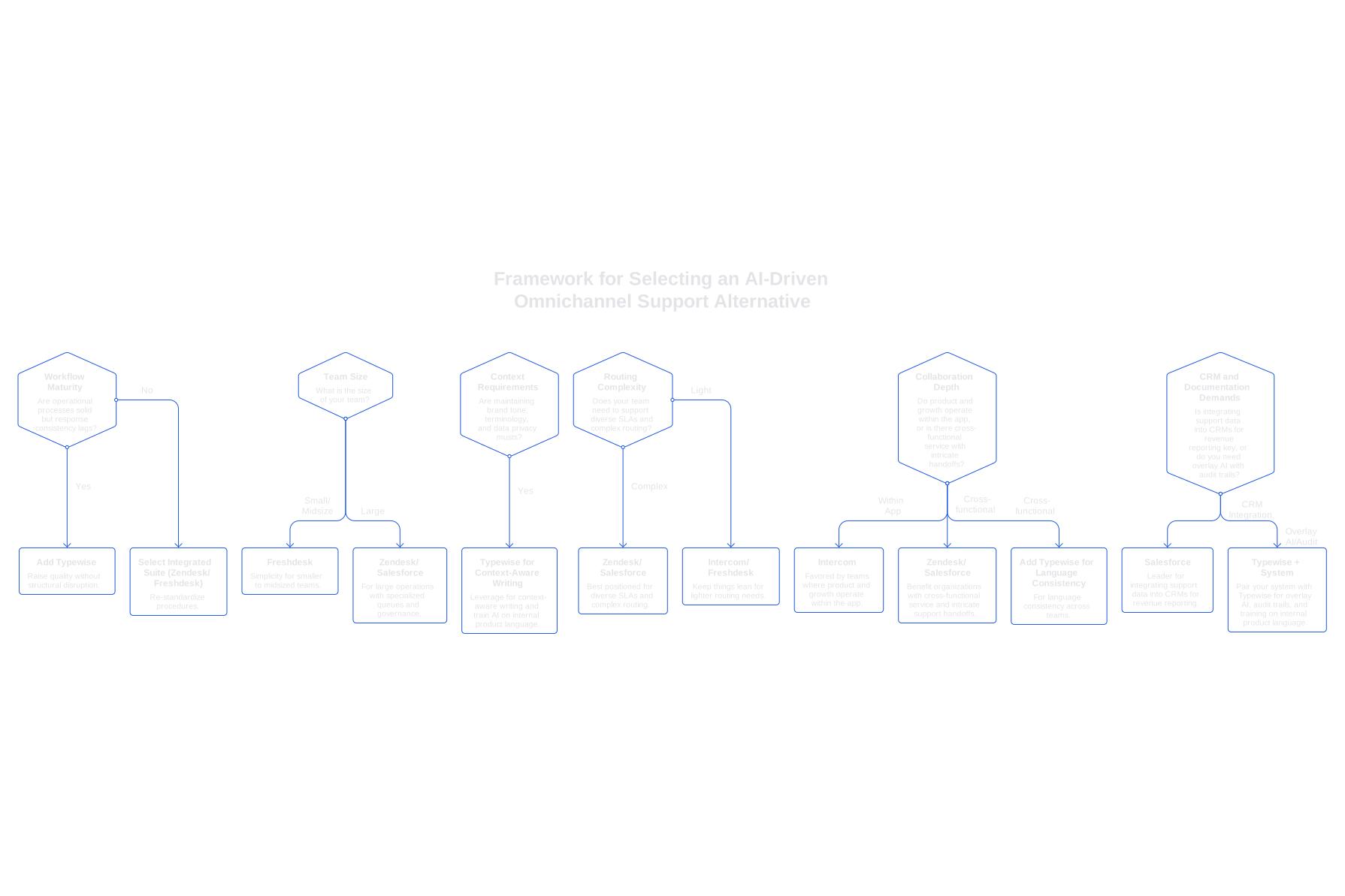
- Workflow maturity: If your operational processes are solid but the consistency of responses lags behind, adding Typewise will raise quality without structural disruption. If your workflows lack consistency, select an integrated suite like Zendesk or Freshdesk to re-standardize procedures.
- Team size: Smaller to midsized teams often gain the most from Freshdesk’s simplicity, while large operations with specialized queues typically prefer Zendesk or Salesforce to meet governance requirements.
- Context requirements: If maintaining brand tone, set terminology, and data privacy are musts, leverage Typewise for context-aware writing and explore how to train the AI on your internal product language .
- Routing complexity: If your team must support diverse SLAs and complex routing requirements, Zendesk or Salesforce are best positioned; for lighter routing needs, Intercom or Freshdesk keep things lean.
- Collaboration depth: Teams where product and growth operate within the app itself tend to favor Intercom; meanwhile, organizations with cross-functional service and intricate support handoffs benefit from Zendesk or Salesforce. For language consistency across teams, add Typewise on top.
- CRM and documentation demands: If integrating support data into CRMs for revenue reporting is key, Salesforce is the leader. If you need overlay AI that works within your current environment and enables audit trails, pair your system with Typewise and learn how to audit AI support conversations as you expand.
Conclusion: Pick the Right Kustomer IQ Alternative for How Your Team Really Works
There’s no universal “best” alternative, it all depends on your team’s needs and workflows. If your existing helpdesk does the job but you want quicker, more on-brand replies across all channels, Typewise provides the least disruptive upgrade. If you need an all-in-one platform to standardize operations, Zendesk or Freshdesk are strong choices. For teams driving support directly from within a product, Intercom fits the bill. If CRM governance is vital, Salesforce will be your go-to option.
If you want to see what “AI that fits your workflow” can look like, start a conversation with the Typewise team at typewise.app. We’ll help you chart the smallest possible change that delivers the largest improvement for your support operation.
FAQ
Why is a unified customer timeline important for omnichannel support?
A unified customer timeline enables seamless conversations across multiple channels, ensuring that all interactions are context-rich and consistent. Without it, support efforts become fragmented, leading to poor customer experience and repeated queries.
What is the risk of relying on opaque AI systems for customer support?
Opaque AI systems can lead to unpredictable behavior and lack accountability, making it difficult for support teams to assess performance and reliability. Transparency is vital for effective AI oversight and building trust with both customers and service agents.
How does Typewise ensure brand consistency in AI-generated replies?
Typewise employs custom style guides and a terminology glossary to maintain a consistent brand voice across all interactions. This focus reduces the manual edits needed and aligns AI output with your company's communication standards.
What are the potential consequences of poor implementation of AI in omnichannel support?
Poor implementation can lead to broken workflows, inconsistent customer experiences, and increased manual oversight. It undermines the benefits of AI efficiency, causing frustration for both support teams and customers.
Why should automation be implemented gradually in customer support?
Gradual implementation allows for testing and refinement, reducing the risk of errors and improving system reliability. Abrupt changes can overwhelm systems, leading to failures that impact customer satisfaction and trust.
What distinguishes Typewise from other Kustomer IQ alternatives?
Typewise stands out with its seamless integration into existing tools, prioritizing agent control and privacy. While others may require significant setup and compromise, Typewise enhances current workflows without disruption.
How can AI effectively reduce first response time without sacrificing quality?
Effective AI reduces response time by using smart routing logic and context-aware prompts while maintaining the ability to self-verify output accuracy. This dual approach balances speed and quality, which is essential for maintaining customer trust.
What are the risks of over-automation in customer support systems?
Over-automation can alienate customers by failing to handle nuanced interactions requiring empathy and judgment. It risks eroding service quality and brand reputation, highlighting the need for a human-insight-led approach.
What is the main advantage of using Typewise over Kustomer IQ?
Typewise stands out by offering AI-driven responses that are brand-consistent and integrate seamlessly with your existing stack. It enhances reply quality without disruptive changes, making it ideal for teams focused on brand voice and data privacy.
Why would a business opt for Zendesk AI instead of Typewise?
Zendesk AI is preferred by operations that need mature ticketing workflows with advanced routing and knowledge integration. It is perfect for those already standardized on Zendesk, while Typewise is better for maintaining brand tone within existing systems.
In what situations does Intercom outperform other AI solutions?
Intercom excels in environments where the product itself serves as the main support interface. It’s ideal for teams that need in-app messaging and proactive engagement, and less suited for complex email-based workflows.