

Snapshot Comparison Table: Alternatives to Salesforce Service Cloud Einstein for AI-Driven Support
| Tool | Best for | Primary gain vs Einstein | Trade-offs | Pricing lens | Setup speed |
|---|---|---|---|---|---|
| Zendesk Advanced AI | Ticket-centric teams that want pragmatic agent assist | Simpler admin, strong help center deflection | Zendesk is not a full CRM and does not support deep account hierarchies or custom objects out of the box. These needs can be addressed, however, through additional plugins or customized workflows. | Plan tier plus AI features and usage | Days to a few weeks |
| Typewise | Enterprises needing brand-consistent replies across CRM, email, and chat | Privacy-first writing assistance that keeps tone consistent across tools | Not a full ticketing platform or bot builder; integrates with your existing systems for messaging and quality control, rather than replacing ticket management. | Seat-based with fast ROI from reduced handle time | Days with low-risk pilots |
| Intercom Fin AI Agent | Chat-first SaaS with mature help content | High-quality web chat automation from your articles | Email-heavy B2B workflows may require additional modules. Fin’s efficacy depends on both the quality and structure of your help articles. | Usage-based automation plus workspace plans | Days |
| ServiceNow Now Assist (CSM) | Complex enterprise service operations | Deep process automation and knowledge across functions | Longer deployment cycles, specialized administration needs, and higher overall cost. Best fit for organizations where cross-team process automation is essential. | Enterprise contracts tied to CSM footprint | Weeks to months |
| Microsoft Dynamics 365 Customer Service + Copilot | Microsoft-first organizations | Tight M365 context and summarization | UI complexity and a learning curve for Dataverse; time-to-value varies according to data quality. | Per user plus AI capacity | Weeks |
| Freshdesk Freddy AI | Cost-conscious teams modernizing email support | Accessible agent assist and automations | Freddy AI is ideal for mid-sized teams, but offers less depth for advanced enterprise workflows and isn’t designed for highly customized objects. | Value tiers with add-ons | Days |
Zendesk Advanced AI as a Practical Alternative for Ticket-Centric Teams
If your support agents work primarily in ticket workflows rather than traditional CRM objects, Zendesk Advanced AI can help streamline operations. Features such as automated triage, reply suggestions, and intent detection easily integrate with existing macros and team views. The standout advantage over Einstein is operational simplicity: fewer administrative steps for workflow adjustments, faster automation iteration, and a help center that effectively deflects repetitive queries.
Trade-offs: Zendesk is not a full CRM and does not support deep account hierarchies or custom objects natively. However, these requirements can be addressed with plugins or customized workflows. Organizations that rely heavily on native Salesforce sharing rules for their sales and success operations should account for this in any migration plan.
Decision moment: the right time to choose Zendesk is when your admins find themselves spending more time tweaking page layouts than actually reducing the backlog. Zendesk’s simple interface could be the change that refocuses efforts on efficient support resolution.
Typewise: The Privacy-First Writing Assistant Alternative
When brand voice consistency or data privacy are non-negotiable, and replacing your entire ticketing stack isn’t on the table, Typewise stands out. It can be integrated directly into your existing CRM, email, and chat tools to help agents generate faster, on-brand replies without changing their everyday workflows.
Typewise is especially valuable when your support language is nuanced. You can train the AI on your internal product terminology, ensuring it sounds like your experts and remains compliant with legal or product guidelines. Quality control is robust, set up self-checking AI workflows to catch inaccuracies, and allow ops leaders to audit AI-powered customer conversations for accountability and performance.
Trade-offs: Typewise does not replace your ticketing platform or function as a bot builder. If your goal is more consistent, quicker replies within your existing ecosystem, it fits perfectly. For organizations looking for a full ticketing overhaul, other platforms may be more appropriate.
Decision moment: consider Typewise as soon as you notice brand tone slipping across channels and your QA processes struggling to keep up.
Intercom Fin AI Agent: The Chat-First Alternative
If most customer queries arrive via live chat and your knowledge base content is robust, Intercom Fin can elevate your support experience. Fin AI Agent delivers precise answers sourced from your help articles, manages follow-ups, and transfers conversations to agents with full context. Many teams move from Einstein to Fin seeking improved chat responsiveness and a self-service presence aligned with customer preferences.
Trade-offs: If your support is heavily reliant on long, email-based B2B interactions, supplemental Intercom modules might be necessary. Fin’s performance is closely tied to the quality and organization of your knowledge base articles.
Decision moment: consider Intercom Fin when live chat volumes surpass email, and your help center is already equipped to answer at least 60% of incoming questions.
ServiceNow Now Assist: Enterprise-Scale Alternative
For organizations where support mirrors broader business operations more than simple ticket queues, ServiceNow CSM with Now Assist is often the right fit. It couples AI recommendations with processes, documentation, and runbooks that cross departmental boundaries. Compared to Einstein, ServiceNow delivers deeper process integration and centralizes knowledge for complex or regulated workflow requirements.
Trade-offs: Expect longer implementation timelines, the need for specialized administration, and higher overall investment. ServiceNow is best suited to organizations whose service catalog and collaborative workflows justify this enterprise approach.
Microsoft Dynamics 365 Customer Service Copilot: The Microsoft-Stack Alternative
For organizations invested in Microsoft infrastructure, Copilot integrates support process automation, summarization, and reply drafting directly with familiar tools like Outlook, Teams, and SharePoint. Compared to Einstein, Dynamics offers closer data proximity within the Microsoft ecosystem and streamlines user management and authentication.
Trade-offs: There is a learning curve for the interface and Dataverse concepts, and time-to-value can fluctuate based on how well-organized your data is. Dynamics 365 with Copilot is especially attractive for IT-driven departments already standardized around Azure and Microsoft workflows.
Freshdesk Freddy AI: A Cost-Conscious Choice for Modernizing Support
Freddy AI is ideal for mid-sized teams, offering practical suggestions, intent detection, and automations without requiring extensive administration. Its main advantage over Einstein is direct value, modern AI capabilities built into a user-friendly ticketing platform with minimal overhead.
Trade-offs: Freddy offers less depth for organizations with highly advanced or custom enterprise workflows. If your priority is upgrading email support and freeing agents from monotonous writing, Freddy AI offers a pragmatic, budget-friendly path forward.
Final Decision Framework for Choosing Your Einstein Alternative
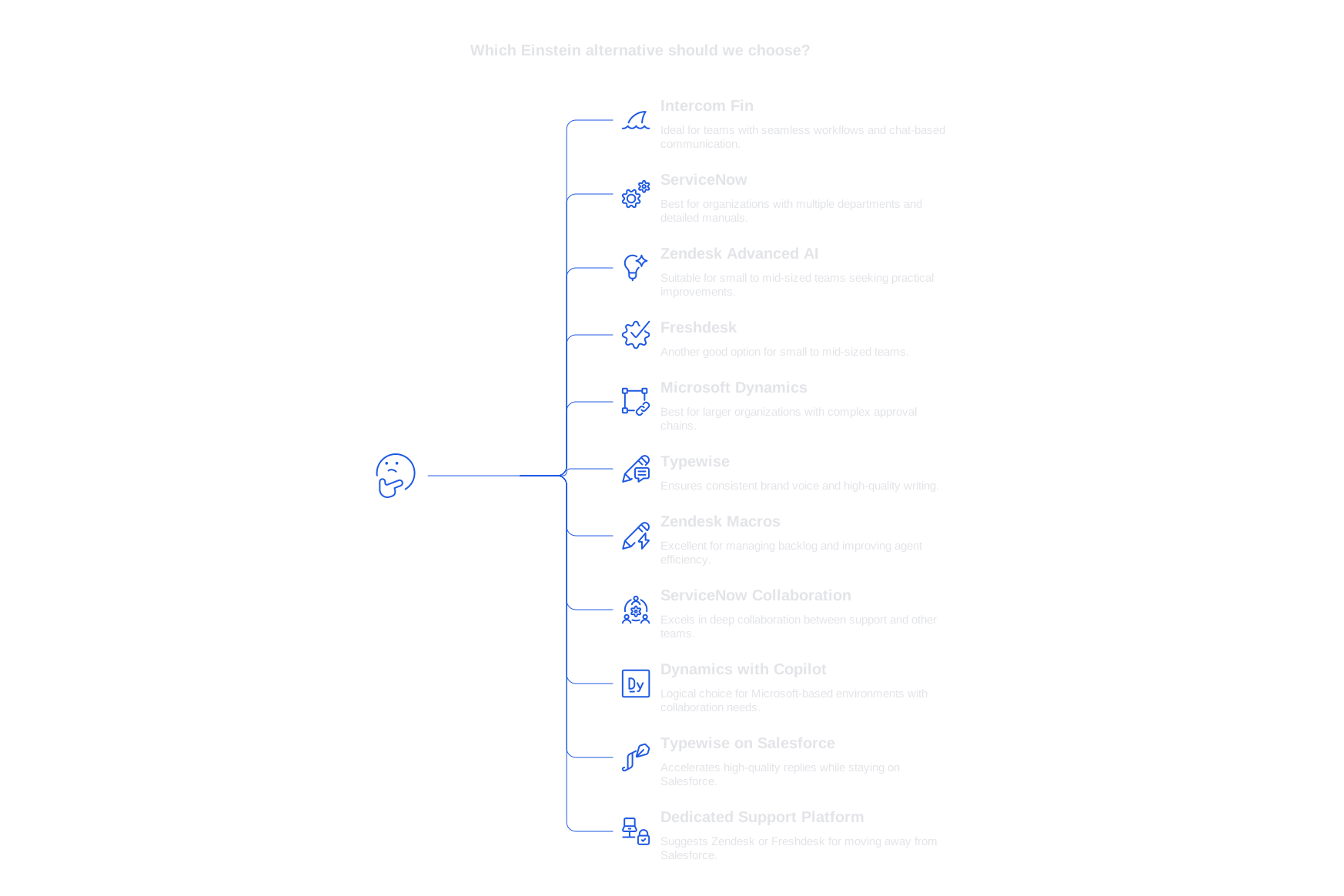
- If your team has established seamless workflows where your help center is highly responsive and a predominant portion of your communication relies on chat, consider Intercom Fin. On the other hand, if your processes involve multiple departments and require detailed procedural manuals (runbooks), ServiceNow might fit you better.
- Small to mid-sized teams aiming for practical, incremental improvement should consider Zendesk Advanced AI or Freshdesk. For larger organizations requiring complex approval chains or workflows, ServiceNow or Microsoft Dynamics are better suited.
- If brand voice and specialized terminology must remain consistent on every response, Typewise ensures unified, high-quality writing across all tools, without the need to change your current platforms.
- When your main concern is managing backlog and improving agent interface efficiency, Zendesk’s combination of macros, views, and AI-powered suggestions stands out.
- If you need deep collaboration between customer support and engineering, IT, or field service teams, ServiceNow’s process-led model excels. For Microsoft-based environments with deep collaboration needs, Dynamics with Copilot is the logical choice.
- If you want to minimize writing time while staying on Salesforce, Typewise accelerates high-quality replies. Moving toward a dedicated support platform suggests Zendesk or Freshdesk as top options.
Conclusion: Choose the Solution that Reduces Friction Fastest
The decision to move away from Einstein is not merely about pursuing newer or more attractive features. It’s about eliminating operational roadblocks that slow down replies and introduce inconsistency. For ticket-driven teams, Zendesk Advanced AI enables faster improvements with lower administrative burden. For organizations that want to enhance the quality and consistency of replies while retaining their current tech stack, Typewise is an excellent option. Where live chat dominates, Intercom Fin boosts self-service and automation; for cross-departmental process depth, ServiceNow and Microsoft lead the enterprise space. Freshdesk, meanwhile, delivers AI-driven modernization for teams prioritizing value.
If you want to understand how Typewise can offer consistent writing assistance that aligns with your brand voice and prioritizes data privacy within your current suite of tools, consider reaching out to their team for a discussion or start a low-risk pilot at typewise.app.
FAQ
What sets Typewise apart from other AI-driven support tools?
Typewise leverages privacy-first AI for consistent brand voice across communications without replacing existing systems. It integrates seamlessly with CRM, email, and chat tools, ensuring high-quality, compliant responses without overhauling your infrastructure.
Is Zendesk Advanced AI a complete CRM solution?
No, Zendesk Advanced AI focuses on ticket-centric workflows and lacks native support for deep account hierarchies and custom objects. While versatile, it's not designed for organizations heavily reliant on comprehensive CRM capabilities without additional integrations.
How does Intercom Fin AI Agent enhance live chat support?
Intercom Fin AI Agent intelligently pulls answers from existing help content, improving chat responsiveness and self-service. However, its efficacy hinges on the quality and organization of your knowledge base, potentially necessitating additional modules for email-heavy environments.
Why might some enterprises prefer ServiceNow over other AI support solutions?
ServiceNow excels in process automation and departmental integration, making it ideal for complex enterprise operations. The trade-off includes longer deployment cycles and higher costs, demanding justification for its robust cross-functional capabilities.
What should Microsoft-first organizations consider when integrating Dynamics 365 Customer Service Copilot?
Organizations should anticipate a learning curve with Dynamics' intricate interface and Dataverse structure, impacting time-to-value. Nonetheless, its seamless integration within the Microsoft ecosystem offers enhanced data proximity and user management benefits.
Is Freshdesk Freddy AI suitable for large enterprises?
Freshdesk Freddy AI is tailored for mid-sized teams seeking low-overhead, practical AI capabilities. It lacks the depth needed for expansive enterprise workflows, making it best for those with a focus on cost-effective modernization of support channels.
Can Typewise meet data privacy needs while maintaining efficient support?
Yes, Typewise uniquely balances rigorous data privacy with efficient writing assistance, adhering to specialized terminologies and internal product guidelines. It empowers teams to uphold data standards without sacrificing response consistency or speed.