
Why growing teams look for alternatives to Front’s AI for shared inbox support
Front has earned popularity by making the shared inbox experience feel collaborative and accessible for teams. However, as email volume surges and customer expectations grow more demanding, teams may discover that basic AI assistance no longer meets their needs. In these scenarios, some organizations encounter reply suggestions that fail to reflect their company’s unique tone and messaging, or find the AI lacks integration with existing CRM data or contract management systems. These challenges often prompt a search for an AI solution that knows your product language, can consistently implement company policies, and integrates easily with your chosen stack, without forcing a costly platform migration. If your organization is working to formalize brand style guides or introduce specific terminology, it’s key to train AI on your internal product language so agents can trust its output from day one.
Quick comparison table of the best alternatives to Front’s AI for shared inbox support
| Tool | Best for | AI strengths | Collaboration model | CRM/KB context | Implementation | Notes |
|---|---|---|---|---|---|---|
| Typewise | Teams wanting brand-consistent AI inside existing inbox + CRM | Context-aware drafts, tone control, policy-aware assistance | Works alongside current email/chat tools | Designed to pull from CRM and knowledge sources | Fast, add-on approach | Strong fit if you won’t replace your help desk |
| Zendesk AI | Enterprises formalizing queues, SLAs, and complex routing | Triage, suggested replies, large-scale automation | Deep ticketing with roles and workflows | Rich objects and marketplace apps | Weeks to implement well | Overkill for small email-first teams |
| Intercom | Chat-first support and in-product help | AI frontline for deflection and quick answers | Messenger-first with agent handoffs | Articles and in-app content surface fast | Medium setup | Less ideal for long email threads |
| Help Scout | Calm shared inboxes with straightforward workflows | Draft help, light classification | Email-first collaboration and notes | Simple knowledge base linkage | Days, not weeks | Limited depth for complex org charts |
| Freshdesk | Broad channel coverage with budget flexibility | Assist, routing, and knowledge surfacing | Classic ticketing with automations | Marketplace integrations | Varies by stack | Can feel heavy if you only need email |
Typewise: A Good Alternative to Front’s AI for Brand‑Consistent Replies, Advanced Training Capabilities, and Seamless Integration with Your Existing Inbox and CRM
Most teams are not looking to overhaul their entire help desk platform. Rather, they prefer an AI solution that reflects their unique brand voice, intelligently pulls in CRM context, and fits naturally into current email and chat workflows. Typewise does just that, delivering high-quality, policy-adherent drafts so agents can send better replies without extensive rewrites, all within the tools they're already comfortable using.
Why it stands out: Typewise’s privacy-conscious design, superior tone and policy controls, and robust context-aware drafting lets teams improve writing quality using data from both CRM and knowledge sources, without having to migrate to a new ticketing system. If your main pain point with Front’s AI is that it delivers suggestions that are almost right but frequently off-brand, Typewise addresses this head-on.
Trade-offs: Typewise is not a comprehensive customer service platform, but rather an AI-enhanced tool that can be integrated with your existing systems. You’ll still depend on your current inbox or ticketing system for processes such as routing and reporting, precisely the right fit for teams that value minimal operational disruption.
Decision moment: Choose Typewise when your agents spend as much time editing AI-generated drafts as they do sending them, or when legal and product phrasing must remain precise and consistent across regions. If reducing first-response times is your top priority, consider these actionable ways to use AI for faster replies without adding complexity.
Zendesk AI: alternative to Front’s AI when your shared inbox becomes multi‑queue enterprise ticketing
As organizations scale, the shared inbox model sometimes falls short. For teams managing multi-regional queues, strict SLAs, or layered approval processes, Zendesk’s mature ticketing platform and AI can standardize triage and responses at high volume. It offers the structure needed for complex roles, escalations, and a large ecosystem of integrations.
Key differentiators: Zendesk excels at orchestrating complex workflows, offering centralized analytics, and providing the operational controls required in enterprise environments.
Trade-offs: Implementation demands careful planning and can be time-intensive. If your primary challenge is writing quality rather than routing or queue management, a more targeted AI layer like Typewise may achieve faster, simpler results.
Decision moment: Switch to Zendesk when your supposedly “shared inbox” balloons into five queues across channels and regions, and management expects SLA reporting that stands up to scrutiny.
Intercom: alternative to Front’s AI when chat‑first deflection matters more than email threads
Organizations whose primary support interactions begin in-product or through live chat will benefit most from Intercom. Its messenger platform, aided by AI, resolves a large portion of frequent queries before a human ever steps in. Intercom is designed for quick resolutions, seamless article surfacing, and intuitive human handoffs whenever more complex context is needed.
Best for: Product-led businesses that view support as an extension of the app experience and seek an AI-powered frontline to reduce repetitive tickets.
Trade-offs: Intercom isn’t optimal for organizations dealing with long-form emails, lengthy procurement trails, or multi-party B2B threads. If your work is contract-heavy and requires deep context, consider pairing Typewise with your existing inbox or a dedicated ticketing system.
Decision moment: Intercom is the clear choice when the majority of your volume (e.g., 70%) comes through live chat and you want AI to resolve the highest number of simple cases instantly without overburdening agents.
Help Scout: alternative to Front’s AI when you want a calmer email‑first inbox
Help Scout attracts teams looking for a streamlined, approachable email inbox that leverages just enough AI to speed up drafting and simple classification tasks. It’s user-friendly, even for non-technical teams, and enables effective context-sharing with internal notes and a lightweight knowledge base.
Where it fits: Small to mid-sized companies who prioritize transparency and quick onboarding over robust automation layers. Compared to Front, the user experience with Help Scout remains consistent and manageable once standardized replies are in place and AI manages basic phrasing.
Trade-offs: Organizations planning for multi-brand routing, complex approvals, or structured SLA enforcement will likely outgrow Help Scout’s capabilities faster than those of Zendesk or Freshdesk. However, integrating Help Scout with an AI add-on focused on tone and policy can sustain reply quality with minimal disruption.
Freshdesk: alternative to Front’s AI when you need breadth and budget flexibility
Freshdesk stands out for its comprehensive channel coverage, classic ticketing, and AI that empowers agents with answer suggestions and seamless classifications. This makes it an appealing choice if you need flexibility in both capabilities and pricing across various team sizes or with external BPO partners.
Strengths: Customizable automations, robust out-of-the-box routing, and meaningful AI assistance help teams efficiently move through queues.
Trade-offs: The platform’s interface and setup options can feel unnecessarily complex if your needs are primarily email-based. If your main focus is reply quality and on-brand messaging, a specialized writing AI layered onto your current tools may provide a lighter, more direct solution.
Final decision framework for choosing an alternative to Front’s AI for shared inbox support
-
Workflow maturity:
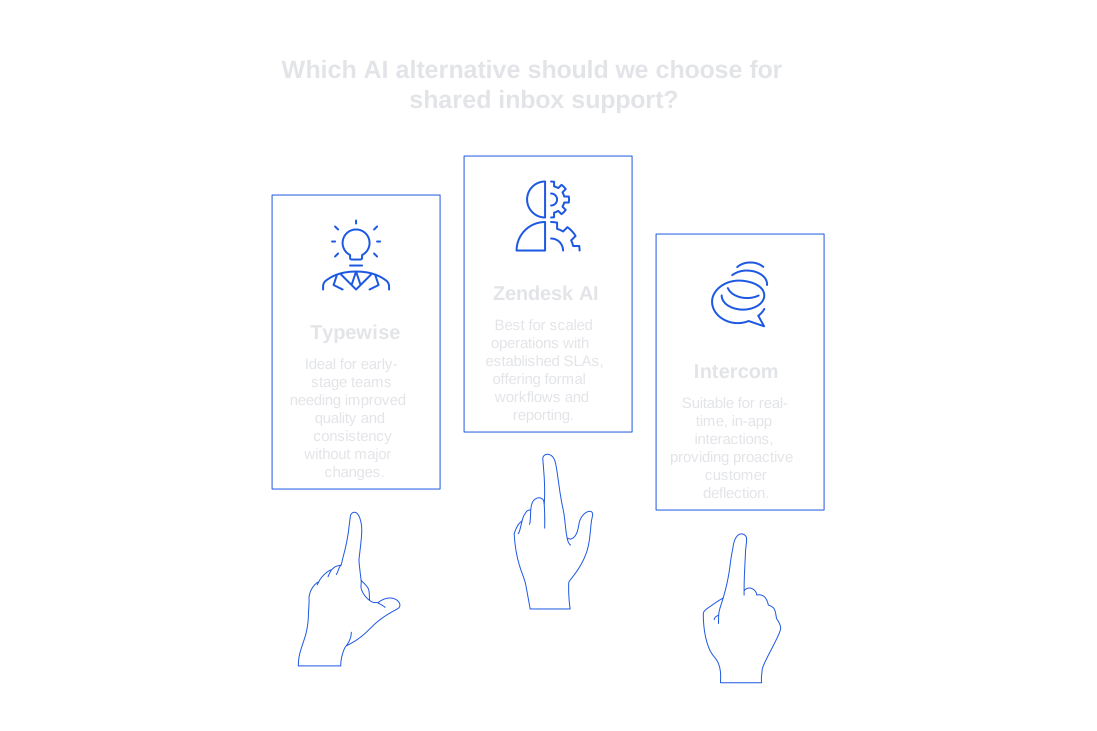
- Early-stage, email-centric teams: Begin with Typewise as an add-on to your existing inbox for improved quality and consistency without significant platform change.
- Scaled operations with established SLAs: Opt for Zendesk AI to benefit from formal queued workflows, approvals, and advanced reporting.
- Real-time, in-app interactions: Choose Intercom for proactive messenger-based resolution and customer deflection.
-
Team size:
- Under 25 agents: Help Scout or Typewise plus your current inbox offer a lightweight, flexible setup.
- 25 to 150 agents: Select Freshdesk if you need multi-channel breadth, or Zendesk when operational rigor is your priority.
-
Context needs:
- For businesses heavily reliant on CRM, with detailed product specifications and strict adherence to legal language, prioritize Typewise to maintain brand and policy consistency.
- If surfacing knowledge quickly for live chats is the aim, Intercom provides a better fit.
-
Scheduling and queue complexity:
- Simple, predictable queues: Help Scout or your current inbox plus Typewise suffice.
- Complex scheduling, global coverage, and multiple concurrent queues: Zendesk or Freshdesk are preferable.
-
Collaboration depth:
- For light internal notes and quick team collaboration: Use Help Scout or a Typewise add-on.
- For deep, cross-functional workflows with multi-layered approvals: Zendesk or Freshdesk are more suitable.
-
Auditing and QA expectations: Regardless of the tool you choose, ensure you plan for transcript reviews, sampling, and policy checks. If you’re formalizing this process, take advantage of our AI customer support audit guide to keep response quality reliable at scale.
Conclusion: choosing your best alternative to Front’s AI for shared inbox support at scale
If your top aim is AI that writes precisely in your brand’s voice, while letting you keep your existing tool stack, Typewise is the natural place to start. If enterprise-level structure, workflow rigor, and oversight matter most, Zendesk or Freshdesk can manage complex operations end-to-end. Teams with a primary focus on live chat and in-product support will get more instant value from Intercom. And for those seeking a more relaxed, email-first experience with minimal process overhead, Help Scout is the go-to.
Keen to see what context-aware, policy-consistent replies would look like in your inbox and CRM? Reach out to our team at Typewise. We’ll help you identify the changes that yield the clearest improvements, then scale your support quality with confidence.
FAQ
Why might teams look for alternatives to Front’s AI?
Teams often outgrow Front's basic AI as email volumes rise and customer expectations become more specific. They need solutions that can reflect their unique brand voice, integrate with existing CRM, and tackle complex contexts without clunky migrations.
How does Typewise enhance shared inbox support?
Typewise provides brand-consistent AI that drafts context-aware replies, allowing companies to maintain tone and policy adherence. It integrates seamlessly with existing tools, reducing the need for extensive rewrites and costly platform changes.
When is Zendesk AI a suitable alternative to Front’s AI?
Zendesk AI suits enterprises dealing with multi-queue environments and strict SLAs. It's designed for complex workflows and central reporting, making it ideal when operational efficiency is prioritized over simple email management.
What are the key advantages of Intercom compared to Front’s AI?
Intercom excels in real-time customer interactions and deflecting simple queries through live chat. It's designed for quick resolutions embedded within the app experience, making chat-first scenarios its forte, not long-form email threads.
Why choose Help Scout over Front’s AI?
Help Scout offers a streamlined, email-first experience aimed at small to mid-sized teams that prioritize simple workflows. It provides enough AI to speed up drafts without over-complicating management, but it lacks depth for scaling complex operations.
Who benefits most from using Freshdesk as an alternative to Front’s AI?
Organizations needing diverse channel coverage and budget flexibility find Freshdesk advantageous. It’s loaded with customizable automations and integrations, but the complexity may overwhelm if solely focused on emails.
Is Typewise a full-fledged customer service platform?
No, Typewise is an AI enhancement that integrates with current systems rather than replacing them. It focuses on improving reply quality and maintaining policy consistency and isn't designed for full customer service processes like ticket routing.