

Establish Trust Before Scaling
Delivering rapid and accurate solutions is essential, even as your policies and product features evolve. Retrieval Augmented Generation (RAG) equips your AI with real access to institutional knowledge by retrieving relevant information and generating clear, referenced responses. When implemented correctly, customers receive precise support, while your organization maintains transparency and control.
Grounding is more effective than speculation. This principle is the foundation of RAG in customer success automation. Achieving this requires a well-structured process, effective tools, and robust methods for measuring performance.
Manage Knowledge Like a Product
Your RAG system’s effectiveness is directly tied to the quality and structure of the information it retrieves. Treat your knowledge base as a dynamic product. Standardize tone, clearly tag intent, and consistently monitor information freshness. Break down extensive documents into sections with consistent identifiers. Ensure product terminology remains uniform across all materials: documentation, macros, and release notes.
Organize Knowledge for Effective Retrieval
- Create task-focused pages addressing only one primary objective each.
- Integrate metadata such as version, language, product area, and audience type.
- Use clear headings to separate steps, prerequisites, and exceptions.
- Incorporate examples that closely mirror real customer inquiries.
Precise and consistent terminology is vital for RAG’s accuracy. If your product’s naming conventions or synonyms are inconsistent, retrieval quality declines. Learn how to train AI on your internal product language for higher accuracy.
Select Retrieval Methods that Reflect Ticket Patterns
Different types of tickets call for different retrieval strategies. Billing queries often function as keyword searches, while complex troubleshooting requires more contextual, semantic retrieval. A hybrid approach addresses both scenarios. Start with keyword filters such as product and version, then process results using semantic (dense vector) search. Ensure that final results comply with permission levels and relevant date ranges.
Document Sectioning that Preserves Context
- Break content into logical sections, rather than arbitrary lengths.
- Carry the parent section title as a breadcrumb in each segment.
- Include citations within your text at the end of each paragraph for better comprehension.
Example of a Hybrid Retrieval Query
query: refund pending after plan downgrade filters: \{ product: Billing, version: v3, locale: en \} retrieve: keyword_top_k 10 then vector_top_k 20 rerank: cross_encoder keep: 5
Develop Prompts that Reference and Constrain
Well-crafted prompts facilitate the extraction of precise answers, reducing the need for guesswork. Instruct your model to reference its sources and remain within their scope. Clearly define steps for addressing situations where information sources conflict or have coverage gaps.
Example of a Grounded Reply Prompt Template
System: You are a customer success AI. Only use the provided snippets. If unsure, say you are unsure and suggest next steps. Cite each sentence with \[doc_id#section\].
User: Customer asks: Why is my workspace locked? Snippets: \[KB-241#2 text...\] \[Runbook-17#A text...\] Task: Draft a reply under 120 words. Tone: clear, calm, and actionable. Include a short checklist and one safety note.
Escalation and Safety Prompt Add-On
System: If the answer requires account changes or exposes PII, stop and respond: This needs secure handling. I will route this to a specialist. Add the exact data points you still need, without collecting them here.
Make Privacy, Security, and Permissions a Priority
RAG systems can inadvertently surface sensitive information. Restrict access by user role, organizational unit, and data classification. Encrypt all indexes at rest, and redact any personally identifiable information before indexing. Remove sensitive tokens and keys from logs. Maintain an audit trail that covers each query, its sources, and responses provided. Cache entries must expire if access rights change. Regularly stress-test your setup using red team techniques to ensure that restricted information remains secure.
Focus on Action-Oriented Responses
Customers prefer concise action steps, rather than large chunks of text. Guide your model to produce responses that include checklists, decision trees, and direct links to self-service options. Clearly present one actionable step for the customer and one for your support representatives. When solutions differ based on plan or region, display clear branches in your response.
- Identify the most probable root cause, then suggest a quick test.
- Provide a fallback action if the test is unsuccessful.
- Use precise product labels as they appear in your user interface.
Concise Action Step Template
Format: Summary in one sentence. Steps: 3–5 bullet points. Put a citation after each bullet (e.g., \[KB-241#2\]). End with: If unresolved, collect X and escalate.
Measure Real-World Outcomes
Assess both customer experiences and model behavior. Use a blend of human review and automated checks, sampling responses daily across different use cases and languages.
Trustworthy Operational Metrics
- Containment rate by intent
- Time to provide the first relevant citation.
- Citation inclusion rate per response.
- Refusal rates when sources are incomplete.
- Retrieval precision and recall using a manually labeled dataset.
- Channel-specific latency tracking.
Effective adoption is key in assisted workflows. Discover how to monitor your AI suggestion acceptance rate to boost trust with accurate citations and consistent tone.
Build and Maintain Golden Sets
Develop a reliable dataset of tickets, scenarios, and ideal responses. Include challenging examples that resemble valid cases but should not match. Perform nightly evaluations, comparing results with previous weeks. If scores drop, examine the retrieval process as the first step, before troubleshooting the model itself.
Target your audits based on risk and ticket volume, then refine your system proactively, don’t limit improvements to team training. For a comprehensive approach, see how to audit AI customer support conversations and feed those insights back into both prompts and source content.
RAG in Customer Success Automation: Align Teams, Content, and Incident Management
RAG operates across various functions: the product team documents changes, the success team presents real case studies, the support team implements playbooks, and the legal team contributes policy guidelines. Assign clear ownership over each knowledge area and schedule reviews to coincide with product release cycles. Link incident reports directly to immediate content updates, not just post-mortem root cause analyses. Update all relevant documentation and internal playbooks on the same day an incident closes.
Choose Your Stack with Insight
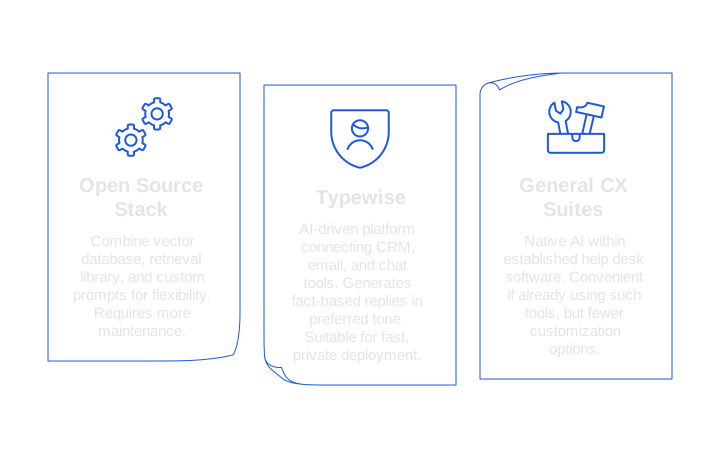
You can either compile a variety of independent software applications together into a stack, or purchase a comprehensive platform that bundles all the necessary features together. Choose based on your support channels, privacy requirements, and internal skillsets.
- Open source stack: Combine a vector database, a retrieval library, and your custom prompts for maximum flexibility, though this requires more ongoing maintenance.
- Typewise: An AI-driven customer service platform that connects with your CRM, email, and chat tools. It generates fact-based replies in your preferred tone while upholding your organization’s data standards. Suitable for teams that want fast, private deployment without heavy in-house development.
- General CX suites: Native AI within established help desk software. A convenient choice if your organization already uses such tools, but may offer fewer options for customization.
Regardless of your approach, document your technology decisions and run tests on real customer tickets before full deployment. If your business uses specialized language, give preference to solutions that understand and adapt to your domain. You can also train AI on your internal product terminology to minimize retrieval errors.
Mitigate Version Drift and Keep Content Current
Outdated information leads to customer frustration. Set explicit review schedules for every content type, especially policy, pricing, and release notes. Use version tags in both your retrieval filters and AI reply templates. Upon each new release, automatically identify outdated segments and refresh or retrain only those portions. Archive legacy features instead of deleting them, maintaining the ability to address older customer issues with the correct background.
Equip Agents for Complex Cases
Self-service works well for straightforward issues, but skilled agents are essential for addressing edge cases. In agent-assist mode, display the top three relevant information snippets along with confidence scores and tags. Allow agents to expand on these details and ensure all changes are tracked for future auditing. Regularly review suggestion quality across intents and languages to continuously improve both AI prompts and knowledge content, thereby increasing your AI suggestion acceptance rate over time.
Start Focused, Iterate Rapidly, and Share Learnings
Begin with a single, high-volume support need that already has robust documentation. Define clear goals and fallback processes. Ensure a human review process is in place for the initial two weeks. Summarize outcomes with concise reports, sample responses, and full citations. Expand to additional intents as you gather learnings. Share improvements with product and documentation teams to ensure ongoing content development is aligned with actual customer needs.
Practical Prompt Snippets for Reuse
Prompt for Clarifying Questions
System: If the retrieved snippets conflict, ask up to 2 clarifying questions first. Keep each under 15 words. Then answer with citations.
Style Prompt for Consistent Brand Tone
System: Write in a friendly, direct style. Use short sentences. Avoid figurative language. Use the same UI labels as in the snippets.
Source Citation Prompt
System: After the steps, list Sources used: with document titles and section names in plain text.
Foster Continuous Improvement Through Conversation Reviews
Conduct weekly reviews of actual customer interactions. Verify that citations accurately support model assertions. Tag any gaps as stemming from content, prompt, or retrieval issues, then update source material and retest on the same scenarios. Create a lightweight rubric for QA teams, allowing each conversation to be evaluated in just a few minutes. For a practical guide, see how to audit AI customer support conversations with structured, repeatable criteria.
RAG in Customer Success Automation: Integrating Typewise Into Your Workflow
Typewise easily integrates with your CRM, email, and chat infrastructure. It produces accurate, grounded responses while maintaining a consistent brand voice and respecting role-based data controls. You retain full ownership and oversight of your knowledge and processes, ensuring balance between rapid implementation and organizational control.
Ready to advance your RAG capability? For a practical approach to generating accurate, well-referenced responses that stand up to quality assurance, connect with Typewise for a discovery session and see how it complements your support stack at /.
FAQ
What is Retrieval Augmented Generation (RAG) in customer success automation?
RAG combines retrieval of institutional data with AI-generated responses, ensuring customers receive precise, well-referenced support. Implementing RAG requires meticulous content management and structured retrieval strategies to maintain accuracy and transparency.
Why is maintaining a consistent terminology important in RAG systems?
Inconsistent terminology leads to retrieval errors and reduces RAG's effectiveness. Regularly updating and standardizing the product language can prevent misinterpretation, ensuring your AI provides precise responses.
How can organizations ensure the privacy and security of data in RAG systems?
Limit access by role, encrypt data, and maintain thorough audit trails. Implementing rigorous red team exercises can further help in identifying and sealing potential data leaks.
How should prompts be designed to work effectively with RAG systems?
Craft prompts to directly reference retrieved information, keeping outputs within the scope of reliable sources. This minimizes speculation and aligns responses with factual data.
How does Typewise optimize RAG implementation?
Typewise integrates seamlessly into existing systems, offering fact-based replies that respect organizational data standards. It ensures rapid deployment without compromising data security and privacy.
Why is it critical to continuously update the knowledge base in RAG systems?
Outdated content erodes trust and frustrates users. Regular reviews and updates ensure responses remain relevant, reducing the risk of misinformation.
What role do agents play in RAG-enhanced support systems?
While RAG can handle straightforward issues, human agents are crucial for complex, edge cases. By using RAG-supplied insights, agents can provide more informed and nuanced support.
How can organizations measure the effectiveness of their RAG systems?
Regularly assess containment rates, citation accuracy, and refusal rates. These metrics reveal how well the system supports both customers and agents, ensuring continuous improvement.