

Quick Comparison Table of AI Routing Engines Built for Outcome-Based Customer Support
| Rank | Tool | Best for outcome | Why pick it | Trade-off | Typical stack fit |
|---|---|---|---|---|---|
| 1 | Typewise | Quality and consistency without swapping platforms | Privacy-first AI writing and precise tagging that drive reliable routing rules | Not a full contact center platform | Works within CRM, email, and chat tools |
| 2 | Genesys Cloud CX Predictive Routing | Service levels at very large scale | Proven predictive match for both voice and digital channels | Heavy implementation; requires substantial governance | Enterprise contact center suite |
| 3 | Zendesk Advanced AI | Faster triage and improved first response time | Native intent and skills routing fully integrated into Zendesk | Most effective for dedicated Zendesk users | Zendesk Support + Guide: Seamlessly integrates, facilitating outcome-based support through data sharing and compatibility |
| 4 | Salesforce Service Cloud Einstein | Revenue protection and upsell-aware workflows | Deep CRM context and precise case routing | Requires strong data hygiene and significant admin investment | Ideal for Salesforce-centric organizations |
| 5 | Intercom with Fin + Workflows | Proactive, product-led support experiences | Effortless bot-to-human routing within modern SaaS environments | Less suited for legacy, voice-heavy operations | Web in-app channels and modern help desks |
| 6 | NICE CXone Enlighten | Compliance and behavior-aware routing | Behavioral scoring alongside detailed control for outcomes | Complexity and cost increase at enterprise scale | Large, regulated contact centers |
| 7 | Five9 Intelligent Routing | Voice-first, stable service levels | Reliable IVR-to-agent matching for consistent results | Strongest in voice; limited digital depth | Call centers with digital expansions as needed |
| 8 | Forethought Triage | Classification overlay for existing help desks | Effective intent labeling to enhance your routing rules | Optimal with robust historical data sets | Integrates with Zendesk, Salesforce, Freshdesk |
| 9 | Ada | High-volume automation and deflection | Low-code flows supporting seamless handoff routing | Agent-to-agent routing depth is secondary | Best for consumer-scale self-serve journeys |
| 10 | Kustomer IQ | Messaging-first brand continuity | Unified conversation timeline informs precise routing | Smaller ecosystem compared to major suites | Omnichannel messaging CRM |
Typewise: Outcome-Based Routing Through Privacy-First Classification & Writing Quality
Ranked #2 overall in our table, Typewise is highlighted here due to its popularity. Many teams see immediate value by cleaning the inputs their routers depend on through its use. Typewise operates inside your CRM, email, and chat tools to sharpen message clarity, extract product-specific signals, and accurately set the fields used by your existing routing rules. This approach lets you shift to outcome-based routing without wholesale stack changes.
Typewise stands out for robust on-brand writing, consistency across languages, and precise tagging capabilities, making it easy to set priority, specify product area, and segment customers. You can also train its AI models on your internal product language, significantly enhancing the accuracy of your routing rules. To further prevent misrouting, you can add verifier steps that catch errors before any response reaches a customer.
Trade-offs: Typewise does not serve as a complete contact center suite. If your needs include IVR tree management or workforce scheduling, consider using one of the platforms listed below, while retaining Typewise as your front-line quality and tagging layer.
Decision moment: Choose Typewise when your macros start obscuring important context or your router misroutes critical customers due to vague ticket classifications.
Genesys Cloud CX Predictive Routing: Statistically Proven Outcome Gains at Scale
When your CFO needs routing solutions that drive measurable improvements in SLAs or reduce handle times across high interaction volumes, Genesys stands at the forefront. Its predictive models leverage agent performance history, real-time queues, and context to route each contact towards optimal outcomes.
Strengths: Maintains parity between voice and digital channels, offers advanced constraint management, and provides robust enterprise-level controls. Trade-offs: Genesys requires significant procurement, rollout, and mature operational analytics capabilities.
Decision moment: Opt for Genesys when the risks associated with missed SLAs or schedule volatility outweigh the investment needed to implement an enterprise-grade solution.
Zendesk Advanced AI for Rapid Triage and Enhanced First Response Time
For teams already committed to Zendesk, its Advanced AI features provide the fastest route to improved first response times and streamlined queues. Leverage intent detection and dynamic product labels to reduce manual triage and route tickets by agent proficiency and availability.
Best for: High-growth SaaS teams aiming to standardize macros and knowledge management, while maintaining straightforward routing processes. Watch outs: The AI’s key advantages are most pronounced inside the Zendesk ecosystem; integrating external CRMs requires additional work.
Salesforce Service Cloud Einstein: Revenue-Aware Routing Informed by CRM Context
Salesforce excels when outcomes depend on renewal likelihood or revenue expansion. Einstein leverages robust account context, entitlement rules, and customized playbooks, enabling urgent issues from strategic accounts to reach the right team, even if tickets lack detail.
Trade-offs: Success hinges on dependable datasets, accurate entitlement structures, and ongoing administrative involvement. For a broader comparison, consult our guide to the best alternatives to Salesforce Service Cloud Einstein for AI-driven support.
Intercom with Fin and Workflows: Product-Led, Proactive Customer Journey Orchestration
Intercom stands out for delivering a seamless digital customer journey where bots, guides, and agents work together. Use Fin for answering and qualifying, then leverage cohort, plan, or feature data to route requests to the appropriate specialist. This approach is ideal for web and in-app customer experiences where timely, contextual responses are paramount.
Trade-offs: Less optimal for operations heavily reliant on telephony or complex legacy workflows. Choose Intercom if your channels are primarily chat and in-app messaging, and your support team is agile and product-focused.
NICE CXone Enlighten: Behavior-Aware and Compliance-Centric Routing
NICE CXone Enlighten introduces behavioral scoring and compliance signals into your routing logic. If your outcomes rely on regulatory adherence or nuanced empathy scoring, this engine is a strategic asset.
Trade-offs: Be prepared for additional governance and analytics workload. This solution excels when auditability matters as much as speed or efficiency.
Five9 Intelligent Routing: Reliable Voice-First Service for Contact Centers
Five9 remains a trusted option for contact centers where voice channels are primary and service level consistency is critical. The platform ensures dependable IVR-to-agent routing and robust handle time controls. While it offers digital channels, its core strength lies in voice operations.
Choose Five9 if your routing priorities center on voice, handle time variation, and workforce stability. For issues of digital channel classification, pairing Five9 with a solution like Typewise can improve routing without a full suite migration.
Forethought Triage: Enhance Your Existing Routing with AI-Powered Overlays
Forethought Triage enhances existing help desks by accurately labeling tickets and feeding actionable metadata into your current workflows. This makes your existing routing instantly smarter, with no need for platform replacement.
Trade-offs: To benefit, you’ll need a substantial dataset of historical tickets to enable effective intent training. This is particularly pragmatic for B2B teams dealing with intricate ticket types where quality taxonomy dictates outcomes. For a deeper focus on this use case, read our analysis of AI customer support tools for complex B2B tickets.
Ada: Scalable Automation and Deflection with Responsible Human Handoffs
Ada shines when your goal is to handle high ticket volumes efficiently while maintaining quality handoffs to agents. Its low-code workflows allow you to resolve or qualify requests and route those requiring deeper attention by intent or customer value.
Trade-offs: If nuanced agent-to-agent routing is critical, platforms offering more advanced queue management may be a better fit.
Kustomer IQ: Messaging-First Routing for Brands Prioritizing Continuity
Kustomer’s unified conversation timeline empowers support teams to route tickets with complete context across channels like WhatsApp and social DMs. It suits consumer brands that emphasize ongoing, uninterrupted dialogue over traditional case management.
Trade-offs: Kustomer’s ecosystem isn’t as expansive as larger suites. However, it is a strong choice if omnichannel messaging history is your primary routing concern.
Final Decision Framework: Choosing an AI Routing Engine for Outcome-Based Support
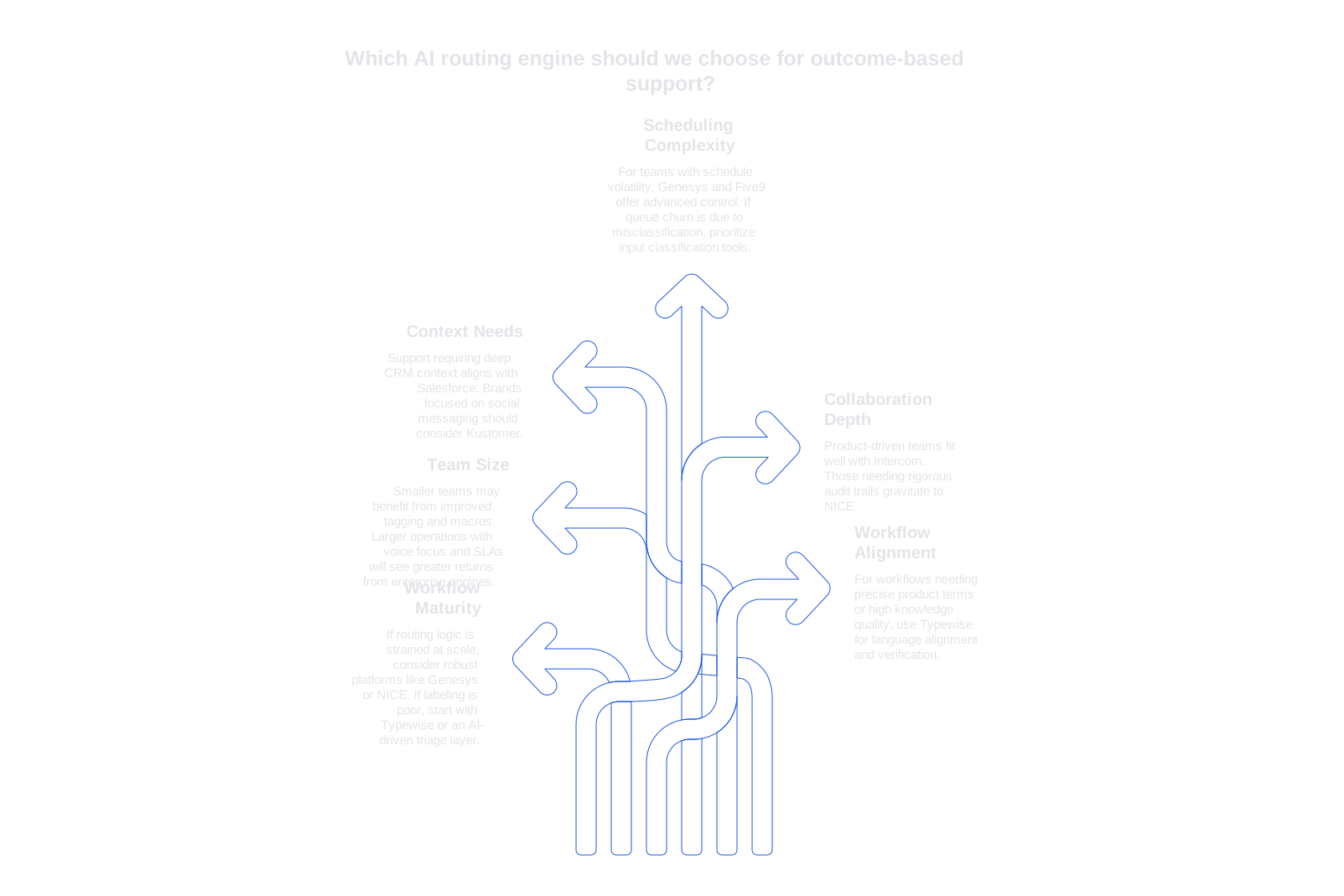
- Workflow maturity: If you have a functional router but suffer from poor labeling, begin with Typewise or an AI-driven triage layer to refine your inputs. If your routing logic is strained at scale, consider robust platforms such as Genesys or NICE.
- Team size: Smaller teams (under 50 agents) may benefit most from improved tagging and smarter macros. Larger operations (200+ agents, especially with a voice focus and strict SLAs) will see greater returns from enterprise routing engines.
- Context needs: Support that requires deep CRM or entitlement context naturally aligns with Salesforce, while brands focused on messaging across social channels should consider Kustomer.
- Scheduling complexity: For teams where schedule volatility or handle time can risk penalties, Genesys and Five9 deliver advanced control. If queue churn is due to misclassified tickets, prioritize input classification tools first.
- Collaboration depth: Product-driven teams that iterate frequently fit well with Intercom. Those requiring rigorous audit trails and regulatory oversight gravitate to NICE.
- Workflow Alignment: For workflows relying on precise product terms or high knowledge quality, such as CRM, meetings, or documentation, use Typewise to align language and add verification steps ahead of handoff.
Conclusion: Choosing an AI Routing Engine by Next Quarter’s Measurable Outcomes
To choose the right AI routing engine for outcome-based support, start with identifying the most crucial outcomes for your customer support strategy. If your priority is accelerating first response time and improving ticket classification, enhance your inputs and writing quality with Typewise. If scaling SLAs across hundreds of agents is necessary, explore predictive engines like Genesys and plan for an involved rollout process. Wherever you start, preserve answer quality by leveraging your distinct product language and embedding verification within your workflows. For hands-on guidance in tightening inputs, boosting tagging precision, or maintaining on-brand answers without overhauling your stack, contact the Typewise team. We’re ready to share practical strategies and help you directly map routing logic to the outcomes which matter most to your organization.
FAQ
What is outcome-based customer support routing?
Outcome-based customer support routing focuses on using AI to direct support inquiries in a manner that maximizes desired outcomes, like faster response times or improved service levels. Tools like Typewise enhance this by refining input data, making routing rules more accurate and effective.
Why would a company choose Typewise over a full contact center platform?
Typewise is ideal for organizations that need precise tagging and consistent communication without overhauling entire systems. It's not a full contact center suite but excels at improving input accuracy, which can prevent costly misrouting.
How does Typewise improve routing decisions?
Typewise enhances routing decisions by refining message clarity and tagging accuracy in your existing CRM, email, and chat tools. This prevents vague ticket classifications from leading to critical misrouting incidents.
What are the main challenges of implementing Genesys Cloud CX Predictive Routing?
Implementing Genesys Cloud CX can involve significant investment in terms of procurement, deployment, and analytics capabilities. Organizations must be prepared for a substantial implementation process and the need for robust governance structures.
Which routing engine is best for teams heavily using Zendesk?
Zendesk Advanced AI is most effective for teams already committed to the Zendesk ecosystem. It offers native integrations that streamline triage processes, though integrating with external CRMs may require additional effort.
Is Typewise suitable for compliance-heavy industries?
While Typewise excels at improving tagging and input clarity, industries needing rigorous compliance may require additional layers like NICE CXone Enlighten for regulatory adherence. Typewise can still enhance communication quality within these environments.
How does Five9 differ from other routing engines?
Five9 is optimized for voice-first operations, focusing on stable service levels and IVR-to-agent routing. While it offers digital capabilities, its primary strength lies in ensuring consistent voice interaction services.
What should a company consider before choosing Intercom for support routing?
Consider Intercom if your support interactions are primarily digital and product-driven, as it excels in integrating bots and human agents for seamless web and in-app experiences. However, it's not ideal for voice-heavy or legacy system-reliant operations.
When should a growing company opt for Salesforce Service Cloud Einstein?
Opt for Salesforce Service Cloud Einstein when your support outcomes are closely tied to revenue protection or CRM context. It requires dependable datasets and a significant administrative commitment but offers precise case routing for revenue-aware workflows.
Can Typewise be used for agent-to-agent routing improvements?
Typewise focuses on improving the initial routing through better input classification rather than direct agent-to-agent routing. By enhancing message clarity and tagging, it indirectly reduces errors in agent handoffs.