
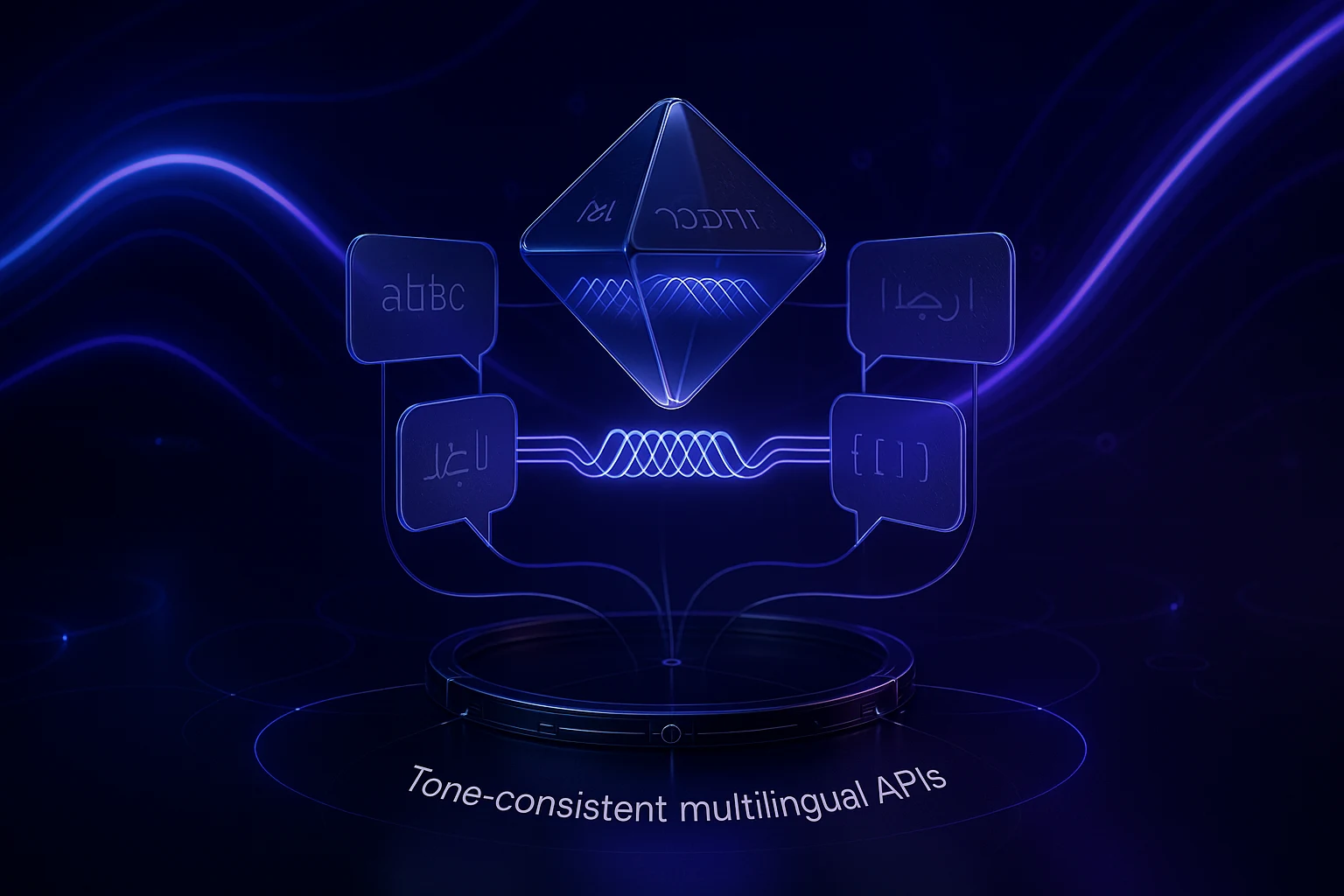
Tone-Consistent Multilingual Support Needs More Than Literal Translation
Your global customers are just as sensitive to tone as to content. A reply can be factually correct and still feel misaligned with your brand. The ideal translation API lets you maintain your brand voice consistently, no matter the language, communication channel, or time zone.
This guide covers practical selection criteria, specific API recommendations, and a straightforward implementation plan that prioritizes both privacy and response speed.
Criteria for Selecting the Best Translation APIs for Tone-Consistent Multilingual Support
Focus on four pillars. First, look for enforceable terminology features, such as glossaries or dictionaries. Second, prioritize tone controls like formality settings or the use of custom models tailored to your brand’s specific language style. Third, assess privacy commitments by reviewing each API’s data-use terms. Fourth, confirm operational fit by evaluating factors like latency, regional hosting, and document translation support.
Plan for robust quality assurance. Combine translation APIs with verifiers and conversational audits to keep tone aligned as support volumes grow. Introducing verifiers can serve as an extra safeguard, and regularly reviewing multilingual chats will help ensure ongoing tone consistency.
DeepL API for Tone-Consistent Multilingual Support: Glossary and Formality Controls
DeepL API enables the use of glossaries to enforce brand-specific terminology.
By supplying a glossary_id, you ensure consistent term usage in text and file
translations. This is especially valuable for product names and UI strings that
must remain stable.
DeepL also provides a formality parameter in supported languages, allowing you
to specify a formal or informal tone per request, ideal for brands with distinct
voice requirements.
(DeepL formality feature)
Privacy is a key strength: DeepL API Pro deletes processed texts immediately. Review your plan’s details to confirm how your data is managed.
Operational note for your teams: DeepL no longer supports older authentication methods embedded within the query or body fields of a request as of November 1, 2025. You should migrate to newer methods, such as passing keys in headers, if you have older clients.
Google Cloud Translation for Tone-Consistent Multilingual Support: Enterprise Policies and Glossaries
Google Cloud Translation Advanced supports glossaries to control domain- and product-specific language across support macros and templates. It also allows for regional and project-based glossary management.
Data-use terms are transparent: Google states that submitted content is used solely to provide the Translation API service, not to train general translation features. This clarity is valuable for your compliance and legal teams. (Google Cloud data usage)
Microsoft Translator for Tone-Consistent Multilingual Support: Custom Models and Dictionaries
Microsoft Translator lets you apply a dynamic dictionary for real-time terminology control. For even greater domain alignment, you can also build Custom Translator models trained with your own parallel data. These features ensure translations match your industry’s unique phrasing.
This approach is especially effective for teams that already use Azure as their primary cloud computing platform. It centralizes keys, logging, and access policies while supporting large-scale terminology tuning.
Amazon Translate for Tone-Consistent Multilingual Support: Terminology, Formality, and Content Usage
Amazon Translate provides custom terminology support for brand and product terms, along with a formality parameter for several languages and optional profanity masking. Together, these tools help keep your brand voice and messaging intent aligned.
Carefully review the service FAQ with your legal and security teams. AWS notes that input texts may be stored and used to improve Amazon Translate and related technologies, so make sure this matches your internal data residency and vendor evaluation policies.
OpenAI Models as a Translation API for Tone-Consistent Multilingual Support: Instructions and Prompts
Large language models (LLMs) such as those from OpenAI are capable of accurate translation while following custom style instructions. OpenAI documents robust multilingual capabilities and allows prompt-based control, ideal for tone-sensitive situations or mixed-language requests. (OpenAI multilingual usage)
To preserve tone and terminology, use a consistent, versioned system prompt that clarifies expectations for placeholders, style, and word choices.
System: You translate support messages for our product. Style: clear, concise, friendly. Spanish uses tú. Preserve placeholders like \{ticket_id\} and markdown. Keep emojis and punctuation. Glossary: workspace → espacio de trabajo; seat → licencia; Knowledge Base → Centro de Ayuda.
For enhanced quality, layer on automated verifiers that check glossary adherence, respectful tone, and honorifics before replies reach customers. See more details in this guide on self-checking AI workflows with verifiers.
Recommended Stacks for Maintaining Tone Consistency Across Languages
- DeepL API plus glossaries: Use
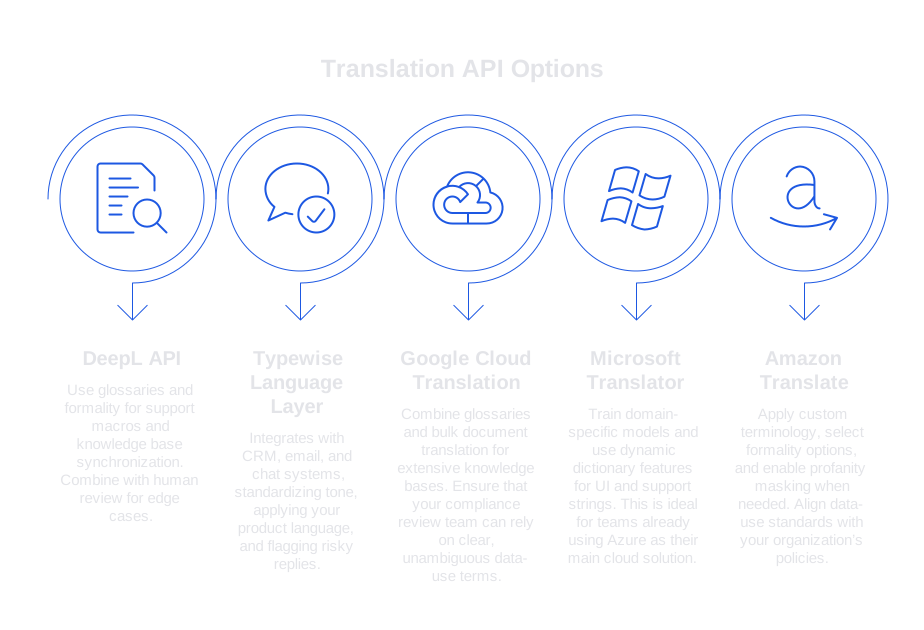
glossary_idandformalityfor support macros and knowledge base synchronization. Combine with human review for edge cases. - Typewise language layer combined with your translation API: Typewise integrates with CRM, email, and chat systems, standardizing tone, applying your product language, and flagging risky replies. Provide it with your term base and macro set, and support it with automated verifiers. Learn to train AI on internal product language or audit AI customer support conversations for continuous improvement.
- Google Cloud Translation Advanced with enterprise policy controls: Combine glossaries and bulk document translation for extensive knowledge bases. Ensure that your compliance review team can rely on clear, unambiguous data-use terms.
- Microsoft Translator with Custom Translator: Train domain-specific models and use dynamic dictionary features for UI and support strings. This is ideal for teams already using Azure as their main cloud solution.
- Amazon Translate for scale and terminology control: Apply custom terminology, select formality options, and enable profanity masking when needed. Align data-use standards with your organization’s policies.
Implementation Checklist for Deploying Translation APIs with Tone Safeguards in Customer Support
- Define clear tone rules and examples for each supported language, with do’s and don’t lists for agents.
- Build a bilingual glossary for product and UX terms. Assign ownership of this glossary to your Product Operations team.
- Select an API that matches your tone and terminology requirements. Verify its privacy policy.
- Establish a feedback loop by sampling support tickets and checking for tone drift each month.
- Add automated verifiers to intercept replies with tone or terminology breaks before they’re sent.
- Document and version system prompts, restricting edit access to approved stakeholders.
For structured verification, see the approach detailed in adding verifiers to catch bad support answers. Combine this with regular audits to keep your multilingual tone sharp.
System: Verify the translated reply. Check glossary conformance. Check formality rules per locale. Confirm placeholders and links are intact. If any check fails, return a short fix suggestion.
Practical Notes on Procurement and Measurement for Tone-Consistent Translation APIs
Run a side-by-side comparison with your own support tickets, including examples that use sarcasm, idioms, and specialized jargon. Measure the hit rate for glossary terms, tone fit, and how much edits are needed before messages are sent.
During trials, verify regional endpoints for data handling and routing, making sure they align with your data policies. Always review vendor documentation for details on formality, glossary management, and data usage prior to purchase.
Where Typewise Fits in Translation Workflows for Tone-Consistent Multilingual Support
Most APIs are capable of accurate translation, but they may lack the ability to maintain tone consistency throughout a conversation without additional input. Typewise adds this crucial layer by standardizing phrasing, nudging replies to align with your brand voice, and integrating seamlessly with your CRM systems.
It also enables ongoing quality assurance. You can track adoption of system suggestions and monitor trends through regular audits. For practical guidance, refer to our article on auditing AI customer support conversations.
Ready to Align Tone Across Languages Without Slowing Replies?
If you’d like an assessment of your current setup and tone guidelines, we’re here to help. Contact us to discuss a pilot project that layers Typewise’s language tools on top of your current translation API. Start your conversation at typewise.app.
FAQ
Why is maintaining tone consistency important in multilingual customer support?
Tone consistency ensures your brand voice remains recognizable, building trust and enhancing the customer experience across different languages. Inconsistent tone can confuse or alienate customers, undermining brand credibility and loyalty.
How does Typewise help with maintaining tone consistency?
Typewise standardizes phrasing and nudges responses to align with your brand voice, ensuring tone consistency across languages. It integrates seamlessly with CRM systems, adding a critical layer of tone management that APIs alone might lack.
What are the risks of choosing the wrong translation API?
Choosing a subpar translation API can lead to miscommunication, tone mismatches, and potential data privacy issues. Incorrect terminology and tone can damage brand reputation and frustrate multilingual customers.
How can we ensure data privacy with translation services?
Review each API's data usage policies and select those with strong privacy commitments. Typewise and other advanced solutions can help ensure compliance through rigorous audits and verifiers.
What challenges do translation APIs face with tone-sensitive content?
APIs often struggle with idioms, sarcasm, and tone nuances without additional context. Adding layered tools like Typewise can enhance tone management and align translations with brand consistency requirements.
How does an automated verifier improve translation quality?
Automated verifiers intercept potential tone and terminology mismatches before they reach the customer. This proactive step minimizes errors and maintains brand integrity in customer communications.
What is the role of glossaries in translation APIs?
Glossaries enforce consistent use of brand-specific terminology, ensuring accurate translations of key terms. They are crucial for maintaining brand voice integrity, especially in technical or industry-specific contexts.