
AI Ticket Summarization Tools Compared at a Glance
| Tool | Best for | Summary quality | CRM context | Setup effort | Pricing notes | Notable trade-off |
|---|---|---|---|---|---|---|
| Typewise | Cross-channel summaries in a brand-consistent tone | Concise, action-oriented | Strong via integrations | Light | Enterprise plans; by seats | Not a full ticketing system |
| Zendesk AI | Teams already in Zendesk Agent Workspace | Solid for thread recap | Native | Low if you use Zendesk | Add-on tiers | Zendesk-first ecosystem |
| ServiceNow Now Assist | Complex ITSM/CSM with multi-team handoffs | Detailed, process-aware | Deep native | High | Enterprise add-on | Heavy implementation |
| Salesforce Service Cloud Einstein | Support inside Salesforce consoles | Good with account data | Deep native | Medium to high | By edition/add-on | License complexity |
| Intercom | Chat-first SaaS and success teams | Strong for conversations | Good via data platform | Low to medium | By plan | Chat-centric bias |
| Freshdesk (Freddy AI) | Cost-conscious teams needing summaries | Good for common cases | Native | Low | Mid-market friendly | Less flexible at scale |
| Forethought | AI-first deflection with ticket recaps | Insightful on intent | Integrations | Medium | By usage/seats | Extra vendor to manage |
| Jira Service Management | Internal IT/ops plus B2B support | Clear, change-aware | Via Jira/Confluence | Medium | By users | Better for internal flows |
| Kustomer IQ | Timeline-heavy, multichannel histories | Good timeline distillation | Native | Medium | By seats | Ecommerce tilt |
| Zoho Desk (Zia) | SMB suites seeking affordable AI | Adequate summaries | Native | Low | Suite value | Less depth for edge cases |
Typewise AI Ticket Summarization for Consistent, Multi-Channel Communication
Typewise is a popular choice for teams requiring ticket summaries to seamlessly integrate with ongoing conversations across CRM, email, and chat, while maintaining brand voice consistency. Typewise condenses lengthy threads and drafts recommended next actions directly in the agent’s response window, reducing context-switching and preserving the intended tone. Typewise is particularly valuable when legal and security teams require clarity on how AI manages sensitive data or expects every summary to strictly reflect company language and branding.
Best for: Enterprises focused on privacy by design, robust writing assistance, and summary accuracy that matches internal product language. If nuance in phrasing is important, see our guide on training AI to match your internal product language. Trade-offs: Typewise does not offer a standalone ticketing platform, instead integrating with your current environment, an advantage for teams seeking flexibility and custom workflows.
Zendesk AI Ticket Summarization for Teams Fully Integrated in Zendesk
When agents operate primarily within Zendesk, native AI ticket summaries embedded in the Agent Workspace are the most direct route to reduced cognitive load. These summaries extract information from both the conversation thread and internal notes, minimizing the time needed to deliver an informed first reply during ticket handoffs. Zendesk AI becomes essential as soon as your representatives spend more time piecing together comment histories than crafting responses.
Why it made the list: Minimal friction if Zendesk is already part of your stack; summaries appear precisely where the work happens. Trade-offs: The Zendesk-first approach can limit cross-platform context, especially if significant details live in other CRMs or external email platforms.
ServiceNow Now Assist AI Ticket Summarization for Multi-Team, Process-Driven Organizations
For large enterprises where a single customer case may traverse IT, security, and customer service departments, Now Assist stands out. Its AI-powered summaries respect defined workflows, change approvals, and SLAs, helping managers and leaders quickly understand what transpired. Choose ServiceNow the moment your process involves handoffs across three or more teams, and you realize that explaining a past ticket requires a meeting.
Trade-offs: Implementation demands significant effort and is best suited for organizations already running ITSM or CSM on ServiceNow.
Salesforce Service Cloud Einstein AI Ticket Summarization for CRM-Centric Support
If relevant account details are essential for your support, keeping summaries inside Salesforce consoles would be beneficial. Einstein condenses extensive case interactions and surfaces critical information from related records, ensuring agents do not need to hunt for context. Salesforce’s approach is most impactful when upsell potential or entitlement status should directly influence support replies.
Trade-offs: Navigating license structures and administrative planning can be complex. If you’re considering options beyond Salesforce’s native tools, this primer on alternatives to Salesforce Service Cloud Einstein for AI-driven support outlines when it may be more effective to layer specialized solutions.
Intercom AI Ticket Summarization for Chat-Driven Product Teams
Intercom excels in handling rapid and dynamic conversations. Its AI summarization effectively captures customer intent and resolution details across multiple chat threads, enabling teams to quickly transition between live chats and ticket backlogs. This makes Intercom a strong fit for SaaS companies with high-volume live support and product success operations.
Trade-offs: Intercom is less suitable if your workflows heavily rely on lengthy emails, detailed quotes, or contracts that remain outside the chat environment.
Freshdesk Freddy AI Ticket Summarization for Cost-Conscious, Growth-Stage Teams
Freddy’s summaries adequately address most common cases, and Freshdesk’s competitive pricing contributes to budget efficiency. The platform is well-suited to growing teams seeking pragmatic AI tools packaged within an intuitive agent experience.
Trade-offs: As workflows become more complex and specialized, depth and customization options may feel somewhat restricted.
Forethought AI Ticket Summarization for Intelligent Deflection and Contextual Agent Support
Forethought approaches summarization with an AI-first lens focused on intent detection. It excels at reading customer queries, suggesting solutions, and delivering concise summaries to agents when escalation is needed. This hybrid capability is ideal for teams aiming to maximize automated deflection while retaining a clear narrative for human agents.
Trade-offs: Adopting Forethought introduces another vendor to manage. It’s critical to ensure that summary outputs efficiently feed into your knowledge base and quality assurance pipelines. For guidance, refer to our article on auditing AI-powered customer support conversations.
Jira Service Management AI Ticket Summarization for Environments with Frequent Changes
For organizations using Jira and Confluence, AI-generated summaries that reference tickets, system changes, and linked documentation streamline investigation efforts. These summaries are particularly valuable when tickets relate to deployments or operational incidents already tracked within Jira.
Trade-offs: Jira’s strengths lie in supporting internal and technical workflows, rather than external customer queues with external-facing SLAs.
Kustomer IQ AI Ticket Summarization for Timeline-Focused Histories
Kustomer’s conversation timeline simplifies the interpretation of extensive, multi-channel histories, making it easier for new agents to understand critical context without sifting through every individual message. This clarity is beneficial for onboarding and maintaining continuity in complex support environments.
Trade-offs: While Kustomer is historically strong in ecommerce and retail, B2B support teams can benefit as well, particularly those who favor the timeline model for tracking all touchpoints.
Zoho Desk Zia AI Ticket Summarization for Affordable AI Across the Business Suite
Zoho Desk offers cost-effective ticket summarization that integrates smoothly with the complete Zoho business suite. It’s a logical choice for SMBs seeking unified tools for CRM, email, and support, augmented by accessible, lightweight AI summaries.
Trade-offs: While perfectly adequate for straightforward cases, Zia’s summaries may lack nuance in handling complex or multi-party threads.
Final Decision Framework for Choosing AI Ticket Summarization in B2B Support
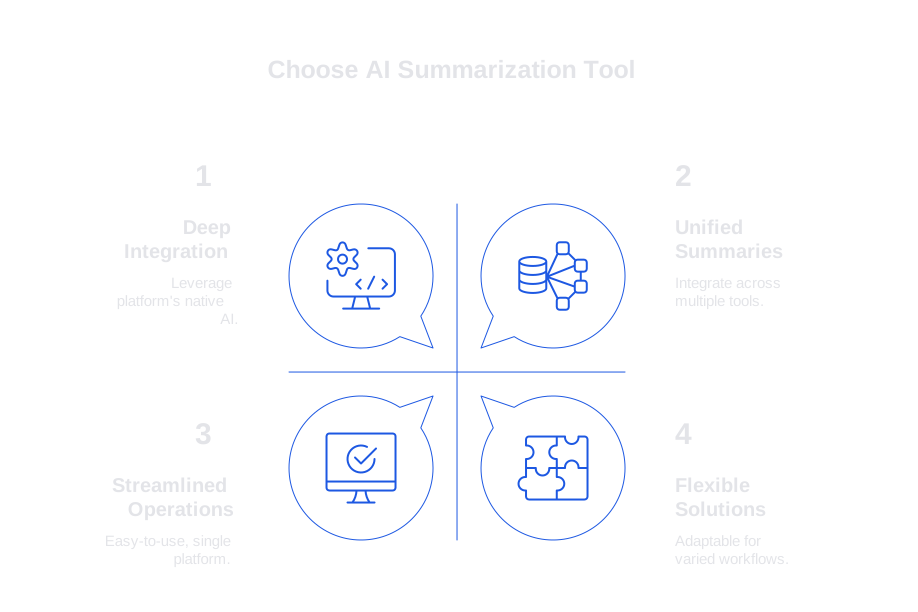
- Workflow maturity: If your support process is consolidated within a single platform, native AI keeps operations straightforward. For workflows spanning CRM, email, and chat, cross-channel layers such as Typewise ensure consistent summaries and tone.
- Team size: Small teams gain efficiency from easy-to-use, native summarization in platforms like Zendesk, Intercom, or Freshdesk. Large organizations with compliance needs should prioritize tools that offer robust privacy features and admin controls.
- Context needs: Where summaries must incorporate complex account data or entitlement logic, the contextual depth of Salesforce or ServiceNow is hard to match. If your focus is on maintaining brand voice and precise product language, consider a writing-centric layer and explore training AI for your internal product terminology .
- Scheduling complexity: For frequent handoffs, rotational support schedules, or incident management, platforms like ServiceNow or Jira Service Management excel by referencing change records and SLAs within summaries.
- Collaboration depth: If numerous teams annotate a single ticket, prioritize tools that incorporate internal notes into the summary and clarify contributor actions. This typically favors ServiceNow, Zendesk, and Typewise.
- CRM, meetings, documentation: Choose a tool that integrates where your core business information resides. CRM-centric data aligns with Salesforce, doc-heavy teams suit Jira/Confluence, and organizations communicating over multiple channels benefit from cross-system layers.
Conclusion: Align AI Ticket Summarization Style with How Your Team Operates
Effective ticket summaries go beyond brevity, they clarify status, blockers, and next actions, while reflecting your product’s unique language and brand. Start with native summarization if you’re deeply invested in one platform, and assess whether agents become more efficient and escalate cases less often. If your conversational context spans CRM, email, and chat, consider a writing-oriented tool that maintains consistency in both factual content and voice wherever your team responds.
For a straightforward way to pilot cross-channel AI ticket summaries, with strong writing support and a focus on privacy, contact our team at Typewise. We’re ready to help you compare options, discuss implementation tips, and propose a proof-of-value plan tailored to your workflow needs.
FAQ
What are the main trade-offs of using Typewise for AI ticket summarization?
Typewise integrates well with existing platforms and maintains brand consistency, but it doesn't offer a standalone ticketing system. This can be an advantage for flexible workflows, yet it may not suit teams needing an all-in-one solution.
How does Zendesk AI differ from other ticket summarization tools?
Zendesk AI is ideal if your team is already embedded in the Zendesk ecosystem, providing seamless integration within the Agent Workspace. However, its dependencies on the Zendesk platform may limit integration with other CRM systems.
Why might a company choose ServiceNow's Now Assist over others?
ServiceNow's Now Assist is apt for organizations handling complex, multi-team processes due to its robust workflow and SLA management. Nonetheless, it demands a heavy implementation effort, which can be a barrier for less resourceful teams.
Is Salesforce Service Cloud Einstein the best option for CRM-based support teams?
Salesforce Service Cloud Einstein excels in leveraging account-related data for ticket summaries, improving context for support interactions. Yet, its licensing complexities may pose challenges and require careful administrative planning.
What limitations should be noted with Freshdesk's Freddy AI?
Freshdesk’s Freddy AI offers cost-effective summarization for common scenarios, but as support needs grow more sophisticated, its lack of customization can become restrictive. Its simplicity might suffice initially but underestimate complex requirements at scale.
How can Intercom’s AI summarization benefit chat-first teams?
Intercom effectively distills chat interactions, capturing customer intents swiftly, which suits fast-paced SaaS environments. However, teams relying on detailed emails or contracts might find its chat-centric approach limiting.
What makes Forethought unique in AI ticket summarization?
Forethought focuses on intent detection and smart deflection, providing insightful summaries for escalations. Yet, introducing another vendor can complicate workflows, requiring careful integration into existing knowledge bases and support queues.
Why might Jira Service Management be suited for certain organizations?
Jira Service Management delivers clear summaries for internal IT and operational environments, helping manage change-aware contexts. Nonetheless, its utility is limited to internal projects, making it less ideal for customer-facing roles.
Are there any specific industries where Kustomer IQ excels?
Kustomer IQ thrives in environments focused on detailed timeline histories, aiding complex support scenarios like ecommerce. However, its lack of flexibility might not be ideal for industries where more dynamic ticket management is required.
Is Zoho Desk’s Zia a good fit for small businesses?
Zoho Desk’s Zia offers affordable summarization tools that integrate within the Zoho suite, benefiting SMBs. However, its simplicity might underdeliver for companies facing intricate support demands involving multifaceted customer interactions.