
When Tidio AI Starts Missing Context: Why Complex SaaS Teams Need a Different Playbook
Tidio AI is well-regarded for enabling fast live chat and providing straightforward automation, particularly for ecommerce storefronts. However, if you operate a B2B SaaS company with multi-step diagnostics, account hierarchies, and nuanced compliance reviews, Tidio’s limitations in managing context become noticeable quickly. The main challenge is maintaining continuity: fragmented notes, product-specific terminology, and CRM data frequently fail to reach either bots or human agents effectively. This article ranks the leading alternatives to Tidio AI for complex SaaS workflows, detailing the key considerations and scenarios that might prompt you to transition, so you can select a tool with fewer unwanted surprises after implementation.
Comparison Table Detailing Features and Benefits of the Tidio AI Alternatives for Complex SaaS Workflows
| Tool | Best fit for complex SaaS | Why switch from Tidio AI | Workflow depth | Integration approach | Implementation effort | Pricing context |
|---|---|---|---|---|---|---|
| Typewise | Agent writing inside CRM, email, and chat with product-accurate tone | Need accurate replies that match brand and product language without moving systems | Deep in-thread drafting, style control, review workflows | Fits into existing stack rather than replacing it | Low to moderate | Enterprise-oriented; keep your current helpdesk |
| Intercom (Fin + Inbox) | In-app support for product-led SaaS already on Intercom | Tighter alignment with Intercom data and journeys | Strong for in-product chat and help center answers | Best if your stack centers on Intercom | Moderate | Suite pricing; usage can influence cost |
| Zendesk AI | Large teams standardizing ticketing, routing, and agent assist | Scaled routing, macros, and reporting under one roof | Broad suite depth across channels | Works best if you adopt more of Zendesk | Moderate to high | Tiered add-ons within the Zendesk suite |
| Ada | Automation-led deflection across channels | Need durable flows that offload repetitive volume | Strong bot builder and orchestration | Connects to your data and channels | Moderate design effort | Automation-focused contracts |
| Forethought | Search-first assistance over complex knowledge | Better retrieval when answers live across many docs | Good for knowledge surfacing and agent assist | Integrates with major helpdesks | Moderate data prep | Usage and tier based |
| Tidio AI | Fast live chat and basic automation | Outgrown by multi-team SaaS workflows | Shallow on complex CRM context | Lightweight widget-centric | Low | SMB-friendly |
Typewise as the Top Alternative to Tidio AI for Complex SaaS Workflows
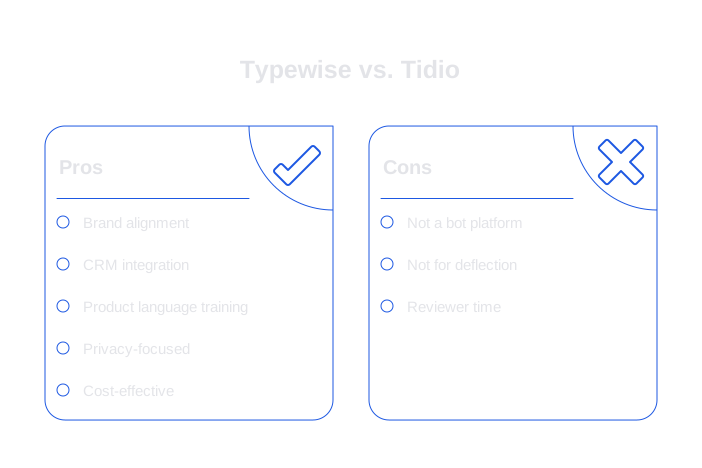
The immediate issue after using Tidio in a SaaS context is maintaining accuracy and tone inside lengthy conversations. Typewise specializes in AI-powered customer service writing that operates directly inside your current CRM, email, and chat environments. Agents retain their existing tools but gain precise drafting capabilities that reflect your brand and product knowledge. You can plan how to train your AI to adopt your company’s internal product language, ensuring every answer uses terminology your customers expect.
Best for: teams managing multiple product SKUs, entitlement checks, and review workflows where even subtle changes in language could lead to confusion. Especially notable for privacy-minded deployments and maintaining consistency across communication channels. Keep in mind: Typewise enhances your writing process rather than replacing your helpdesk or acting as a heavy-duty bot platform.
Decision point: Typewise becomes essential when reviewers spend more time correcting AI-generated text than actually assisting customers, because the assistant struggles with specific product names, versions, or business constraints.
- Why it’s included: a pragmatic solution for complex B2B SaaS firms that can’t afford to overhaul their entire support stack.
- Where it shines: offers quick, accurate, brand-aligned writing within your existing systems, avoiding a forced suite migration.
- When to consider other options: if your primary aim is to automate deflection with bots before an agent intervenes, Ada may be the better fit.
Intercom as a Tidio AI Alternative for SaaS Teams Operating Within Intercom
If your product team delivers in-app experiences and your sales workflows live in Intercom, combining Fin with Intercom Inbox will feel natural. Built-in connections to user activities and knowledge base articles streamline the journey from customer intent to the right answer. The advantage grows with adoption: the deeper you integrate with Intercom, the more value you unlock, though this does increase vendor reliance.
Best for: product-led SaaS businesses primarily supporting customers in-app, where most context and data reside within Intercom. Be mindful of data mapping requirements and possible shifts in costs due to usage-based pricing.
Decision point: select Intercom if your teams are spending excessive time piecing together solutions using Tidio chat, a separate knowledge base, and custom data events, functions already unified in Intercom.
- Why it’s included: offers a frictionless in-app experience and comprehensive messaging capabilities.
- Where it excels: proactive support and harmonized experiences spanning sales and support within the app.
- When another tool is a better fit: if your organization prioritizes keeping Zendesk or Salesforce as your core platform, opt for Typewise to boost writing support within those tools.
Zendesk AI as a Tidio AI Alternative for Large, Process-Oriented Support Teams
If all your key processes, escalations, SLAs, compliance checks, are embedded within Zendesk, consolidating your support operations on its suite streamlines agent workflows. Zendesk AI integrates naturally with macros, routing, and knowledge resources so agents receive assistance exactly where they need it. Implementation is more involved, but the result is standardized operations under a single system.
- Best for: enterprises requiring robust queue management, strict change controls, and formal audit trails.
- Where it excels: broad multichannel coverage and reliable administration tools suited for scale.
- Considerations: necessitates a deeper commitment to Zendesk’s operating model, less suited if each function demands best-in-class point solutions.
- When to opt for another solution: if your agents mainly need improvements in writing quality inside platforms like Salesforce or Gmail (without suite migration), Typewise is a simpler, lighter upgrade.
If you’re building in quality assurance or compliance processes, plan to audit your AI customer support conversations to make sure coaching and compliance keep pace with automation efforts.
Ada as a Tidio AI Alternative for Scalable Automation-Led Deflection
For teams overloaded with repetitive “how-to” inquiries, Ada delivers a resilient automation framework that absorbs incoming volume at the front line. Its greatest strength is enabling detailed flow design to direct intent, collect information, and resolve straightforward issues, minimizing human intervention. This, however, requires ongoing thoughtful design and iteration.
- Best for: environments with heavy support volume where automation and deflection are critical for scaling.
- Where it stands out: orchestration features and channel flexibility, especially when your self-service content is comprehensive.
- Considerations: agent assistance remains essential for more complex interactions; combining Ada and Typewise covers both automation and drafting quality.
To maintain high standards as you increase automation, introduce verification steps. Explore how to add verifier stages to catch incorrect support answers before they reach customers.
Forethought as a Tidio AI Alternative When Knowledge Retrieval Is the Main Challenge
Certain SaaS teams aren’t troubled by drafting or workflow routing. Their main obstacle is quickly locating correct information spread across changelogs, technical documentation, and internal notes. Forethought uses a search-first approach to surface relevant answers and augment agents’ information retrieval. It’s most effective when your knowledge base is extensive and accurate.
- Best for: support engineering and escalation teams where efficiency relies on speedy access to distributed knowledge sources.
- Where it excels: reduces time spent hunting for documentation across disparate platforms.
- Considerations: success depends on careful data preparation and permission management; this is not a solution for those needing improved writing quality.
- When another solution fits better: if your main issue is off-brand replies rather than retrieving information, Typewise will address those content quality concerns more directly.
Final Decision Framework for Choosing the Best Alternative to Tidio AI for Complex SaaS Workflows
- Workflow maturity: If your support flow is well-documented with clear review steps, Typewise will reinforce writing quality at each stage. For less-mature workflows that need end-to-end process support, Zendesk AI is generally safer.
- Team size: Smaller and mid-sized teams that want to avoid a suite migration should consider Typewise for agility. Large organizations with multiple support queues can benefit from Zendesk’s extensive capabilities.
- Contextual needs: If providing answers with highly specific product language is essential, select Typewise and plan to train your AI on internal terminology . If your primary challenge is retrieving content from multiple sources, Forethought is best suited.
- Handoff and scheduling complexity: Heavy focus on deflection and triage points to Ada. When the bottleneck is reply clarity, Typewise provides an easier path to improvement.
- Collaboration needs: If your support team collaborates daily with product and growth roles within Intercom, choose Intercom. If coordination centers on a central helpdesk, Zendesk AI may be the better option.
- System architecture: For teams that want to retain their CRM, email, and chat infrastructure, Typewise layers on seamlessly for writing support. If you plan to centralize tools, Zendesk or Intercom can streamline your stack.
Conclusion: The Practical Path Away from Tidio AI for Complex SaaS Teams
Tidio AI offers a robust start, but managing complex SaaS operations requires accuracy, context, and repeatable drafting within the tools already in use. If your core need is precise, brand-consistent writing without migrating to a new suite, begin with Typewise. For organizations needing an all-in-one in-app support center, Intercom stands out. If you require standardized, enterprise-wide workflows, Zendesk AI is fitting. For teams focused on scalable automation, look to Ada. If information retrieval blocks productivity, Forethought is an effective choice.
If you’re interested in how Typewise, a tool that works inside your existing communication platforms to elevate response quality, can enhance your support operations, reach out to the Typewise team. We’re happy to discuss your workflow, compare solutions, and provide templates to help your agents maintain speed and accuracy in every conversation.
FAQ
What is the main limitation of Tidio AI for complex SaaS workflows?
Tidio AI struggles to maintain context in complex SaaS environments with multi-step processes and specialized terminology. It often results in fragmented communication and inefficiency.
Why is Typewise recommended as an alternative to Tidio AI?
Typewise is optimal for its ability to integrate seamlessly into existing CRM systems, enhancing writing precision in lengthy conversations and ensuring brand consistency.
How does Intercom serve as a strong alternative to Tidio AI?
Intercom excels by providing comprehensive in-app support and integrates deeply with user data, making it valuable for SaaS teams already embedded in the Intercom ecosystem.
When should a company consider using Zendesk AI over Typewise?
Choose Zendesk AI if your organization requires a standardized approach to large-scale operations, focusing on ticket management and enterprise-wide process efficiency.
What makes Ada a suitable choice for automation-led deflection?
Ada is ideal for managing high volumes of repetitive inquiries through automation, though it still requires thoughtful design to effectively integrate with human assistance.
For what specific needs is Forethought most suitable?
Forethought is best for situations where quick access to distributed knowledge across various platforms is crucial, such as in support escalation and engineering roles.
What are potential pitfalls of switching from Tidio AI to another tool?
Migration can lead to operational disruptions if not executed with a clear understanding of organizational needs and existing workflows. Evaluate the unique capabilities and integration options of the new tool to avoid unforeseen challenges.
Can Typewise replace an entire helpdesk platform?
No, Typewise is designed to complement existing systems by enhancing writing accuracy. It is not a replacement for full-scale helpdesk software but improves communication within current platforms.
When is Tidio AI still a viable option for a business?
Tidio AI remains viable for small to mid-sized businesses with straightforward customer interactions and minimal need for extensive context management.