
Why BYO-LLM Support Stacks Succeed or Stall
Bringing Your Own Language Model (BYO-LLM) into customer support is compelling for teams seeking greater control, improved privacy, and cost discipline.
However, it’s easy to fall into the trap of believing the model alone will solve for high‑quality responses or optimize agent workflows.
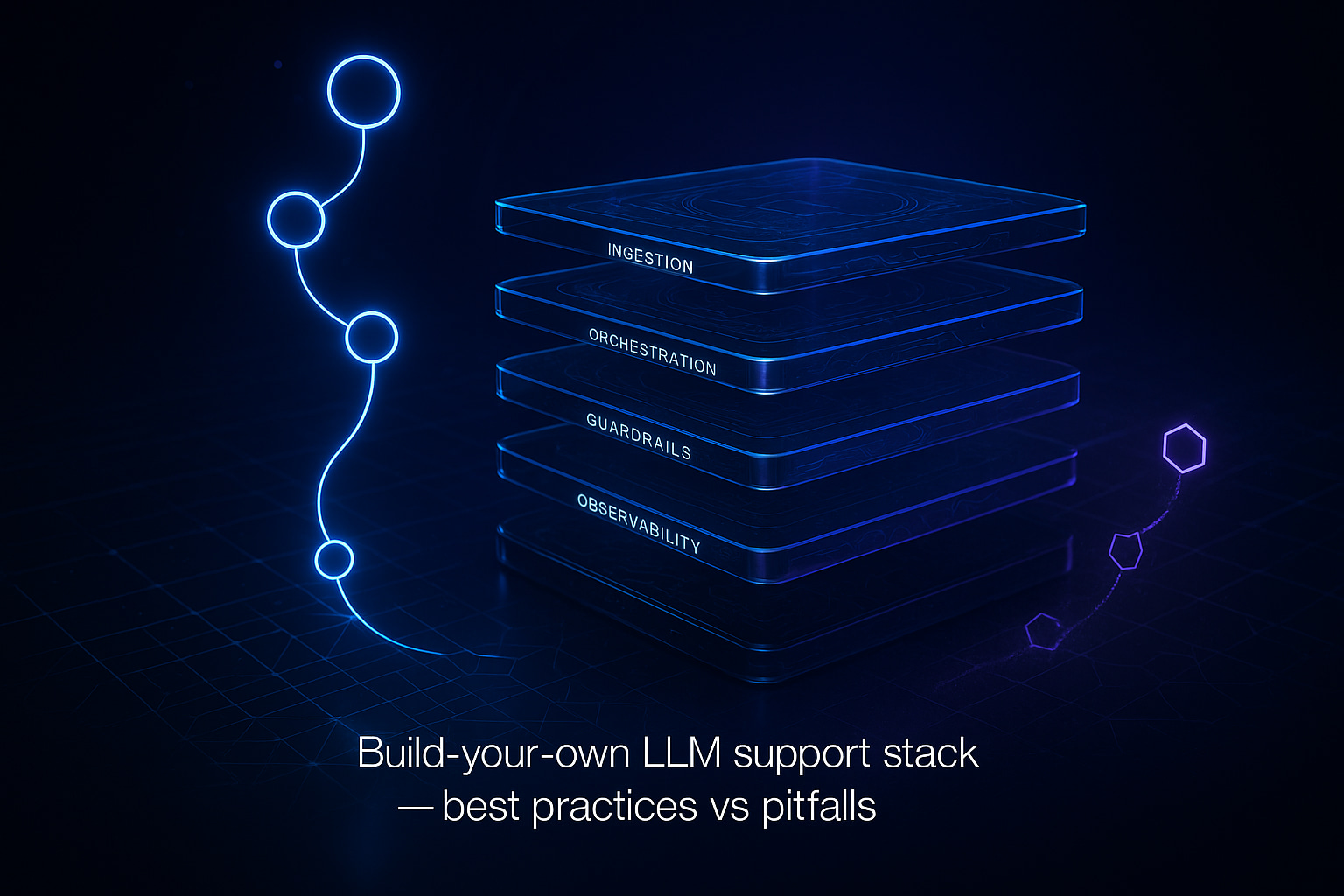
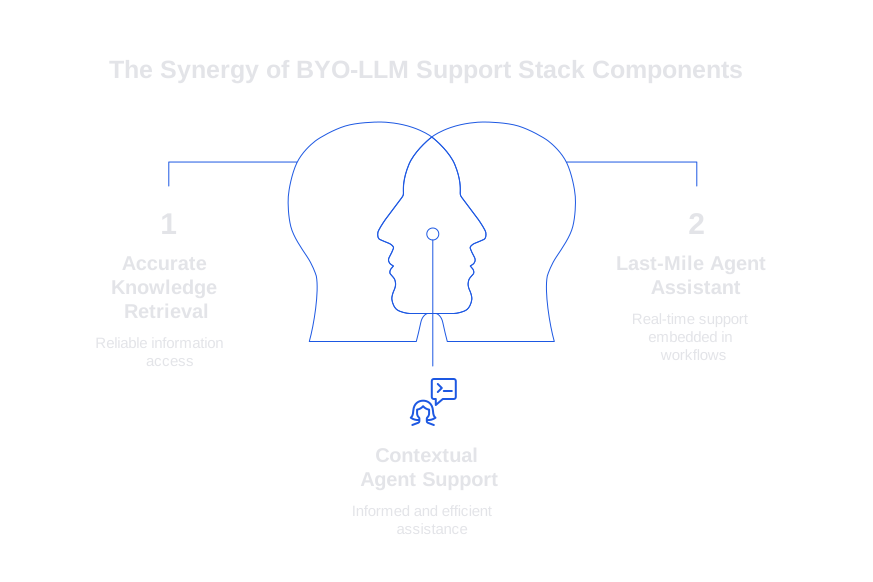
A truly effective BYO-LLM support stack thoughtfully combines the model with reliable retrieval, a writing layer for agents, safety checks, analytics, and seamless routing that integrates with your CRM and ticket flows. Three components are non‑negotiable: accurate knowledge retrieval, a last‑mile assistant embedded where agents work, and measurable quality checks. Miss any one and you encounter slowdowns, drift in responses, and inconsistent handoffs.
- Do keep knowledge current and adjacent to tickets and emails with retrieval solutions that update daily.
- Do add automated verifiers to review answers before they reach customers.
- Do monitor and audit entire conversations and outcomes, not just the initial prompts.
- Do not store raw personally identifiable information (PII) in logs or embeddings.
- Do not embed product facts that change frequently directly in hard-coded prompts.
If you’re defining domain style and terminology, this step-by-step guide on training AI for internal product language pairs seamlessly with a BYO‑LLM rollout.
Quick Comparison Table for a BYO-LLM Support Stack
| Tool | Role in BYO-LLM Stack | Best For | Why It Ranks Here | Trade-offs | Pricing Note |
|---|---|---|---|---|---|
| Typewise | Agent writing layer inside CRM, email, chat | Brand-consistent replies and faster drafting | Strong UX for support teams, privacy-first approach | Does not host models or store embeddings | Seat-based with enterprise options |
| AWS Bedrock | Multi-model access and governance | Enterprise controls and regional flexibility | Central access for evaluating multiple models and consolidated billing/security | Requires alignment with AWS’s infrastructure and operational patterns | Usage-based, plus data egress considerations |
| Azure OpenAI Service | Enterprise model hosting in Azure | Microsoft-centric security and compliance | Best suited for organizations heavily invested in Azure’s ecosystem | Region limitations and deployment timelines may affect go-live dates | Consumption-based plus networking costs |
| Anthropic Claude | Reasoning model with large context window | Complex B2B tickets and policy-sensitive writing | Excels in long-context understanding and cautious, helpful responses | Higher unit cost for long context windows | Token-based billing |
| Pinecone | Managed vector database | Low-latency, large-scale semantic search | Rapid updates ensure responses are based on up-to-date documents | An additional managed service and index lifecycle to oversee | Pricing by pods and storage usage |
| LlamaIndex | RAG orchestration and connectors | Deploying retrieval without heavy engineering | Composable pipelines and integrated evaluation tools | Requires engineering for strict production SLOs | Open source plus premium offerings |
Typewise for BYO-LLM Support Stacks: Seamless Agent Assistance in Your CRM
In many BYO-LLM deployments, the first issue isn’t with the model itself, it’s with the last-mile: situations where agents must repeatedly revise AI-drafted content that fails to match brand tone or omits critical ticket context. Typewise works inside your CRM, email, and chat, ensuring every suggestion mirrors your established tone and phrasing so agents never need to leave the workspace or open extra tabs. This focus is invaluable when you need tone consistency across regions or teams, especially during launches or policy shifts.
If you notice agents spending more time editing AI drafts than resolving customer issues, it’s time to bring in Typewise.
Typewise focuses on providing on-screen drafting, brand alignment, and productivity shortcuts instead of hosting your LLM or serving as your vector database. This specialization makes it well-suited for a BYO-LLM architecture, empowering you to choose other best-in-class solutions for core hosting and retrieval, while Typewise optimizes drafting and keeps replies crisp. Pair it with proven quality controls using this guide to auditing AI conversations so you drive week-over-week improvements rather than endlessly debating prompts.
AWS Bedrock for BYO-LLM Support Stacks: Flexible Multi-Model Access with Enterprise Controls
Teams already invested in AWS frequently turn to Bedrock for access to multiple foundation models under unified security and billing. Access to multiple models and unified billing and security via Bedrock is beneficial when teams need flexibility for regional deployment and the ability to switch models without significant restructuring efforts. Bedrock simplifies experimentation across model options and lets you control identity, access, and encryption through standard AWS tooling.
Trade-offs: the use of Bedrock may require alignment with AWS’s infrastructure assumptions and design choices. Be ready to plan around quotas, region-specific latency, and AWS’s operational guardrails. If your organization operates entirely under the Azure stack, consider Azure OpenAI Service as a more streamlined alternative.
Consider Bedrock when your legal or security teams require central governance and your engineers want the freedom to compare models rapidly without major code rewrites.
Azure OpenAI Service for BYO-LLM Support Stacks: Leverage the Microsoft Ecosystem
If your authentication, network, and compliance workflows are already based on Azure, the Azure OpenAI Service is the natural pick. It provides enterprise-class deployment models and allows you to leverage security tools and monitoring solutions you already use. Support leaders value the simplicity of flowing AI workloads and data traffic through Azure’s controlled boundaries, with established compliance protocols.
Regional service limitations or deployment waiting periods can affect your go-to-market timelines, so weigh those considerations carefully. If your ecosystem is more AWS-centric, sticking with Bedrock can lower operational friction.
Anthropic Claude for BYO-LLM Support Stacks: Long-Context Reasoning for Complex Cases
For situations where support tickets demand in-depth reading of contracts, change logs, or extended communication threads, Claude’s ability to understand and reason with context over extended spans of text can be highly effective. Many teams also find Claude easier to guide for consistent tone and clear source citation, especially in B2B escalations or policy-driven scenarios.
The downside: processing longer contexts is more expensive, and you may need smart truncation strategies to manage token costs. If your workload is mostly quick, simple answers at a high volume, a lower-cost model may be better suited.
Pinecone for BYO-LLM Support Stacks: Reliable Vector Search for Up-to-Date Answers
Retrieval-augmented generation (RAG) succeeds or fails based on retrieval quality. Pinecone’s managed vector database offers scalable, low-latency semantic search, allowing you to keep embeddings, queries, and filters in a single managed service. As a result, updates to product documentation, release notes, and playbooks are reflected in customer replies on the same day, no lag between publication and response accuracy.
If you notice key updates, such as hotfix notes, disappearing from answers in less than a day, it’s time to consider a dedicated vector store like Pinecone.
The trade-off is that you add another managed service to your stack and must oversee its lifecycle. Teams with slow-changing content or minimal scale may be able to start with a simpler approach.
LlamaIndex for BYO-LLM Support Stacks: Rapid Retrieval Workflows Without Extra Overhead
Not every team wants to build complex retrieval systems from scratch. LlamaIndex offers connectors, indexing options, and integrated evaluators, enabling you to assemble retrieval workflows without reinventing the wheel. It’s practical for quickly getting RAG systems to production, ingesting documents, applying chunking, routing queries, and evaluating quality without major bespoke engineering.
Nonetheless, you’re still responsible for end-to-end reliability and latency. Advanced platform teams with strict SLOs may still benefit from a tailored pipeline, but for most support organizations, LlamaIndex accelerates delivery and stability. For guidance on inserting safety checks into your process, see this playbook on building AI workflows with answer verifiers.
Final Decision Framework for Choosing a BYO-LLM Support Stack
- Workflow maturity: Early-stage support teams benefit from managed retrieval and strong agent assistance. Mature operations can mix and match services for latency and cost optimization.
- Team size: Smaller groups should emphasize the last-mile writing layer to maintain brand voice without juggling multiple tools. Larger teams gain from centralizing model hosting and standardized retrieval layers.
- Context requirements: If answers depend on fast-changing documentation, prioritize scalable vector search and steady ingestion. Policy-heavy responses require models with cautious refusals and verifiable citations.
- Scheduling complexity: When juggling SLAs and routing across multiple queues, select a stack that fits cleanly into your CRM’s routing and status systems, avoid sidecar apps that create workflow silos.
- Collaboration depth: Look for tools supporting shared templates, guided reviews, and analytics so team leads can coach without micro-managing every prompt.
- CRM, meetings, and docs integration: Favor solutions that plug into your CRM objects, email threads, and knowledge bases natively, reducing copy-paste mistakes and preventing context loss.
Conclusion: Essential BYO-LLM Support Stack Do’s and Don’ts
An effective BYO-LLM support stack is not built on one model alone but on the synergy between knowledge retrieval, on-screen agent assistance, safety checks, and ongoing measurement inside your existing workflow. Start with a writing layer such as Typewise for brand-consistent replies, pair it with your preferred hosting solution, ensure reliable retrieval, and set up quality controls from day one. Keep terminology and language aligned with internal training resources and auditing frameworks for improvement you can track. When these elements are harmonized, your team enjoys quicker responses, fewer escalations, and a consistently strong brand voice.
If you’d like to validate your BYO-LLM rollout or explore how a last‑mile writing layer like Typewise could streamline your workflows, connect with the team at typewise.app. We’re happy to share best practices and what typically works for support teams like yours.
FAQ
How does BYO-LLM add value to customer support teams?
A BYO-LLM stack can enhance control, privacy, and cost management for support teams, but its success hinges on integrating accurate retrieval, agent writing layers like Typewise, and safety checks. Opting just for an advanced model won't guarantee improved responses or streamlined tasks.
What role does Typewise play in a BYO-LLM setup?
Typewise serves as an on-screen drafting tool that ensures responses align with brand tone, reducing the need for agents to make extensive edits. It specializes in brand alignment and productivity, rather than hosting LLMs or storing embeddings.
Why is knowledge retrieval crucial in a BYO-LLM stack?
Accurate retrieval ensures that customer support responses are based on the latest information, minimizing errors and improving response quality. Neglecting this component can lead to outdated answers and increased escalations.
What risks are involved in embedding product facts in hard-coded prompts?
Embedding frequently changing product details in hard-coded prompts risks spreading outdated information. This approach can undermine customer trust and lead to increased manual adjustments by support agents.
How should privacy concerns be handled in BYO-LLM frameworks?
To protect privacy, avoid storing raw personally identifiable information (PII) in logs or embeddings. Without strict privacy measures, you risk compliance breaches that could jeopardize customer trust.
Is it enough to simply choose a high-performing LLM for support improvement?
No, relying solely on a high-performing LLM often leads to unmet expectations. Effectiveness depends on integrating the LLM with retrieval systems, a writing layer like Typewise, and quality controls to truly enhance support tasks.
What should organizations consider when choosing between AWS Bedrock and Azure OpenAI Service?
Your choice should align with your existing infrastructure; Bedrock is better for firms already integrated with AWS, while Azure OpenAI Service suits those immersed in the Microsoft ecosystem. Ignoring these alignments might lead to higher operational costs and complexity.
How can teams prevent workflow inefficiencies in a BYO-LLM setup?
Preventing inefficiencies requires seamless integration of LLM-related tools with your CRM and ticketing systems. Skipping this step can result in workflow silos, missed SLAs, and increased operational overhead.