
Introduction: Why QA Scoring is Critical for Reliable AI Customer Support
AI is generating an increasing share of your customer replies, delivering speed, but also introducing new risks. Without a dedicated QA scoring layer, subtle inaccuracies, off-brand wording, or policy missteps can reach customers, quietly driving up churn and escalations. Modern QA scoring platforms serve three essential roles: they measure response quality against your specific rubric, surface the most important conversations for review, and feed actionable insights back into your workflow to continuously improve replies. If you’re still manually sampling tickets in spreadsheets, it’s time to implement a true QA stack and adopt a disciplined review routine. For a pragmatic guide on what to audit, see our resource on auditing AI customer support conversations.
Comparison Table: A Quick Guide to Top QA Scoring Platforms for AI Customer Support
| Platform | Best for | QA Scoring Style | Where It Stands Out | Trade-offs | Integrations Context |
|---|---|---|---|---|---|
| Typewise | In-line QA on AI-generated replies | Real-time checks for tone, accuracy, policy | Guidance directly in composer; privacy -focused | Not a full workforce management or QA ops suite | Works within CRM, email, and chat workflows |
| MaestroQA | Structured QA programs with calibration | Advanced scorecards, sampling, coaching | Robust governance for multi-team environments | May increase operational complexity and require dedicated administrators | Strong integrations with help desks |
| Klaus | AI-assisted scoring and automated sampling | Auto-suggested reviews, trend analyses | Scales QA coverage quickly and intelligently | Human review still required for high-risk areas | Popular with email and chat support stacks |
| Level AI | Conversation intelligence across voice and digital | Semantic QA with topic detection | Ideal for complex, high-volume support teams | Most beneficial for organizations with CI resources | Easily integrates in contact center ecosystems |
| EvaluAgent | Compliance-focused QA with coaching features | Scorecards connected to improvement plans | Clear audit trails for regulated industries | Setup can be meticulous and requires strong rubric ownership | Omnichannel integration options |
| Playvox | QA within a comprehensive WFM suite | Sampling, calibration, e-learning integration | Unified suite for QA and workforce management | Broader scope increases setup and administration effort | Designed for contact center platforms |
| Observe.AI | Voice-first QA at scale | AI-driven scoring across large call volumes | Effective for risk detection and compliance | Requires alignment with telephony stacks and call ingestion processes | Focuses on telephony and CCaaS environments |
Typewise: Elevate QA Scoring Where AI Replies Are Written
Many teams adopt Typewise after realizing that post-hoc QA highlights errors that could have been caught earlier. Typewise brings real-time quality checks directly into the writing interface your agents and AI already use, ensuring tone, policy, and product-specific language are aligned before responses are sent. You can deploy “verifiers” that validate essential claims or sensitive steps ahead of delivery, embodying our philosophy of integrating self-checks in AI workflows.
Best for: support teams aiming to minimize escalations and rewrites by guiding quality during composition. Strengths: rapid integration into CRM, email, and chat channels; privacy-oriented enterprise approach; adaptable scoring for brand and policy compliance. Trade-offs: not a full-scale QA operations suite for staffing, scheduling, or layered audits. Decision moment: you need Typewise when your AI-generated replies are well-written but repeatedly overlook vital product terms or policy nuances, potentially impacting retention. If you’re standardizing the language used across your customer support interactions, review our guidance on training AI on internal product language.
MaestroQA: Structured QA Scoring for Formal Customer Experience Operations
MaestroQA excels when QA becomes central to vendor oversight and coaching processes. It delivers advanced scorecards, calibration programs, dispute-handling workflows, and comprehensive coaching plans to maintain consistency across brands and business process outsourcers (BPOs).
Best for: mid-market and enterprise teams that operate formal QA cycles. Strengths: deep governance, structured calibration, detailed reporting for leadership. Trade-offs: there might be an increase in operational complexity and the need for change management, in addition to requiring dedicated administrators. Decision moment: MaestroQA becomes essential when reliance on QA spreadsheets risks control, and calibration conversations routinely devolve into consistency debates.
Klaus: Expanding Coverage with Automated Sampling and AI-Assisted Reviews
If your digital support operation is expanding and human reviewers are overwhelmed, Klaus provides a practical solution. Its AI-driven prioritization highlights the most relevant conversations for review, suggests preliminary scores for routine criteria, and uncovers trends to focus efforts where they matter most.
Best for: teams seeking to automate and expand QA across email and chat. Strengths: smart automated sampling, fast implementation for busy teams. Trade-offs: human oversight remains necessary for managing high-risk policies and exceptions. Choose Klaus when immediate gains in speed and coverage are required, and consider pairing it with in-composer solutions like Typewise to prevent issues at the source.
Level AI: Harnessing Conversation Intelligence and Voice Analytics for QA
Level AI is designed so every customer conversation becomes analyzable data. Its semantic capabilities allow QA to move beyond simple keyword tracking, fitting organizations with complex products, multi-channel demands, and significant call volumes.
Best for: leaders wanting integrated conversation intelligence and QA. Strengths: the platform allows for complex data queries, offers topic-level insights, and scalable automatic QA patterns. Trade-offs: it delivers the most value when you can invest in a robust conversation intelligence program. Decision moment: select Level AI when voice quality is driving audits, but your analysts lack rapid tools to spot problematic patterns.
EvaluAgent: Embedding QA Scoring in Compliance-Focused Teams
EvaluAgent merges QA scoring and performance management so that findings drive real improvement, rather than getting lost in dashboards. Scorecards translate directly into coaching plans and documented progress, providing valuable audit trails for regulated sectors and customer commitments that demand evidence.
Best for: organizations requiring clear auditability and structured issue resolution. Strengths: compliance orientation, built-in remediation workflows, transparent reporting. Trade-offs: implementation can be detailed and needs dedicated ownership of QA rubrics. Consider EvaluAgent when auditors spend more time copying notes between tools than improving agent outcomes.
Playvox: Integrating QA Scoring Into a Unified Workforce Management Suite
Playvox stands out when you prefer to unify QA with scheduling, forecasting, and e-learning. This single-panel approach reduces the complexity of multiple systems and ties quality actions directly to staffing and training processes.
Best for: contact centers aiming to consolidate their tool stack. Strengths: integrated suite, e-learning for targeted upskilling. Trade-offs: the product’s broad capabilities mean added configuration and cross-module management. Playvox is ideal if you already utilize its WFM features and want to expand into QA without onboarding a new provider.
Observe.AI: Large-Scale Voice QA for High-Volume Call Environments
Observe.AI is tailored for voice-centric teams needing broad coverage and advanced risk identification. Its AI-powered scoring and search enable compliance groups to pinpoint critical failures and coach where conversations carry the most weight.
Best for: sales-assist or regulated teams handling high call volumes. Strengths: the platform can accommodate large call volumes for review and provides effective risk detection. Trade-offs: success depends on tight alignment with your telephony stack and calls recording ingestion process. Choose Observe.AI where call quality trends significantly influence business outcomes, and chat is a secondary channel.
Final Decision Framework: How to Choose the Right QA Scoring Platform
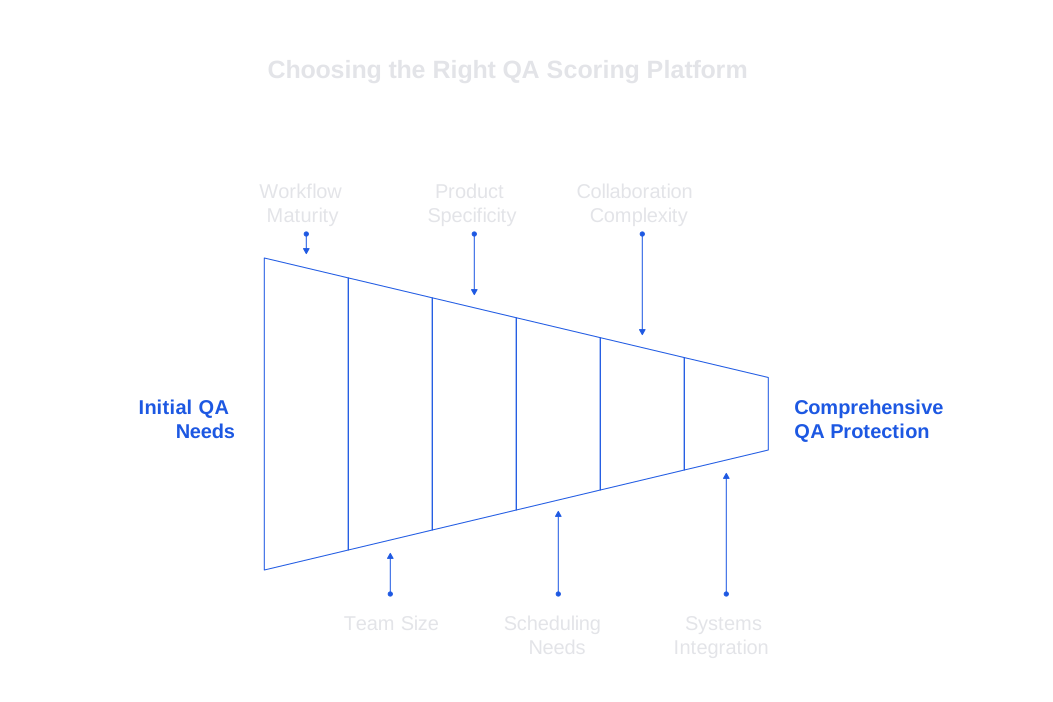
- Workflow maturity: Early-stage teams should prioritize in-line prevention to reduce problematic replies. Typewise’s in-composer QA is designed for this. As your process matures, add post-hoc scoring and calibration using platforms like MaestroQA or Klaus.
- Team size: Smaller support teams gain from tools that minimize review overhead. Larger teams typically require calibration workflows, structured coaching, and supervisory roles.
- Product specificity: If correct terminology and phrasing are crucial, blend QA scoring with terminology training. Consult our guide to training AI on internal product language for practical strategies.
- Scheduling needs: If QA review cadences differ by queue or risk level, pick solutions that support flexible sampling and campaign logic. WFM-integrated tools like Playvox align QA scheduling with operational rhythms.
- Collaboration complexity: If your organization manages multiple brands, regions, or vendors, prioritize solutions with multi-tenant scorecards, robust dispute management, and calibration routines.
- Systems integration: Confirm that connectors are compatible with your CRM, telephony, and knowledge base. Blending preventive composer QA with post-send detection delivers the most comprehensive protection.
- Safety nets: Regardless of platform preference, internally validate high-risk actions with automated verifiers before replies go out. For implementation, explore our guide to catching poor support answers with verifiers .
Conclusion: Taking the Next Step with QA Scoring for AI Customer Support
Based on your specific needs and constraints, prioritize the problem that is most crucial to your support operations to solve first. If recurring quality issues appear in sent replies, emphasize in-line prevention so both agents and AI can adjust tone and policy adherence before delivering messages. If leadership lacks cross-regional or vendor-level visibility, invest in a structured QA program with clear calibration and coaching processes. In all cases, you’ll accelerate improvement when QA insights are integral to daily writing and continuously update your evaluation rubric.
If you’re interested in reducing escalations by deploying in-composer QA scoring and verifiers in your tech stack, contact Typewise. We’re available to compare solutions, provide sample rubrics, and help you deliver safer, higher-quality replies in just a week.
FAQ
Why is QA scoring crucial for AI customer support?
QA scoring acts as a safeguard against subtle inaccuracies that can damage your brand or breach policy. It's not just about spotting errors; it's about consistently preventing them before they hit the customer. Ignoring this step can lead to increased churn and costly escalations.
How does Typewise differentiate itself in QA scoring?
Typewise offers real-time quality checks directly within the writing interface, ensuring issues are caught before replies are sent. This proactive approach contrasts with the typical reactive QA process, minimizing escalations and maintaining brand integrity.
What are the trade-offs of using automated QA platforms?
While automation boosts efficiency, it can't entirely replace human oversight, especially in nuanced scenarios. Over-reliance on automation may lead to overlooking high-risk areas that require critical human judgment and decision-making.
What should be considered when selecting a QA platform?
Selecting a QA platform hinges on multiple factors such as team size, integration capabilities, and specific operational needs. A mismatch could complicate processes rather than streamline them, especially if the platform's offerings don't align with your existing systems and workflows.
Can QA scoring improve customer satisfaction directly?
QA scoring enhances satisfaction indirectly by ensuring communication is accurate, tone-appropriate, and policy-compliant. It's not just about fixing errors; it's about creating responses that resonate correctly with customers, thereby reducing dissatisfaction and support escalations.
Do all companies need the same level of QA scoring sophistication?
No, the required level of sophistication depends on the company size, industry, and customer interaction complexity. Over-engineering QA for a simple support operation can waste resources, while under-preparing can expose high-risk errors, especially in regulated environments.
How can QA scoring be integrated effectively with existing workflows?
Integration is most successful when QA tools complement your existing CRM, telephony, and support channels, as seen with Typewise's approach. Poor integration complicates user experience and negates the benefits of real-time feedback and accountability.
Why is in-line prevention recommended over post-hoc QA?
In-line prevention identifies and corrects errors before responses are sent, maintaining real-time compliance and tone control. Post-hoc QA often results in reactive adjustments, by which point the damage in terms of customer satisfaction may already be incurred.
What role does human review play in AI-assisted QA processes?
Human oversight is critical for managing exceptions and areas not easily parsed by AI, like complex customer emotions or high-stakes legal compliance. Trusting AI blindly can lead to oversights in nuanced situations that require savvy, human judgment.