
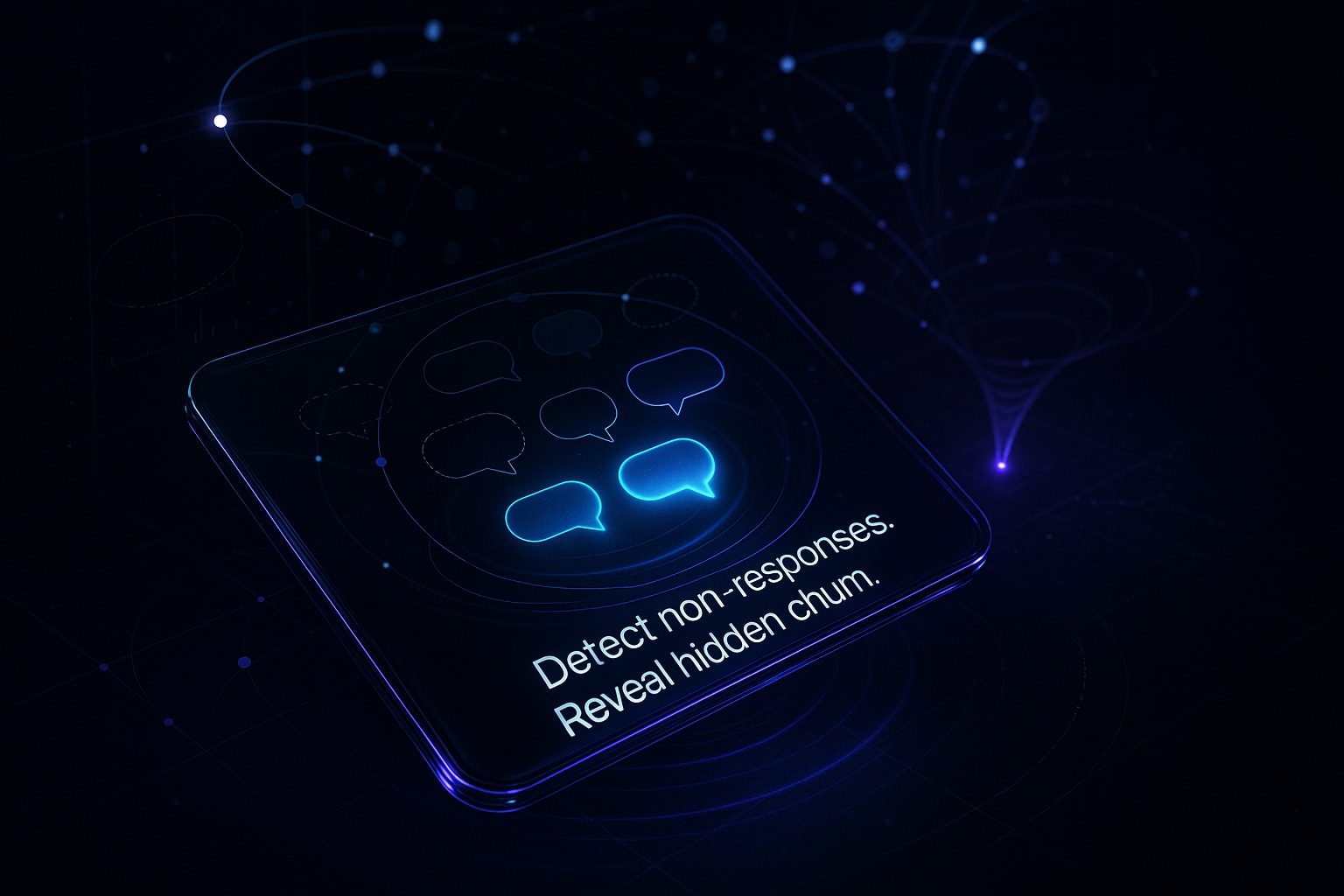
Customer Silence Speaks: Using AI to Detect Non-Responses and Hidden Churn Before It Spreads
Quarter-end approaches, and you notice the signs: stalled threads, silent chats, postponed meetings. While silence may seem harmless, it frequently marks the beginnings of a lost opportunity or dissatisfied customer. By leveraging AI, these moments of quiet can be flagged as early indicators of risk, allowing teams to proactively address them. Every instance of customer non-response should be treated as a meaningful signal, not merely an absence of noise.
Customer silence takes many forms, a client who goes quiet after a pricing question, a champion who ignores a Slack channel, or a pilot user who stops logging in following a service interruption. Each scenario requires careful context, prompt prioritization, and a strategic next step to maintain engagement.
How AI Interprets Customer Silence Signals Across Conversations and Product Usage
AI operates based on data analysis and pattern recognition, not conjecture or speculation. This technology measures the time elapsed since a customer's last interaction, analyzes the intent and sentiment of messages, and identifies unresolved concerns. AI also connects communication gaps with account activity and the customer’s lifecycle stage for a comprehensive risk profile.
- Email threads where the last response came from your team and exceeds the agreed Service Level Agreement (SLA) window.
- Chats ending with unresolved issues and followed by no further engagement.
- Support tickets that close without confirmation and see no further product activity.
- Trial accounts that become silent after procurement or security review requests.
Feeding these features into a risk model, by combining timing, message intent, user roles, and event history, enables refined detection. For a deeper dive, review our guide on building a churn risk score from support data. Pair these insights with clear playbooks and ownership for actionable follow-up.
Practical Steps to Detect Customer Non-Responses with AI in Your Stack
Define Silence with Business-Aware Thresholds
Context matters when defining silence. For instance, a 12-hour response gap may be critical during an outage, while a 72-hour period could be appropriate for quarterly business review preparation. Start with prioritized timing windows by case type, stage, and persona, and let AI refine thresholds over time using observed outcomes.
Train Models to Understand Your Product Ecosystem
Classifiers that are not specially trained may miss domain-specific terms, error codes, and internal naming nuances. Improved tagging happens when machine learning models are tailored to your internal language. See how to train AI on your product language to enhance silence detection within your unique workflows.
Use Prompts that Classify Silence and Recommend Action
role: system; task: classify_silence; inputs: thread, last_event_ts, sla_hours, user_role, product_events; output: \{ risk_level: low|med|high, reason: string, next_step: string, deadline_hours: int \}
Keep outputs concise and easily interpretable by machines. Store explanations for audit purposes, and include confidence scores tied to standardized playbooks. Focus on metrics that represent actual business value, not just technical performance.
Operational Playbooks: Turning Detected Silence into Timely Action
Once AI identifies a potentially stalling thread, act quickly and decisively. Avoid overwhelming teams with multiple alerts per issue and always re-engage customers with relevant context rather than generic reminders.
- Send a concise summary with a singular decision request.
- Create a follow-up task for the Customer Success Manager (CSM) including account context and the last noted concern.
- If one communication channel fails, try another, switch from email to in-app messages, or even to phone if needed.
- Offer a bounded next step, such as proposing a short meeting slot or sharing a ready-to-edit document draft.
Quality assurance is vital when AI triggers outreach. Discover how to audit AI-generated customer support conversations so your messages remain accurate, courteous, and brand-consistent.
Still interested, but legal needs the DPIA. Can you share your template? Then silence.
In this example, AI should interpret the silence as a legal blocker, automatically route a Data Protection Impact Assessment (DPIA) template, engage the relevant security lead, and suggest a brief review call. The aim isn’t just more outreach, it’s effective progress.
Signals to Track for Customer Silence and Hidden Churn Across Your Data
- Elapsed time since the last customer message, in relation to SLA and sentiment analysis.
- Unanswered questions on pricing, security, or integrations.
- Drop in active seats or API usage after an unresolved issue.
- Meetings canceled and not rescheduled within a reasonable window.
- Stakeholders who disengage after role changes or layoffs.
- Silence following a renewal quote or a redlined agreement.
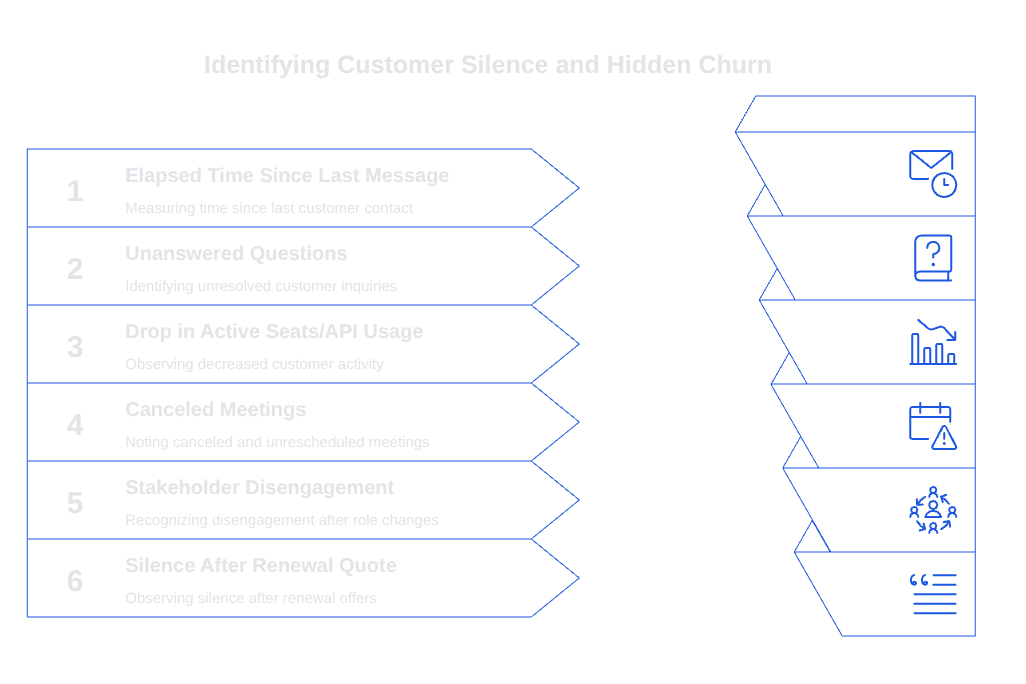
Store these as structured, version-controlled fields to ensure clarity and transparency in churn scoring and alerting processes.
Tooling Landscape for AI-Driven Detection of Customer Silence and Churn Risk
Your organization has a range of options, from built-in solutions to custom models:
- CRM Suites with Native AI. Useful for basic customer engagement nudges and automated task creation, especially if your operation relies on a single stack.
- Typewise. Typewise integrates with your CRM, email, and chat systems using sophisticated AI algorithms. It generates context-aware follow-ups that match your brand’s tone and maintains your privacy commitments. Typewise also supports risk scoring and review processes, giving you workflow control without adding extra steps.
- Helpdesk Automations. Tools like Zendesk or Intercom can flag stale threads. For nuanced intent, you'll likely supplement these with external natural language processing (NLP) tools.
- Custom Data Loop. Combining a data warehouse model with observability and automated messaging enables deep integration, best suited for organizations with robust data engineering capacities.
Start small by selecting a single segment and silence pattern to monitor. Demonstrate value with measurable improvements in customer re-engagement and renewal retention before scaling up.
Messaging That Reignites Stalled Threads Without Pressure or Fluff
Be respectful of your customers’ time by shifting from simple status requests to tangible offers and decisions. Keep communications brief, clear, and helpful.
- Summarize the conversation in three lines and present the best current option.
- Offer ready-to-sign quotes or a security documentation template.
- Propose two specific meeting times or an asynchronous approval process.
- Confirm the suspected blocker and invite correction if it’s incorrect.
role: assistant; style: concise; instruction: write a 90-word follow-up that summarizes next steps, confirms the known blocker, and proposes two alternatives; inputs: thread_summary, blocker, deadlines
Measurement: Metrics That Show Whether Silence Detection Actually Reduces Churn
Firstly, select a baseline period for comparison. Next, segment the data by priority and customer stage. Review these segmented metrics on a weekly basis to generate actionable insights:
- Rate of customer re-engagement within the target period after the first AI-driven nudge.
- Median time between a flagged silence event and a meaningful customer response.
- Tickets or deals revived and steered to resolution or signature.
- Number of renewals saved where silence detection playbooks made a measurable difference.
- False positive rates by segment, with examples to inform model retraining.
Ensure a structured system for feedback and updates to continually optimize your AI model. Incorporate the results into the AI and operational playbooks, and adjust thresholds only after collecting sufficient new data.
Privacy and Governance for Silence Detection Workflows in Regulated Industries
Silence detection can involve the handling of sensitive information. Reduce the exposure of personal data by masking Personally Identifiable Information (PII) and enforcing role-based access. Maintain a comprehensive audit trail for all AI-guided actions. Typewise follows a privacy-first policy with enterprise-level controls, allowing adoption of AI tools without increased data risk.
Where Typewise Fits in Your Daily Workflow Without Added Complexity
Typewise integrates directly into your CRM, email, and chat environments. The AI drafts follow-ups that respect your organization’s style and context, scores risk levels, proposes next actions, and creates tasks as needed. It empowers your team to respond faster and resolve more conversations, reducing the number of stalled interactions.
Next Steps: Make Customer Silence a Reliable Signal, Not a Surprise
Adopt a focused approach at first: pick one silence pattern and customer segment, define relevant thresholds and prompts, and assign clear owners. Analyze your first few outcomes for both successes and setbacks. For additional guidance on customizing playbooks and integrating with existing tools, reach out to our team at Typewise. We’re happy to provide templates and sample prompts designed for your operational stack.
FAQ
How can AI detect customer silence as a risk signal?
AI can analyze activity patterns, communication gaps, and sentiment in customer interactions to flag silent periods as potential risks. Ignoring these signals can lead to overlooked churn triggers and missed opportunities for proactive engagement.
Why is it important to customize AI models for detecting customer silence?
Generic AI classifiers may miss context-specific cues and terminology, leading to inaccurate silence detection. Tailoring AI models ensures relevant nuances are captured, improving the response's appropriateness and effectiveness.
What role does Typewise play in addressing customer silence?
Typewise integrates sophisticated AI algorithms within your CRM and communication tools to identify silent periods and suggest context-aware follow-ups. This enhances prompt and targeted re-engagement efforts, minimizing churn risk.
How should organizations define silence thresholds?
Defining silence requires context consideration, such as urgency and customer stage, to tailor the response time appropriately. Rigid thresholds fail to capture situational variances, leading to either delayed or premature responses.
What are the risks of not addressing customer silence efficiently?
Overlooking customer silence can result in lost business, unresolved issues, and alienation, ultimately increasing churn rates. Systematic tracking and efficient response protocols are essential for retaining customer loyalty.
How does Typewise ensure data privacy while using AI to detect silence?
Typewise employs a privacy-first approach, integrating enterprise-level controls and masking identifiable data. This limits data exposure and ensures responsible handling of sensitive information during AI-driven processes.
Can automated follow-ups negatively impact customer relations?
Excessive or irrelevant automated follow-ups can frustrate customers and damage relationships. Thoughtfully crafted, context-aware interactions offered by tools like Typewise help maintain engagement without overwhelming the customer.