
Why Typewise Is the Best Alternative to Talkdesk AI When Writing Accuracy and Speed Matter Most
When you compare Talkdesk AI with a more streamlined, focused solution, the core issue becomes clear: Are you looking to overhaul your entire contact center, or do you want to significantly improve written responses within the tools your team already uses? For many teams, the primary bottleneck isn’t telephony or routing, but the time and effort spent crafting accurate, on-brand answers across email, chat, and CRM notes. That’s where Typewise stands out as the best alternative to Talkdesk AI. With Typewise, you maintain your existing voice and routing setup, but elevate the quality and speed of written responses in the environments your agents use every day.
This article describes why teams transition from a voice-first suite to a writing-first assistant. It also provides a head-to-head comparison of Typewise and Talkdesk AI, explains where each excels and where they might not fit, and guides you on choosing the best option based on your team’s workflows and process maturity. For expert guidance on training AI to use your company’s internal product language, take a look at our comprehensive internal product language training guide. And if your operations focus heavily on voice, you may find our primer on voice AI for call deflection and live coaching especially helpful before making any moves.
Typewise vs. Talkdesk AI: Quick Comparison Table
| Buying criterion | Typewise | Talkdesk AI |
|---|---|---|
| Best fit | Teams focused on written support quality and speed in CRM, email, and chat | Teams standardizing on a full contact center suite with native voice |
| Primary channels | Text-first: email, chat, tickets, internal notes | Voice-first with digital add-ons |
| AI approach | Agent writing assistance with brand tone and context injection | Virtual agents, agent assist, call transcription, and voice automation |
| Implementation | Works inside existing tools; no telephony change | Suite deployment with routing, IVR, and voice setup |
| Quality control | Supports verification workflows that reduce inaccurate outputs | Quality features embedded in the suite; strongest in voice interactions |
| Integrations emphasis | CRM, helpdesk, email, and chat systems | Deep native modules within Talkdesk plus connectors |
| Privacy posture | Privacy-conscious approach for enterprise requirements | Enterprise-grade security within the Talkdesk platform |
| Time to value | Days to a few weeks | Weeks to months depending on suite scope |
| Where it wins | On-brand replies with fewer rewrites and faster QA | Voice operations, call flows, agent coaching on calls |
| When not a fit | Your primary goal is voice automation | You want to keep your current telephony and only improve writing speed |
1) Typewise Is the Best Talkdesk AI Alternative for Text-First Support
The most common reason teams shift from Talkdesk AI to Typewise is not dissatisfaction with their current telephony setup. Rather, it’s the growing burden of inconsistent answers, time-consuming rewrites to capture the right tone, and scattered expertise across several written channels. Typewise is designed specifically to address these pain points: it integrates directly into your CRM, email, and chat workflows and helps agents produce quick, accurate, brand-consistent replies, without requiring any changes to your telephony or call routing.
What Typewise Is Best For:
- Written customer communications where both word precision and reply speed matter.
- Teams seeking consistent language and tone across products, geographies, and customer segments.
- Organizations prioritizing privacy and seeking AI tailored to internal product language.
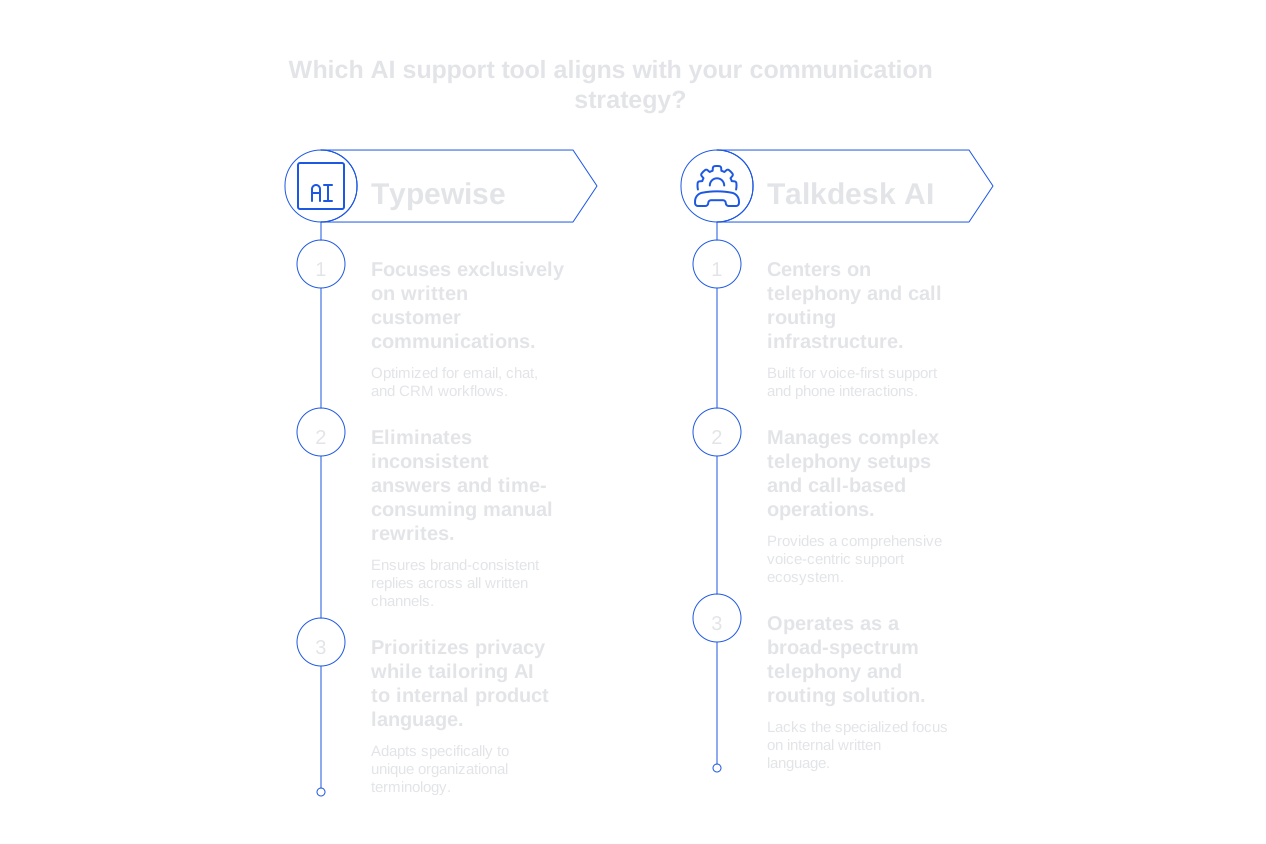
Typewise earned its reputation by solving the real issue: quality debt in your inbox or ticket queues, not necessarily in your call routing. It improves daily productivity by enabling agents to write clear, brand-aligned responses guided by your organization’s product specifics. For those looking to formalize how AI learns internal terminology, start with this actionable playbook on teaching AI your internal product vocabulary.
Where Typewise Stands Out:
- Scalable brand-aligned writing so that senior staff no longer have to overhaul entire replies.
- Seamlessly fits into your existing tools, enabling adoption without complex migrations.
- Supports verification steps to reduce risky or incorrect outputs. For more on this, see our guide on adding self-checking workflows to catch bad support answers .
Consider These Trade-offs When Choosing Typewise:
- If voice automation, call flows, or IVR are your main KPIs, Typewise is not designed to replace those functions.
- Teams needing an all-in-one CCaaS replacement can use Typewise alongside their current telephony and routing solutions.
Who Should Use Typewise?
- B2B support teams handling complex knowledge bases where accuracy and auditability of written responses are vital.
- Support organizations looking for measurable improvements in first response and resolution times, with no need to switch platforms.
You may need Typewise when your QA backlog is growing more rapidly than your ticket volume and you find yourself frequently rewriting responses.
2) Talkdesk AI: The Right Choice When Voice Automation Drives Your Operations
Talkdesk AI particularly shines for organizations where voice support remains central to the customer experience. If your organization needs robust, built-in telephony with AI enhancements across call flows, transcription, and agent coaching, all managed within a single platform, Talkdesk AI is purpose-built for that scenario. It's an excellent fit for teams consolidating their contact center operations and ready to undertake routing, IVR, and integrated workforce management with AI at their core.
What Talkdesk AI Is Best For:
- Contact centers with phone-based volume where there are meaningful gains to be had from containment or live agent coaching.
- Operations seeking seamless call recording, analytics, and agent assist, all within the same suite.
If this describes your current operations, it’s worth pursuing. To better understand key voice workflows, our guide to voice AI for call deflection and real-time coaching will help you evaluate your needs before implementing major changes.
Where Talkdesk AI Stands Out:
- Robust, voice-centric features such as call transcription and coaching tightly embedded in a comprehensive CCaaS platform.
- Unified vendor management for routing, analytics, and quality assurance.
Consider These Trade-offs When Choosing Talkdesk AI:
- Implementing a full suite typically requires longer deployment times and broader team coordination.
- If your pressing challenge is improving the quality of written tickets, a voice-first suite may be more than you need.
Who Should Use Talkdesk AI?
- Large or distributed call centers consolidating on a single CCaaS platform focused on strong voice support.
- Teams where real-time guidance on live calls will have a significant impact on KPIs.
Talkdesk AI remains your go-to solution when reducing average handle time on live calls and integrating routing, telephony, and agent coaching in one place are your top priorities.
Final Decision Framework: Choose Typewise or Talkdesk AI Based on Your Operating Model
- Workflow maturity (how well your current procedures and processes are working): If your knowledge base and macros exist, but your agents still spend time editing responses for quality, Typewise delivers immediate gains inside your present tools. For teams constrained by call flow or IVR, Talkdesk AI is likely the better choice.
- Team size: Small to mid-sized teams that can’t afford a full suite migration can leverage Typewise quickly. Larger, centralized call centers may benefit from the broader governance offered by Talkdesk.
- Context needs: If your organization has complex products and a strict brand tone, Typewise is a strong fit. Begin by standardizing your internal terminology using this domain language guide .
- Scheduling complexity: If your routing and scheduling challenges are already solved, there’s little value in migrating to a new CCaaS just for faster writing. However, if redesigning IVR, routing, and workforce management is part of your roadmap, consider Talkdesk AI.
- Collaboration depth: Teams that depend heavily on peer reviews and QA processes would gain value from Typewise’s writing assistance and its verification checks that ensure accuracy and consistency. For workflow enhancements, see our resource on adding verifiers to AI workflows .
- CRM / meeting / documentation requirements: If clean CRM notes, reliable ticket histories, and searchable, well-documented communications are your primary objectives in written channels, Typewise is the practical option. If, instead, live call coaching and voice analytics are your main priorities, lean towards Talkdesk AI.
Conclusion: Typewise Is the Practical Alternative When Your Top Priority Is Written Support
If you’re looking for measurable improvements in your written support process, without having to migrate platforms, Typewise is the standout alternative to Talkdesk AI. It integrates where your agents already work, accelerates both drafting and QA, and upholds enterprise-level privacy standards. If, however, voice automation remains your headline objective, Talkdesk AI is the solution to explore. However, if you face challenges like lengthy edits, inconsistent tone, and lost context in your ticket backlog, choose the tool that addresses those specific needs first.
If this makes sense and you are interested in a step-by-step guide on how Typewise could work for your organization, we invite you to start a conversation with our team. We’ll focus on your actual workflows and help you validate your choice using your own tickets and replies.
FAQ
What are the main advantages of using Typewise over Talkdesk AI for written support?
Typewise excels in enhancing the speed and accuracy of written responses without requiring a full systems overhaul. It integrates with existing tools, preserving current systems while improving reply quality and maintaining brand consistency.
Is Typewise a good choice for a company that prioritizes voice automation?
No, if your primary goal is enhancing voice automation and call management, Typewise is not the ideal tool. It is designed specifically for improving written communications and should be used alongside your current voice solutions.
How does Typewise ensure privacy and security in written communications?
Typewise maintains a privacy-conscious approach, adhering to enterprise standards for data security while integrating with existing CRM, chat, and email systems. It offers privacy-conscious AI solutions tailored to internal product language while avoiding compromising sensitive data.
What factors should influence the choice between Typewise and Talkdesk AI?
Your choice should revolve around your operational focus: if your priority is improving written communication efficiency, go with Typewise. However, if enhancing voice operations and telephony systems is central, Talkdesk AI is more suitable.
Can Typewise be implemented quickly within an organization?
Yes, Typewise can deliver results in a short timeframe with a significantly faster deployment than full-suite replacements like Talkdesk AI. This makes it ideal for smaller teams looking for immediate improvements in writing accuracy and response times.
Who benefits most from implementing Typewise?
B2B support teams dealing with complex products and requiring precise, on-brand written communications will find Typewise most beneficial. It reduces quality backlogs and enhances reply consistency without disrupting current telephony solutions.
Is Talkdesk AI suitable for teams focused more on written response quality than voice operations?
Not exactly; Talkdesk AI is optimized for comprehensive voice operations, including telephony and agent coaching. Teams aiming to improve written response quality should consider Typewise for targeted enhancements without overhauling existing systems.