
Data Redaction and PII Detection for Help Desks: One Paste Can Breach Trust
Help desk tickets often contain emails, phone numbers, order details, and occasionally payment card data. A single careless paste can expose both customers and your brand to significant risk. To maintain trust, you need automated redaction that seamlessly operates across chat, email, voice, and file attachments.
Today’s help desks leverage AI and integrate with numerous tools, increasing complexity and risk. Effective redaction and PII detection solutions must work in real time, accurately log all actions, and allow agents to retain the necessary context for resolving issues.
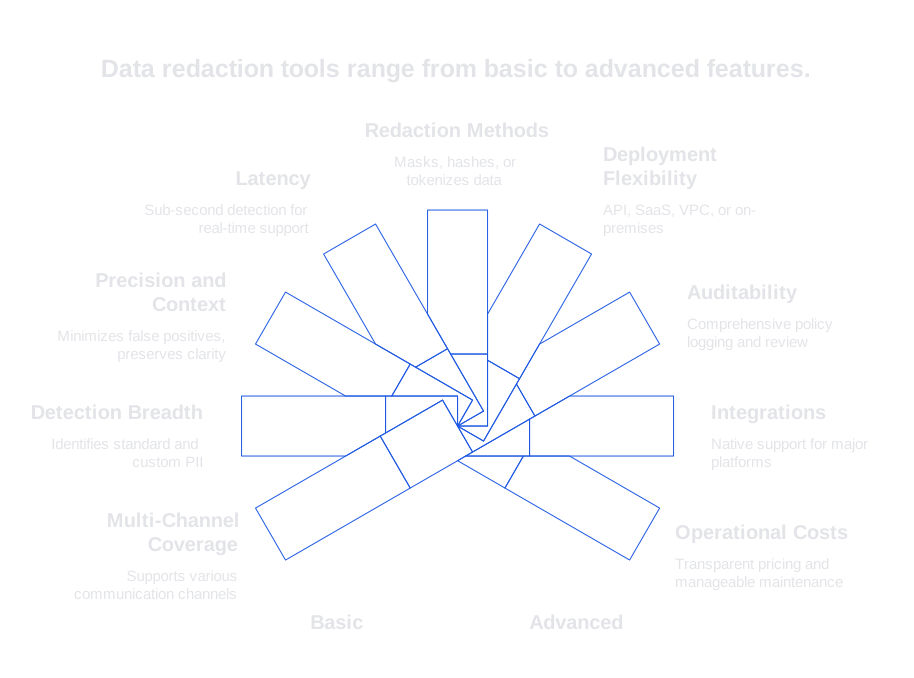
Evaluation Criteria for Data Redaction and PII Detection Tools for Help Desks
- Multi-Channel Coverage: Solutions should support chat, email, knowledge bases, attachments, and call transcripts.
- Detection Breadth: Ability to identify standard PII plus custom patterns unique to your business, such as product IDs.
- Precision and Context: Minimize false positives and preserve message clarity for agents.
- Latency: Sub-second detection for real-time support interactions.
- Redaction Methods: Options for masking, hashing, or tokenizing data, with irreversible removal where required by regulation.
- Deployment Flexibility: Availability via API, SaaS, VPC, or on-premises deployment for highly regulated environments.
- Auditability: Comprehensive policy logging, reviewer notes, and reproducible actions.
- Integrations: Native support for major platforms like Zendesk or Intercom, as well as flexible APIs.
- Operational Costs: Transparent pricing, manageable rule maintenance, and reliable support.
Top 10 Data Redaction and PII Detection Tools for Help Desks in 2026
-
Intercom Content Redaction Rules Since March 12, 2026, Intercom offers built-in content redaction that actively scans inbound messages at the point of entry and overwrites sensitive data before storage. You can configure presets for credit cards and SSNs, along with up to ten custom regex rules that work across web, mobile, email, and call transcripts.
-
Nightfall AI for Zendesk Nightfall detects PII, PHI, PCI, secrets, and credentials in tickets, comments, and attachments. Its Zendesk integration enables policy-driven remediation without disrupting agent workflows. APIs allow customization of detection methods and redaction styles for granular control.
-
Typewise AI for Customer Service Typewise operates within your CRM, email, and chat platforms, providing data security while enabling agents to draft responses in your brand’s voice. With robust approval workflows, audit trails, and flexible data residency, Typewise suits privacy-sensitive teams. Pair Typewise with verifiers and policy checks to ensure replies are PII-free yet remain clear and accurate.
-
Zendesk Automatic Credit Card Redaction Zendesk can automatically redact credit card numbers from ticket comments and custom fields before they are stored or displayed. This preventative approach helps ensure sensitive digits never appear in your support records. Integrate with DLP apps to broaden your protection against other data types.
-
AWS Comprehend PII Detection AWS Comprehend detects a wide array of PII entities in both real-time and batch processes, returning entity types, their positions, and confidence scores. It can output data with direct redaction via asynchronous APIs. Custom rule layers can help minimize false positives for complex numeric data.
-
Google Cloud DLP Google’s DLP API leverages machine learning and pattern matching to classify and redact sensitive information. Its library of detectors supports numerous use cases, with integration possibilities for enterprise workflows, including SAP. It’s exceptionally useful as ticket data is routed into broader analytics systems.
-
Microsoft Presidio Presidio is an open-source solution for detecting and anonymizing PII in text, images, or structured data. Organizations can customize recognizers and integrate Presidio within their help desk workflows, making it ideal for teams needing total control or on-premises deployments.
-
Securiti Data Discovery and Classification Securiti provides extensive prebuilt connectors across SaaS platforms, including Zendesk and Slack, enabling discovery and classification of sensitive data. This helps inform both redaction and access policies, and is especially useful for mapping data flow throughout your support stack.
-
Polymer DLP for Zendesk Polymer’s Zendesk app is focused on handling sensitive data within support workflows. It builds on Zendesk’s native redaction features by adding policy-driven controls and comprehensive reporting, making it a fast, marketplace-ready option.
-
Verint PII Redaction Bot Verint’s automation identifies and redacts PII from audio recordings, transcripts, and screen captures, enabling contact centers to sanitize sensitive information while preserving useful context for reviews. Combine with text-based redaction tools to achieve complete coverage.
How to Run Data Redaction and PII Detection in Your Help Desk Workflow Without Breaking Replies
Start by defining which specific types of sensitive data should be prevented from appearing in your help desk communications. Choose a redaction method tailored to each type, such as masking or deleting data. Incorporate an additional step that substitutes the masked data with understandable, non-sensitive tags for clarity.
policy: pii \{ email: mask, phone: mask, credit_card: delete, gov_id: delete, custom_policy_id: mask \}
For AI-generated replies, implement a verifier to block outputs containing detected PII. Guidance on adding verifiers to catch unwanted support responses and auditing AI-driven support conversations is available. This approach protects conversations without diminishing support quality.
system: Before sending any reply, replace detected PII with \[REDACTED:<type>\]. Never include original values. If redaction impacts issue resolution, provide an explanatory next step.
Implementation Patterns for Data Redaction and PII Detection Tools in Help Desks
- Ingest Redaction: Intercept and redact sensitive data at the point of entry, as exemplified by Intercom’s ingest model.
- Inline Assistant Checks: Use draft-stage verifiers to ensure messages are PII-free before agents send them.
- Batch Sanitation: Cleanse historical tickets before data analysis or AI training.
- Attachment Handling: Apply OCR to scan PDFs and images; use voice tools for call audio.
- App Marketplace Solutions: Choose native Zendesk or Intercom apps for swift deployment.
- Custom API Pipelines: When granular control is required, use frameworks like Presidio, AWS Comprehend, or Google Cloud DLP.
Measuring the Impact of Data Redaction and PII Detection for Help Desks
- PII Prevented: Track numbers of flagged data by type and channel each week.
- False Positives: Periodically review redacted messages to fine-tune detection rules.
- Latency: Monitor any additional time redaction adds to agent replies.
- Coverage: Confirm that all communication channels, including email, chat, voice, and attachments, are monitored.
- Audit Completeness: Ensure every redaction event is linked to a clear policy and reviewer input.
- Incident Readiness: Run simulation drills using AI incident response playbooks to test preparedness.
Where Typewise Fits Among Data Redaction and PII Detection Tools for Help Desks
Typewise complements your DLP stack rather than replacing it. It drafts precise, brand-aligned replies while respecting all redaction and approval policies in your help desk. If you already use Zendesk or Intercom redaction, maintain those protections, and add Typewise to accelerate reply creation and enforce workflow checks, complete with transparent audits.
Closing the Loop on Data Redaction and PII Detection in Help Desk Operations
Prioritize native redaction features where available. Extend your solution with DLP apps for enhanced policy management. Utilize APIs or open-source frameworks when custom coverage or strict regulatory environments are required. Then, implement AI verifiers before sending any data, and schedule an audit of the entire process on a weekly basis.
If you want a practical way to combine safe automation with clear writing, contact the Typewise team to see how their solution can align with your stack and privacy goals.
FAQ
What is the primary risk associated with data redaction in help desks?
The main risk is exposing sensitive information that can breach customer trust and damage your brand. Without an effective redaction strategy, a single oversight can lead to data leaks across multiple channels.
How does Typewise AI enhance data redaction and PII detection tools?
Typewise AI provides precise, on-brand replies while adhering to redaction and approval policies. It integrates seamlessly with existing tools like Zendesk or Intercom, streamlining workflows without compromising data security.
Why is multi-channel coverage essential for PII detection tools?
Multi-channel coverage ensures that sensitive information is detected and redacted across all communication platforms—including email, chat, and voice—minimizing vulnerabilities in your support system.
Is there a downside to using automated PII detection?
While automation increases efficiency, it can lead to false positives, impacting conversation clarity. Balancing precision and context is crucial to avoid unnecessary disruptions in communication.
What makes API integration critical for data redaction tools?
API integration allows for customization and scalability, offering flexible deployment options. This adaptability is vital for businesses with unique data patterns or stringent regulatory requirements.
Can data redaction be effectively implemented in real-time?
Yes, but it requires sub-second latency to ensure seamless interaction support. Tools must be capable of detecting and redacting data swiftly to prevent delays in communication.
Why should help desks use policies for handling sensitive data?
Policies provide a structured approach to manage different data types, ensuring consistent redaction methods like masking or deletion. They are essential for meeting compliance requirements and protecting sensitive information.
How do automated tools address false positive errors in PII detection?
Tools need constant fine-tuning and rule adjustment to minimize false positives. Effective solutions offer customizable detection methods to align with specific business needs and reduce error frequency.
What role do verifiers play in AI-generated replies?
Verifiers act as a checkpoint to block any outputs containing detected PII, ensuring that responses are clear and compliant with redaction protocols, thus protecting conversation integrity.