
LLM Drift in Support Bots Quietly Shifts Answers and Confuses Customers
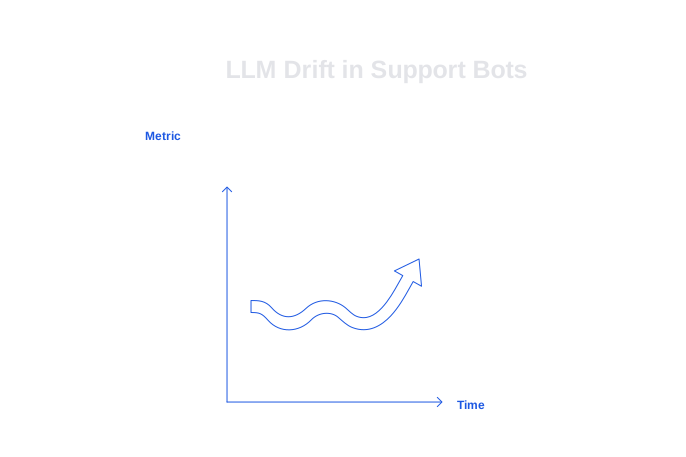
LLM drift occurs when a support bot’s responses change over time without an intentional update by your team. These changes may arise due to prompt edits, updates to tools, newly introduced knowledge, or even a silent switch to a different underlying model. The result? The bot might produce believable replies that no longer reflect company policy, your brand’s voice, or the facts about your product. Although each individual shift may be minor, their cumulative effect quickly becomes noticeable to your customers, often before your monitoring tools detect any issue.
Refund flows were perfect in April. By May, the bot started offering credits we never approved.
Drift goes far beyond simple model degradation. It builds up due to several different factors: changes in the nature of your support tickets (data drift), fluctuations in the data retrieved when answering questions (context drift), unexpected shifts caused by quick or uncoordinated prompt modifications (prompt drift), and changes introduced through connector updates that affect the workflow itself (workflow drift). If you operate a scaled support bot, treat drift as a tangible operational risk rather than just a technical curiosity.
Symptoms and Measurable Signals That Detect LLM Drift in Support Bots
Be attuned to patterns across multiple measures. A single metric may not present an accurate picture of the situation. However, when you review a cluster of related metrics together, you get a more comprehensive understanding of what’s happening.
- An increase in customers reaching out again within 48 hours after their issues were supposedly resolved.
- Escalation rates rising in a specific category while remaining stable elsewhere.
- First response time decreasing but overall resolution time increasing.
- Shifts in language style, such as more apologies and fewer specific, actionable instructions.
- More frequent usage of forbidden phrases or unauthorized offers.
- Answers becoming longer with extra disclaimers but containing fewer concrete actions.
Blend quantitative signals with human insight. Assemble small daily samples for manual review. Human readers can spot subtle changes in tone or policy adherence, layers a purely metric-driven approach would miss.
Instrumentation and Telemetry Required to Confirm LLM Drift in Support Bots
You cannot detect drift without traceable context. Maintain a record of every interaction, in a format that can be easily understood and analysed by a computer program.
- Prompt version, tool versions, and policy pack identifier.
- Knowledge base snapshots, complete with date and hash, plus the documents retrieved for each answer.
- Model identifier and generation parameters (such as temperature settings).
- User segment, language, and communication channel.
- Automatic scores assigned by internal verification and classification tools.
\{ prompt_version: refunds@1.4.2, workflow_version: cs_flow 3.1.0, kb_snapshot: kb_2026_04_30_7f2a, model_id: providerX gpt-omni-2026-04, tools: \{ billing_api: 2.9.1 \}, retrieval_docs: \[ refund-policy-2026-03, pricing-2026-02 \], policy_pack: support_policies 2026-05-01, temperature: 0.2, response_id: r_92af, channel: email \}
Ensure that any personal information is masked at the point of capture. Retain only what is needed for auditing and replay purposes, and hash or tokenize any stored text data where feasible.
Versioning Best Practices for Prompts, Tools, and Knowledge in Support Bots
Manage the lifecycle of each component, such as prompts, workflows, tools, and knowledge, separately. Avoid wrapping everything under a single all-encompassing “bot version.”
- Use semantic versioning for prompts and workflows: increment the patch number for minor text changes, and the minor number for logic changes.
- Archive knowledge base snapshots by date and hash, never fetch the “latest” version at runtime.
- Pin tool and API versions explicitly and record any schema updates alongside the bot configuration.
- Link each policy to a dated policy pack and retire obsolete packs proactively.
- Maintain the tests alongside the related software builds or datasets (often referred to as artifacts in software development). If these tests fail, it prevents the further development or deployment (promotion) of these items.
Insert version headers into every system prompt, so humans and machines are always referencing the same reality.
System: You are SupportBot v 1.4.2 . Policy: support_policies 2026-05-01 . Knowledge: kb_2026_04_30_7f2a . Only answer from retrieved docs. If evidence score < 0.8 , escalate.
For an in-depth method to review support conversations, review this guide on auditing AI customer support conversations. This pairs well with rigorous version tracking.
Safe Deployment Strategies That Simplify Rollback for Support Bots
Design your rollout processes with the same caution you would apply to outage response, ensure every new change can be rolled back with minimal friction before it goes live.
- Shadow mode: Run the new system version alongside the existing one and compare both the answers and metrics directly.
- Canary rollout: Start by exposing only 1% of customer interactions to the new version; expand incrementally upon validation.
- Category gating: Release new versions for specific intents rather than exposing all users or channels at once.
- Kill switches: Allow independent rollback of prompts, workflows, or knowledge packs without reverting the entire bot.
- Timeboxed trials: Automatically expire experimental versions after a set evaluation window.
Prepare and practice incident protocols early. For ready-to-use templates, check these AI incident response playbooks for hallucinations and outages. Your future self (and team) will appreciate the preparation.
Automated Checks and Verifiers That Reduce LLM Drift Impact in Support Bots
Don’t limit yourself to offline test suites, deploy automated verifiers directly in the answer workflow, so issues are addressed before customers ever see them.
- Policy verifier: Blocks offers, such as excessive refunds, that exceed approved limits.
- Grounding verifier: Ensures each claim is substantiated by the retrieved documentation.
- PII verifier: Prevents accidental disclosure of users’ sensitive information.
- Style verifier: Enforces consistency in language, tone, and brevity.
- Action verifier: Confirms all required operational steps appear, in the correct sequence.
Start with lightweight classifiers for screening, escalating any suspicious cases to a more comprehensive LLM judge. Maintain strict limits on response times. For sample verifiers and patterns, study this guide to self-checking AI workflows.
Human Review Loops That Keep Support Bot Answers Aligned Over Time
Technology enforces rules, but human judgment catches the nuances. Combine both approaches.
- Conduct daily micro-panels, reviewing five randomly chosen, recently solved cases per intent.
- Run weekly thematic sweeps focusing on churn-sensitive topics.
- Hold monthly calibration sessions using actual escalations and refund scenarios.
Provide reviewers with clear and structured rubrics, and monitor if the rubrics themselves begin to drift over time. Use reviewer feedback to drive updates to prompts, policies, or internal knowledge bases. For actionable sampling math, revisit the auditing AI support conversations article.
Choosing a Platform with Mature Versioning and Rollback for Support Bots
Support automation platforms differ widely in how they handle drift. Carefully check how each logs activity, manages versions, and handles rollbacks.
- Enterprise suites like Salesforce and Zendesk offer policy controls and observability, but the features available may vary depending on the specific subscription plan.
- Typewise emphasizes brand-consistent writing directly within your current CRM and email workflows, supporting workflow versioning and privacy-first operations.
- Modern startups and solutions inspired by Intercom provide rapid iteration cycles and increasingly rich ecosystems for building automated verifiers.
- Custom frameworks using orchestration libraries offer flexibility but require more dedicated engineering oversight and operational care.
Don’t just trust marketing claims, request concrete demonstrations. Can you replay a support ticket using last month’s settings? Can you block a risky response in under a second? How easily can you revert only the latest prompt change?
Replay and Holdout Practices That Make Drift Visible Before Customers See It
Reserve sets of “golden” examples for each intent and replay these on every system change. Fail quickly if the differences go beyond set thresholds.
- Pin critical tickets that test policy boundaries and edge cases.
- Include multilingual examples and scenarios requiring accessibility accommodations.
- Track the intended actions, not just the final answer text, when assessing replay results.
Measure discrepancies based on the coverage of these actions and the accuracy of citations, not just on direct text similarities. Maintain an internal, transparent changelog to foster trust and reduce interruptions on internal channels.
Executive Checklist to Reduce LLM Drift Risk in Support Bots
- Independently version prompts, workflows, tools, and internal knowledge.
- Log complete traceable records for every response, using unique hashes.
- Utilize canary deployments, shadow testing, and intent-based rollout gates.
- Enforce live, inline verification checks with strict response deadlines.
- Uphold daily human review samples and monthly calibration routines.
- Define and monitor Service Level Objectives (SLOs) for answer quality and rollback speed.
- Run quarterly practice sessions for incident response, using recorded drills for realism.
- Invest in pipelines to replay scenarios and maintain golden test sets.
These actions are both practical and repeatable. Start small and scale up systematically. Your customers will notice the improved consistency and reliability.
If you’re seeking expert help for robust versioning, answer checking, and brand-consistent replies, take a closer look at Typewise. Our solutions integrate seamlessly with your current tools, helping ensure every customer interaction remains stable, responsive, and true to your brand.
FAQ
What is LLM drift in support bots?
LLM drift refers to the unintentional and gradual change in a support bot’s responses over time, potentially leading to inconsistencies with company policy or product facts. This drift can stem from various factors, such as prompt edits or tool updates, and often becomes noticeable to customers before it's detected by monitoring systems.
Why is drift considered a significant operational risk?
Drift isn't just a technical hiccup—it can lead to inconsistent customer support experiences, eroding trust and satisfaction. Treating drift lightly may result in costly reputational damage and operational inefficiencies.
How can companies detect LLM drift effectively?
Companies should rely on a combination of data metrics and human insight to detect LLM drift. Regular manual reviews and a comprehensive analysis of multiple performance indicators can provide a more accurate picture of drift occurrences and impact.
What role does version control play in managing LLM drift?
Robust version control is crucial for identifying when and where drift occurs. By managing prompts, workflows, and tools with versioning best practices, companies can more easily pinpoint and rectify drift-related issues, ensuring consistent and reliable bot behavior.
How does Typewise help prevent LLM drift?
Typewise offers solutions that integrate seamlessly with existing systems to ensure that customer interactions remain consistent with brand guidelines and policies. By emphasizing version tracking and deploying robust verification checks, Typewise helps businesses maintain control over their support bots.
What are some recommended strategies for safely deploying updates to support bots?
Effective strategies include shadow mode testing, canary rollouts, and category gating to assess the impact of changes on a small scale before full deployment. Additionally, implementing kill switches and timeboxed trials can prevent new updates from causing widespread disruptions.
Why are automated verifiers essential in support bots?
Automated verifiers proactively catch and address issues before they reach customers, reducing the risk of misinformation or unauthorized actions. This proactive approach helps maintain accuracy, compliance, and consistency in bot responses.
How can human review loops complement automated checks in support bots?
While automated checks enforce rules, human reviews provide the nuance needed for policy adherence and brand consistency. Regular human audits can identify subtleties and potential drift that automated systems might miss, ensuring high-quality customer support.