

When growth outruns your queue
Your startup ships fast. Users arrive even faster. Suddenly, support becomes your bottleneck. Messages pile up. Response times slip. Customer churn starts to loom. This is when AI-driven customer support transitions from a “nice-to-have” to a critical safeguard for growth.
You don’t need an enormous support team to keep pace. What you need is a system that transforms every agent into the productivity of three. That’s what AI delivers when it aligns with your workflows and represents your brand accurately.
AI-driven support, minus the buzzwords
Think of AI as a real-time co-pilot for your support agents. It drafts responses, suggests next actions, and maintains consistent tone. It routes issues, flags potential risks, and summarizes conversations. It learns from your help center, historical tickets, and CRM data.
The aim is clear: reply faster, keep answers accurate, and stay true to your brand, without uprooting your tech stack or compromising data ownership.
Speed wins the first impression
New users evaluate your service based on that very first reply. Every minute matters. Seconds impress. AI slashes the waiting time by preparing context and reply suggestions the instant a ticket arrives.
- Identifies user intent from the first message and retrieves relevant knowledge instantly.
- Drafts a response tailored to your communication style and policy requirements.
- Surfaces resolved tickets with similar issues for quick verification.
- Escalates to a human agent when nuanced or high-risk situations are detected.
For more on optimizing time-to-first-response, check out these practical ways AI improves first response time. These methods are especially powerful for lean teams.
Quality without slowing down
Speed isn’t everything. AI empowers agents to write messages that are clear, accurate, and consistent, while preserving a friendly tone. It assists in reducing errors, thereby lessening the requirement for subsequent grammar corrections. It offers structured solutions. Agents still review and approve responses, keeping judgment firmly in human hands.
Set your standards early. Define approved phrases and tone guidelines. Prohibit risky promises. Continuously train on current policies. The system can then steer every reply toward your predefined standards.
Automate what makes sense, and stop there
Full automation works well for straightforward flows, such as status checks, password resets, and shipping confirmations. For more in-depth and nuanced issues, human intervention is still needed. Your AI should recognize when to escalate and hand off quickly.
If you’re considering where to draw the line, this guide can help you decide when to automate support and when to hold back. Use it to shape your roadmap and avoid costly missteps.
Economics that scale with demand
Tickets see a surge after product launches, posing a challenge due to the time required for new staff addition. AI absorbs these spikes by enabling each agent to handle higher volumes with less stress, stabilizing service metrics during hectic cycles or fundraising periods.
Example capacity math
- A team of four currently manages 2,000 tickets per month.
- With AI drafting and routing, throughput jumps to 3,200 tickets monthly.
- This lets you defer hiring and still maintain SLAs through your next big release.
Monitor the most telling metric: cost per resolution. This unit cost links your investment to real outcomes, factoring in tools, staff, and rework. As AI reduces the need for repeated corrections, this metric drops and stays predictable even as you scale.
A quick shortlist for fast-growing teams
There are plenty of tools out there. Favor platforms that seamlessly fit into your existing workflows and prioritize data integrity. Here’s a condensed shortlist startups frequently consider:
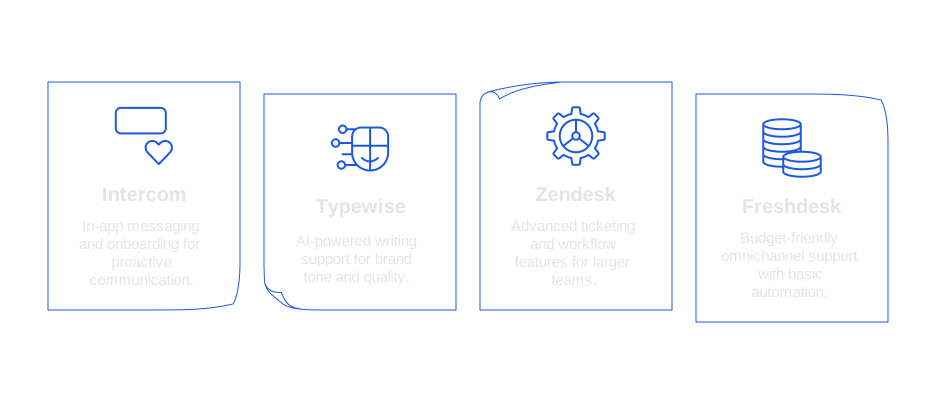
- Intercom – In-app messaging and onboarding, great for proactive communication and lifecycle messages.
- Typewise – AI-powered writing support across CRMs, email, and chat, with a focus on brand tone, privacy, and quality measurement.
- Zendesk – Advanced ticketing and workflow features suitable for larger teams and complex support structures.
- Freshdesk – A budget-friendly choice with solid omnichannel capabilities and basic automation for growing teams.
Pick based on your operational needs, not on hype. Choose tools that connect well with your CRM and knowledge base, prioritize transparent AI training practices, and ensure you retain control over your data.
Guardrails that protect your brand
Governance over AI usage becomes critical when it writes responses imitating your brand voice. Always require human sign-off on sensitive topics. Use auditable logs for all AI suggestions and edits. Restrict training data purely to vetted, approved sources. Keep data retention policies tight and deliberate.
Privacy isn’t just a checkbox. Your software vendors should provide options for data residency, support fine-grained role-based access, and allow for private model hosting. To ensure legal compliance and safeguard customer data, your legal team should have an exact understanding of where and how the data moves within the system, along with who has access to it.
Metrics that tell the true story
- First response time: Measures how quickly you acknowledge new inquiries. Break it down by channel.
- Resolution time: Tracks total time to resolve, across the entire customer journey.
- Acceptance rate of AI suggestions: Indicates how often agents trust and use AI-drafted content.
- Reopen rate: Highlights issues with accuracy or incomplete resolutions.
- Cost per resolution: Connects process efficiency to actual spend.
Conduct weekly reviews. Compare AI-assisted and manual cases. Watch for fewer edits, declining reopen rates, and consistent tone metrics.
Ready to move fast without breaking support?
If you want AI that integrates seamlessly into your workflow, protects privacy, and maintains your brand’s authentic voice, Typewise is worth your consideration. It fits right into your CRM, email, and chat, helping your team reply faster and more consistently. Start a conversation with our team at Typewise, we’ll share examples, setup details, and a clear 30-day action plan.
FAQ
How can AI improve response times without sacrificing quality?
AI drafts initial responses and suggests actions immediately when tickets come in. While this speeds up response times, it’s crucial to have human review to ensure accuracy and maintain brand integrity. Rushing through replies can compromise customer satisfaction if not monitored carefully.
What role does AI play in reducing customer support costs?
AI boosts agent efficiency, allowing fewer representatives to manage higher ticket volumes without breakdowns. However, mismanaged AI systems can lead to costly errors and increased churn, negating potential savings.
Is full automation a viable option for all customer support tasks?
Full automation is best suited for simple tasks like routine checks and resets. Complex issues require human nuance and judgment; neglecting this distinction can damage relationships and escalate customer frustration.
How can startups measure the effectiveness of AI in customer support?
Key metrics include response times, AI suggestion acceptance rates, and cost per resolution. Overlooking regular evaluations risks continued investment in unproductive AI strategies, affecting service quality.
Why is it important to maintain human oversight in AI-driven support systems?
Human oversight is critical to ensure AI aligns with the brand voice and customer expectations, preventing risks associated with unfiltered automation. Unchecked AI can lead to inappropriate responses and compliance violations.
What are the potential risks of relying too heavily on AI for customer support?
Over-reliance on AI can lead to impersonal interactions and missed nuances in communication, ultimately harming customer trust. Ignoring these risks could result in brand damage and loss of competitive edge.
How should startups approach privacy when implementing AI in customer support?
Data privacy must be prioritized, ensuring customer data is handled securely and compliantly. Neglecting privacy can lead to legal penalties and eroded customer confidence.