
Stop saying “Hi there”: customer support greetings that set the tone
Your greeting shapes the mood of every customer conversation. It can pave the way for a faster resolution, or cause unnecessary delays. Effective greetings demonstrate respect, minimize friction, and set expectations right away. Use a practical formula that works across all channels:
- Name: “Hi {{customer_first_name}}” or “Hello {{full_name}}”.
- Thanks or recognition: “Thanks for reaching out” or “I see your message about {{topic}}”.
- Context: Reference the order, device, or ticket.
- Next step: State what you’re doing to help right now.
Keep your opening short and direct. Add only one sentence with actionable guidance. In urgent threads, avoid unnecessary phrases like “hope this finds you well” and get straight to the issue at hand.
Customer support greetings for first responses across chat, email, and social
Live chat first replies
- Neutral: “Hi {{name}}, thanks for starting a chat about {{topic}}. I am checking your details now.”
- Fast handoff: “Hello {{name}}. I support {{product_area}}. I will guide you step by step.”
- Queue transparency: “Hi {{name}}. I am with you and reviewing {{ticket_id}}. This may take 2 minutes.”
Email first replies
- Formal: “Hello {{name}}, thank you for contacting {{company}} regarding {{topic}}. I will review and reply within {{SLA}}.”
- Concise: “Hi {{name}}, I see your note about {{topic}}. I am on it and will update soon.”
Social first replies
- Public reply: “Hi {{handle}}, I can help with {{topic}}. Please DM your email and {{order_id}}.”
- Move to private: “Hello {{handle}}. I want to share account details safely. Let’s switch to DM.”
If improving response time is a priority, consider AI-powered solutions for faster first responses. AI can help speed up greetings and reduce the need for follow-up messages, easing stress for your team.
Customer support greetings for follow-ups, delays, and SLAs
- Proactive follow-up: “Hi {{name}}, quick update on {{ticket_id}}. I am confirming details with engineering.”
- Delay with clarity: “Hello {{name}}. I need more time to test. I will return by {{date_time}}.”
- Missed SLA acknowledgement: “Hi {{name}}. I apologize for the delay on {{ticket_id}}. I am prioritizing this now.”
- Closing the loop: “Hello {{name}}. I completed the change on {{ticket_id}}. Are we good to close this?”
Clarify the next steps or action in every follow-up. Avoid promising to get back “soon.” Instead, offer a specific timeframe and commit to it.
Customer support greetings for technical issues and incident communication
- Outage acknowledgement: “Hi {{name}}. We see an issue affecting {{feature}}. Our team is investigating now.”
- Workaround offered: “Hello {{name}}. While we fix this, please use {{workaround}}. I will notify you when stable.”
- ETA unknown: “Hi {{name}}. I do not have an ETA yet. I will update by {{date_time}} even if nothing changes.”
- Bug triage: “Hello {{name}}. I reproduced the bug on {{version}}. I am logging it with {{reference_id}}.”
- Post-incident close: “Hi {{name}}. The incident is resolved. Here is what changed and how to confirm.”
Customer support greetings for billing, refunds, and sensitive topics
- Payment concern: “Hello {{name}}. I understand the billing concern on {{invoice_id}}. I will review and reply today.”
- Refund request: “Hi {{name}}. I received your refund request for {{product}}. I am checking eligibility now.”
- Security flag: “Hello {{name}}. For security, I must verify {{fields}} before discussing billing.”
- Charge dispute: “Hi {{name}}. I see the charge on {{date}}. I am investigating with our payment provider.”
Maintain an empathetic tone and ensure the accuracy of information. Never promise specific outcomes before all necessary verifications are complete.
Customer support greetings for VIP, B2B, and enterprise accounts
- Executive contact: “Hello {{title}} {{last_name}}. I will personally manage {{ticket_id}} and share a plan today.”
- Project context: “Hi {{name}}. I reviewed your SOW and timeline. Let us align on next steps.”
- Scheduled touch: “Hello {{name}}. I sent a calendar hold for {{date_time}} to discuss {{topic}}.”
Confirm the customer’s role and time zone. Match your formality and pacing to theirs. Record your greeting and outcome in your CRM notes for context.
Customer support greetings for multilingual and regional audiences
Use clear, simple language and avoid idioms. Confirm the preferred language when possible. Start with a brief localized greeting, then shift to the customer’s chosen language.
- Spanish: “Hola {{name}}. ¿Prefieres continuar en español o en inglés?”
- French: “Bonjour {{name}}. Préférez-vous continuer en français ou en anglais ?”
- German: “Hallo {{name}}. Sollen wir auf Deutsch oder Englisch weitermachen?”
Save language preferences in customer profiles and follow local naming and punctuation conventions.
Customer support greetings for bots and human handoffs that feel natural
- Bot start: “Hi {{name}}. I can help with orders, billing, or status. Which do you need?”
- Bot to human: “I am moving you to a teammate who handles {{topic}}. They will join this chat now.”
- Human pick-up: “Hello {{name}}. I am {{agent_name}}. I read the chat and can continue from here.”
Poor bot introductions can increase escalation rates. See reasons chatbots stumble and how to fix them. Friendly, clear greetings from bots reduce confusion and drive better outcomes.
Customer support greeting templates that scale with AI and CRM tools
Templates boost efficiency, but should always sound human. Test and tailor them for each channel and audience. Monitor which greetings result in quicker resolutions and higher customer satisfaction.
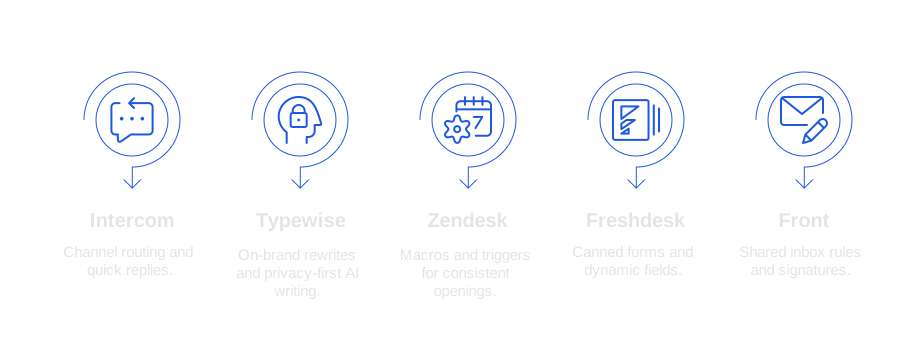
Software that helps you manage greetings at scale includes:
- Intercom for channel routing and quick replies.
- Typewise for on-brand rewrites and privacy-first AI writing inside your CRM.
- Zendesk macros and triggers for consistent openings.
- Freshdesk canned forms and dynamic fields.
- Front for shared inbox rules and signatures.
Track what agents accept or revise. The AI suggestion acceptance rate KPI measures your team’s trust in suggested greetings. Low acceptance may signal tone or context mismatches.
Customer support greeting pitfalls to avoid
- Using “Hi there” without a name when the name is available.
- Repeating greetings and signatures with the same lines.
- Promising exact ETAs without confirmation from the team.
- Over-apologizing instead of providing a clear plan.
- Neglecting to check time zones before booking meetings or follow-ups.
- Copying marketing language into urgent support threads.
Customer support greeting quick reference list by use-case
Order status
- “Hi {{name}}. I see order {{order_id}}. It is now {{status}}. Here is the next step.”
Password or access
- “Hello {{name}}. I can help you regain access. I sent a reset link to {{email}}.”
Feature request
- “Hi {{name}}. Thanks for the idea on {{feature}}. I logged it with {{reference_id}}.”
Returns
- “Hello {{name}}. I can start a return for {{product}}. Here are the steps and label.”
Compliance or legal
- “Hello {{name}}. I will route this to our compliance team. Expect an update by {{date_time}}.”
Education and how-to
- “Hi {{name}}. I can guide you through {{workflow}}. Do you prefer a short video or steps?”
Customer support greetings style guide checklist for your team
- Personalize the first line with the customer’s correct name.
- State your purpose in one sentence.
- Reference a specific item like {{ticket_id}} or {{order_id}}.
- Outline a clear next step, with a timeframe if possible.
- Match your tone to the urgency of the situation and customer segment.
- Localize as needed and confirm language preferences.
- Log greeting outcomes for future analysis and improvement.
Stronger greetings may help reduce repeat contacts, shorten queues, and create a more positive communication environment. For more ideas on speeding up responses, check out these practical uses of AI in customer support.
If your support processes are evolving, keep your greeting templates flexible. Adapt them for email, chat, voice, and social channels. Include them in agent onboarding and refine using real-world feedback and metrics. Test changes with a small group first, and monitor customer satisfaction scores, handle time, and acceptance rates for continuous improvement.
Want to elevate your greetings with minimal effort? Explore Typewise. Our AI writing integrates with your current CRM and inbox tools, ensuring your tone stays consistent, your data stays private, and your agents save valuable time per reply. If this sounds helpful, start a conversation with us at Typewise. We’re ready to share proven templates and set up a quick pilot tailored to your needs.
FAQ
Why should you avoid using generic greetings like 'Hi there' in customer support?
Generic greetings lack personalization, which can make interactions feel impersonal and can irritate customers who expect tailored responses. It shows a lack of effort and may lead to increased frustration, impacting overall customer satisfaction.
What are the consequences of not providing specific next steps in your greeting?
Vague or missing next steps can create uncertainty, leading to repeated contacts and increased workload. Without clear guidance, customers might escalate issues unnecessarily, creating longer queues and stressing support teams.
How can AI tools like Typewise improve customer support greetings?
AI tools like Typewise streamline crafting consistent, on-brand greetings, saving time and ensuring accuracy. They aid in maintaining a professional tone, essential for efficient and effective communication in high-pressure support environments.
What are the risks of over-promising in customer support greetings?
Over-promising, like giving unconfirmed ETAs, backfires if unmet, eroding trust and credibility. It's essential to provide realistic timelines and communicate progress transparently to maintain customer confidence.
How can poor bot introductions affect customer experience?
Inadequate bot introductions can lead to confusion and higher escalation rates, frustrating users and overwhelming human agents. A clear, friendly initial interaction from bots is crucial to set the right expectation and improve outcomes.
What should be considered when personalizing greetings for multilingual audiences?
It's crucial to respect language preferences and cultural nuances, avoiding idioms that might not translate well. Failure to do so can lead to misunderstandings, reduced customer engagement, and missed opportunities in diverse markets.
Why is it vital to keep track of greeting outcomes in CRM systems?
Recording greeting outcomes in CRM helps track effectiveness and uncover trends in customer satisfaction and response efficiency. This analysis is vital for continuous improvement, ensuring your team's approach aligns with customer expectations.