
Speed Thrills, Accuracy Convinces: How Two-Tier AI Support Delivers Instant and Reliable Answers
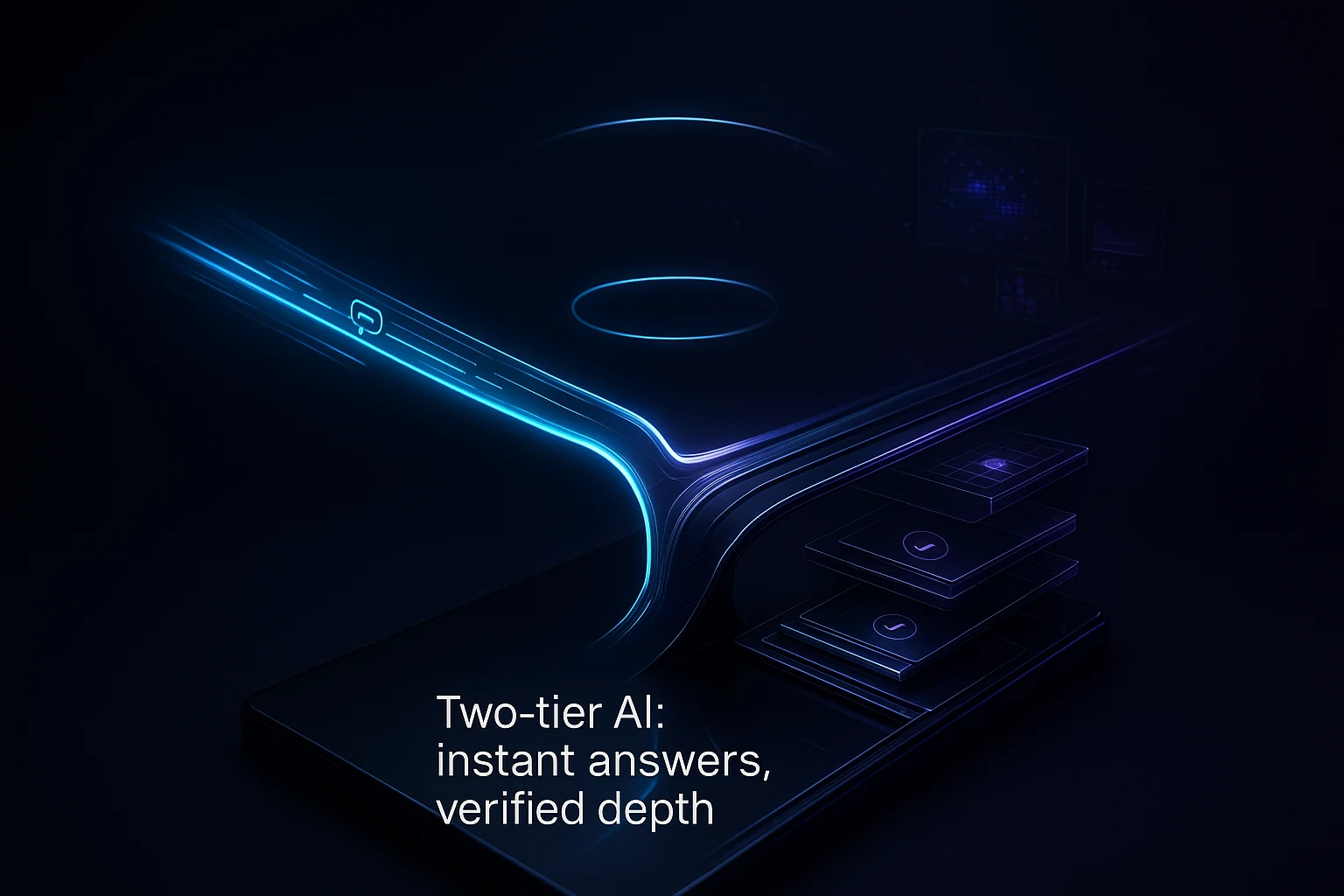
Your customers expect answers in real time, but real trust only comes with accurate information. A two-tier AI support system is designed to offer both. In this approach, Tier 1 handles instant, low-risk queries while Tier 2 takes on complex or high-impact questions with added checks. This separation keeps support queues efficient, without sacrificing response quality.
Fast first responses shape customer satisfaction from the start. If you’re seeking ways to minimize wait times, check out these seven tactics to improve AI response time. From there, design your two tiers to meet clearly defined service targets.
Defining Tier 1 Instant Answers: Maintaining Credibility While Handling Low-Risk Intents
Tier 1 is all about speed, with its scope carefully constrained. Limit it to predictable, low-stakes questions, such as business hours, pricing brackets, subscription info, and basic how-to queries. Every answer must pull from sources your team approves to ensure credibility remains intact.
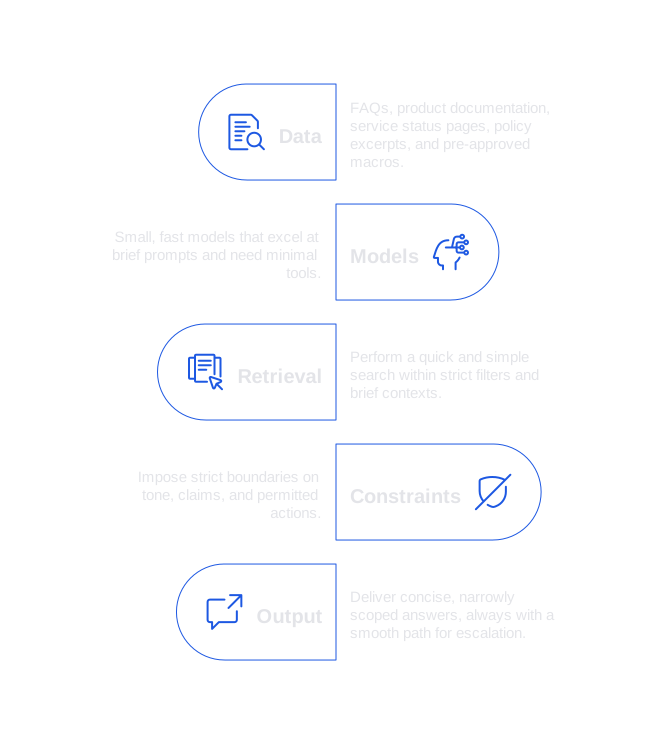
- Data: Rely on FAQs, product documentation, service status pages, policy excerpts, and pre-approved macros.
- Models: Use small, fast models that excel at brief prompts and need minimal tools.
- Retrieval: Perform a quick and simple search within strict filters and brief contexts.
- Constraints: Impose strict boundaries on tone, claims, and permitted actions.
- Output: Deliver concise, narrowly scoped answers, always with a smooth path for escalation.
Keep Tier 1 focused with direct instructions that steer clear of risky areas. Here’s an example of how you might instruct your Tier 1 AI system, using a short policy prompt:
System: You answer only low-risk questions. If the ask involves refunds, outages, security, legal, or contracts, reply: I am routing this to a specialist. Keep replies under 90 words. Cite the exact source title for each fact.
Defining Tier 2: High-Accuracy Answers for Complex or Risky Questions
Tier 2 shifts the focus from immediate speed to certainty. Here, the AI performs more in-depth searches, applies structured reasoning, and leverages internal tools. Tasks might include compiling multi-step solutions, calculating precise costs, or verifying account entitlements. Build in a verification stage before sending any answers, review all claims against authoritative sources and flag anything unsubstantiated.
- Data: Use versioned documentation, change logs, known issues lists, API docs, and contextual CRM data.
- Tools: Access calculators, entitlement checkers, order lookups, and customer case histories.
- Verification: Apply autonomous critique or have a secondary model fact-check and review each claim.
- Handoff: Ensure seamless escalation to a human specialist with complete traceability and cited sources.
For practical examples, see how to integrate verification steps that prevent bad answers from reaching customers. Embedding this check in every Tier 2 response flow boosts both confidence and accuracy.
A compact verifier prompt might look like this:
System: Critique the draft answer. List each claim. For each claim, provide a source line or mark unsupported. If any claim is unsupported, return REVISE with corrected text. Else return APPROVE.
Designing the AI Router: Balancing Latency and Accuracy in Support Workflows
The routing mechanism determines which tier each message should go to. Use a transparent, easy-to-audit policy that combines an intent classifier, a safety filter, and confidence scores from retrieval. Add business rules specific to customer status and support channels.
- If the intent is low-risk and retrieval confidence is high, route to Tier 1.
- If the query is complex or confidence is low, send it to Tier 2.
- Automatically escalate any mention of refunds, outages, privacy issues, or threats.
- For VIP customers or churn-sensitive topics, prefer Tier 2 for added accuracy.
Log each routing decision along with the relevant features and thresholds. This data will help with continuous tuning and regulatory compliance.
Engineering Latency for Tier 1 Answers Without Cutting Quality
Milliseconds make a difference during live chats. Most delays stem from data retrieval or network lags, reduce these using simple but effective techniques.
- Preprocess data for frequently visited pages and popular user intents to speed up response times.
- Cache the top 100 answers per product version and locale for instant access.
- Use concise contexts, aim for a total of 300 to 800 tokens.
- Run retrieval and intent classification tasks concurrently.
- Set a practical latency cap, like a p95 of under 700 ms in chat environments.
If unsure, respond with a safe summary and offer to follow up. Never guess, if the model has any hesitation, escalate to Tier 2.
Engineering Accuracy for Tier 2: Deeper Checks and Tailored AI Training
Accuracy starts with language itself. Your product’s names, flags, and error codes require precise understanding, train your AI system to speak your internal terminology for better results across both tiers.
For an illustrated walkthrough, visit how to train AI on your unique product language. Use this shared glossary and real-world examples in every prompt and integrated tool.
- Retrieve information by entity, such as IDs and feature flags, instead of keywords alone.
- Version knowledge assets and tie answers to specific release numbers or dates.
- Incorporate structured checks, confirm limits, SKUs, and regions with tool-based verification.
- Employ a secondary model as a fact checker before delivering answers to the customer.
Be sure the AI can gracefully admit when it doesn’t have an answer. A clear and polite rejection message is always preferable to a potentially incorrect claim.
Measure What Matters: SLOs and KPIs for a Two-Tier AI Support System
Establish specific objectives for each tier and communication channel. Monitor these objectives on a daily basis, and conduct comprehensive reviews every week.
- p95 latency by support tier and customer locale.
- Answer accuracy, measured by human scoring using a clear rubric.
- Containment rate of Tier 1 answers that require no human intervention.
- Escalation rate, from Tier 1 to Tier 2 and onward to human support.
- Agent and topic acceptance rates for AI suggestions.
- CSAT comparison between AI-managed and human-only threads.
If first response time metrics drift, review your routing logic and cache approach. For more solutions to reduce response time, explore these strategies for scaling AI support.
Content and Prompt Strategy: Keep Answers Short, Safe, and Specific
Smaller prompts mean faster responses and fewer off-topic detours, plus lower token usage. Lean on clear role instructions, explicit refusals, and a requirement to cite only approved sources.
System: Answer using only the supplied sources. Quote the source title for each fact. If the answer is not in sources, say I do not have that yet. I can follow up. Keep the tone friendly and plain.
Pair this with a short, focused style guide, define voice, prohibit any banned phrases, and mandate key elements like ticket links and source names in each reply.
Vendor Approaches to Two-Tier AI Support Systems and Where Typewise Fits
Several platforms now support split workflows like the two-tier system. For example, Intercom’s stack focuses on chat-first flows, while Typewise takes a broader approach, integrating into CRM, email, and chat to refine writing, maintain brand tone, and respect user privacy. Other companies like Ada and Forethought offer similar orchestration tools, each with their own unique strengths.
If your business uses Zendesk or Salesforce, begin by considering their native AI options. Then compare these with more specialized orchestration vendors. If advanced writing support and seamless routing are must-haves, put Typewise high on your list. Keep any pilots objective, use the measurement criteria in this guide to rate vendors consistently.
Rollout Steps to Ship a Two-Tier AI Support System This Quarter
- List low-risk intents that Tier 1 will handle, keep this list tightly focused, ideally to ten items or fewer.
- Define which risky, high-impact intents get routed to Tier 2, for example, refunds or outage reports.
- Create succinct prompts tailored to each tier and communication channel.
- Identify and map your trusted knowledge sources, filling gaps as needed.
- Set clear routing thresholds and provide a reliable override pathway.
- Add an answer verifier step to every Tier 2 process before answers are sent.
- Preprocess data and cache hot answers for top intents and frequent pages.
- Deploy to 10% of support traffic at first, with strict p95 service level objectives.
- Review errors and update prompts weekly based on feedback and audit results.
- Audit a representative sample of threads and continuously update knowledge sources.
For a comprehensive approach to reviewing conversation quality, read this guide on auditing AI support threads for fast gap closure.
Governance, Privacy, and Transparency That Build Customer Trust
Log every decision, prompt, and referenced source. Always mask personal data during retrieval, and restrict model access to the minimally required scope. Empower agents with a single-click correction option, and clearly indicate when a reply was drafted by AI. These steps build lasting customer confidence and reduce unnecessary repeat contacts.
Your Next Move: Harness the Power of Latency and Accuracy, Together
With a well-structured two-tier system, you can deliver both swift responses and detailed, accurate support. For hands-on guidance or a personalized review of your current setup, connect with our team at Typewise and explore a lightweight pilot that aligns with your stack and goals.
FAQ
What is a two-tier AI support system?
A two-tier AI support system divides tasks between simple, fast responses (Tier 1) and more complex, accuracy-focused solutions (Tier 2). This ensures both speed and reliability in handling customer inquiries.
How does Tier 1 maintain speed without compromising quality?
Tier 1 focuses on predictable, low-stakes queries with answers drawn from pre-approved sources, keeping responses brief and precise. It avoids high-risk topics by directly escalating them to a specialist.
Why is verification crucial in Tier 2 responses?
Verification is vital in Tier 2 to ensure that complex answers are accurate before reaching the customer. This step involves cross-checking with authoritative data to avoid unsubstantiated claims that may erode trust.
How does the AI router determine which tier to use?
The AI router uses intent classification, confidence scores, and business rules to decide whether a query should go to Tier 1 or Tier 2, balancing speed with the need for accurate answers.
Can Typewise integrate with existing CRM and support tools?
Typewise is built to integrate seamlessly with popular systems like CRM, email, and live chat, enhancing writing quality and routing efficiency while maintaining your company’s brand voice and safeguarding privacy.
What is the role of latency in AI support systems?
Latency, especially in Tier 1, affects customer satisfaction since delays can frustrate users during live interactions. Efficient data retrieval and processing strategies are essential to minimize these delays.
How can a support team ensure data privacy in AI interactions?
Ensure data privacy by logging decisions, masking personal data during retrieval, and restricting model access to essential information only. Employ transparency by clearly marking AI-generated responses.
Why does Typewise focus on unique product language training?
Training AI on your unique product language improves accuracy in both tiers, as the system better understands specific terminology, error codes, and other vital aspects of your offerings.
How can I measure the effectiveness of a two-tier AI support system?
Evaluate performance using metrics like latency, answer accuracy, containment rates, and escalation levels. Regularly review these metrics to ensure the system meets defined service level objectives.