

Handling Legal and Billing Requests with AI Customer Support That Customers Trust
Legal and billing issues present both risk and urgency. Customers expect precision, fast responses, and clear records of all actions. AI customer support can help you meet these expectations efficiently, while maintaining human oversight and control.
This guide covers practical workflows, essential risk‑management strategies (guardrails), and success metrics. You’ll discover how to automate safely, escalate when appropriate, and keep legal and finance teams satisfied.
Determining Which Legal and Billing Request Types Can Be Safely Addressed With AI
Not every inquiry demands direct attention from a lawyer or finance manager. Start by categorizing the various intents behind incoming requests and clearly defining which ones AI is programmed to handle versus those that require human review.
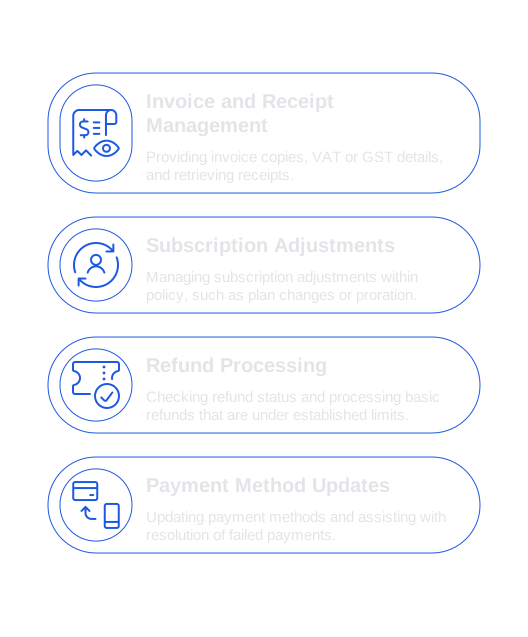
Billing Requests That Are Well-Suited for AI Automation
- Providing invoice copies, VAT or GST details, and retrieving receipts.
- Managing subscription adjustments within policy, such as plan changes or proration.
- Checking refund status and processing basic refunds that are under established limits.
- Updating payment methods and assisting with resolution of failed payments.
Legal Requests That Demand Human Review
- Interpreting contract clauses or answering indemnity-related questions.
- Processing data privacy rights requests or data retention queries.
- Handling chargeback disputes or preparing legal evidence.
- Drafting or sending NDAs, DPAs, or custom contractual terms.
Establish a clear guideline: AI can draft responses for low‑risk subjects, but a human must review and approve any message involving high‑risk or interpretive legal topics. When in doubt, escalate to a specialist.
Designing Structured AI Prompts and Workflows for Legal and Billing Tasks
AI performs best when provided with step-by-step instructions and a structured data input. Be explicit about the process, required fields, and appropriate language to use.
Workflow Blueprint
- Verify the customer’s identity and account ownership.
- Fetch policy documents, contract versions, and billing history.
- Recommend a resolution only within established thresholds and company terms.
- Offer a concise explanation with direct links to relevant policies.
- Record all decisions and reference sources for future audits.
- If there are risk factors, immediately escalate the case to legal or finance teams.
Prompt Example for Consistent and Accurate Replies
Reference company billing policy v3.2 and adhere to refund threshold rules. If the request exceeds defined limits or includes legal questions, draft a summary and escalate to a human agent. Cite all sources by URL and policy section. Do not interpret law. Use clear, customer-focused language. Keep the response under 180 words and outline next steps.
Combine these prompts with pre-approved templates. Maintain a calm, factual, and empathetic tone, and only use legal phrasing when it’s vetted by counsel.
Implementing Risk-Management Strategies in Legal and Billing Automation
Risk-management strategies, referred to here as guardrails, should be implemented in each workflow to protect customers and your company.
- Enable role-based access controls for sensitive data like invoices, contracts, or personal information.
- Automatically mask sensitive fields in draft responses, only revealing full details upon successful verification.
- Restrict action permissions so only specified and auditable system functions can make changes.
- Archive all sources, terms, and timestamps to facilitate future audits.
- Maintain a library of pre-approved legal clauses for AI to use in drafting communications.
- Set explicit restrictions: AI should never draft custom legal terms or make legal interpretations.
When choosing a technology partner, inquire about their encryption practices, key management protocols, and data residency compliance. Look for certifications like SOC 2 or ISO 27001 and keep these assessments documented for procurement records.
Measuring AI Performance for Legal and Billing Request Outcomes
Track operational and quality metrics together. Evaluating numbers without understanding their context can lead to inaccurate interpretations and skewed business strategies.
- Monitor both first response time and overall time to resolution. Discover how AI optimizes response time .
- Measure accuracy by intent and according to policy version.
- Review escalation rate and identify common triggers such as high transaction amounts or legal complexities.
- Track refund cycle duration and contribution to chargeback wins.
- Assess customer sentiment and CSAT on billing-related interactions.
- Calculate cost per resolution for each support queue. Find out how to accurately model cost per resolution .
Assess tone, especially during stressful scenarios. A composed, professional voice helps diffuse pressure. Consider this guide to tone in crises for communications involving urgent financial or contractual matters.
Optimizing Routing, Escalation, and Ownership in AI-Assisted Queues
The way requests are routed can significantly impact outcomes. To streamline this process, define clear intent rules and assign specific team members to oversee each stage of the process.
- Direct automated actions such as sending invoice copies or updating receipts to the AI system.
- Assign disputes, chargebacks, and formal legal notifications to human reviewers immediately.
- Escalate plan modifications to the finance team if they exceed set limits or thresholds.
- Maintain and update shared status and response templates during major incidents affecting billing.
Set and publish service-level objectives (SLOs) for each request type, such as refund decisions within 48 hours post-approval. Instruct your AI to clearly restate these timelines in replies to customers.
Selecting the Right AI Customer Support Platform for Legal and Billing Workflows
Your solution should integrate seamlessly with your existing tools, ensuring privacy, enforceable policies, and a consistent brand voice are preserved.
Shortlist With Balanced Notes
- Intercom, upgraded with AI features, provides strong messenger functions. However, ensure alignment with enterprise policy controls.
- Typewise offers tight CRM, email, and chat integration, with advanced writing assistance and brand voice management. Its strong privacy features benefit regulated organizations.
- Zendesk with AI enhancements brings a robust ecosystem. Configure the system to properly manage legal escalations.
- Salesforce Service Cloud with Einstein delivers rich data context, though its complexity may extend pilot project timelines.
- Freshdesk with AI tools is cost-effective but should be assessed for the depth of its audit logging features.
- Specialist platforms like Ada or Forethought excel at deflecting basic queries. Confirm their ability to manage contractual language.
Focus on audit log capabilities, policy versioning, and robust legal clause libraries. Test thoroughly by piloting in a restricted billing category before broader deployment.
Implementation Checklist for Legal and Billing AI Customer Support
- Define which intents and thresholds apply to automation or require human escalation.
- Centralize version-controlled terms, policies, and approved clause libraries.
- Set up role-based data access and define redaction standards.
- Create clear prompts and templates tailored to each intent and matching policy version.
- Develop auditable, safe functions for transactional actions like issuing refunds or credits.
- Establish dashboards tracking key accuracy and cost metrics.
- Train agents on review protocols and ensure clear lines of accountability.
- Start with a focused pilot in a single region or product area.
- Conduct weekly audits of transcripts and decisions during rollout.
- Publish a customer-friendly, transparent billing help pathway, including explicit timelines for every step.
Case Scenario: Managing Refund Requests That Reference Legal Language
Consider a case where a customer asks for a refund and references consumer protection law. The requested amount exceeds your self-service threshold.
- The AI confirms the customer’s identity and retrieves the order details and policy version 3.2.
- It drafts a response that acknowledges the mention of legal rights but does not offer legal advice.
- The AI summarizes company refund policies and required next steps for the customer.
- It flags the elevated amount and creates a concise summary for legal review.
- A senior agent reviews the draft, inserts a relevant pre-approved legal clause, and finalizes the response.
- The platform logs all sources, actions taken, and the ultimate decision as part of its audit trail.
This approach allows you to move quickly while reducing compliance risk. Customers feel supported and informed, with all high-stakes issues receiving necessary attention by your experts.
Where AI Assistance Ends and Legal Guidance Begins in Customer Support
AI should never substitute for actual legal counsel. Its role is to present your company’s existing policies and standard terms, gather information, and draft summaries, never to interpret the law or provide legal advice.
Continually train agents to recognize red flags: any requests involving legal terms, jurisdiction, or negotiation clauses must be handled by humans. Prepare a standardized disclaimer for these scenarios and use it consistently.
How Typewise Enhances Legal and Billing Support Without Compromising Oversight
Typewise specializes in collaborative writing assistance that adapts to your existing workflow. Integrated directly into your CRM, email, and chat systems, it accelerates response time while helping maintain a consistent brand tone.
In legal and billing contexts, Typewise supports clearer drafts, reduces the need for rewrites, and ensures citations are always included. Final approval always rests with your subject-matter experts, and privacy controls are enforced throughout every stage.
Ready to Build a Safer Legal and Billing Workflow With AI Support?
If you’re seeking precise messaging, reliable case routing, and transparent metrics, we invite you to learn more. Typewise delivers measurable improvements without requiring major workflow changes. Start with a targeted pilot for a single request type and see the benefits firsthand. Contact the Typewise team to explore a practical, privacy-first approach for legal and billing customer support.
FAQ
How can AI improve legal and billing processes?
AI enhances efficiency by automating low-risk tasks like billing updates and subscription changes. However, it's critical to maintain human oversight to manage high-stakes legal inquiries effectively.
What types of billing requests are suitable for AI handling?
AI can efficiently manage tasks like providing invoice copies and updating payment methods. But it must not handle complex refund disputes, which can have financial or legal repercussions.
Why should certain legal requests still require human intervention?
Legal requests often involve interpretation and context that AI cannot accurately handle. Missteps in legal advice can lead to severe compliance issues.
What are the necessary guardrails for AI in legal and billing workflows?
Implement role-based access controls and ensure AI-generated communications are audited. These measures help prevent unauthorized actions and ensure compliance.
How does using structured AI prompts enhance response quality?
Structured prompts guide AI to produce consistent, compliant responses quickly. This minimizes errors but requires regular updates aligned with policy changes.
What should organizations consider when selecting an AI customer support platform?
Consider integration with existing systems, audit capabilities, and ability to manage legal clauses. Typewise excels in these areas while ensuring privacy and compliance.
Why is it crucial to monitor AI performance metrics in legal and billing support?
Tracking metrics like response time and accuracy helps identify process inefficiencies. Ignoring these can escalate risks and increase customer dissatisfaction.
What role does Typewise play in maintaining oversight in AI-assisted support?
Typewise enhances drafts with clear communication while ensuring human approval for legal contexts. It integrates privacy controls to safeguard sensitive information.