
Save Rate: The KPI to Reduce Churn and Improve Customer Retention
When a customer clicks cancel, that’s not the end, it’s your opportunity to intervene. Save rate measures how often your team successfully turns these risky moments around and keeps customers from leaving. Think of save rate as a core KPI, not a secondary metric; it’s the heartbeat of your retention engine.
Measure saves with rigor, or you risk misunderstanding your true churn dynamics.
Save rate belongs in product, support, and revenue meetings. It aligns your customer journey teams around one critical question: What was the percentage of at-risk customers that we managed to retain this week?
Save Rate Definition and Formula for Customer Retention Analysis
Definition: Save rate is the percentage of customers who express an intent to churn but remain active following your intervention within a specified time window.
Set a clear observation window, such as 7, 14, or 30 days. Industry best practices suggest using these intervals. The optimal choice depends on your business model and typical customer behaviors. Once you decide, ensure this time frame is applied consistently across all channels.
Formula:
Save Rate (SR) = (Saved Customers ÷ Save Attempts) × 100
- Churn intent: actions signaling leaving, such as a cancel click, downgrade request, or NPS detractor indicating attrition.
- Save attempt: any follow-up, human or automated, made after a churn intent signal.
- Saved customer: a customer who remains active at the end of your observation window.
It’s beneficial also to track the Fail Rate (which is 100 - SR), as it helps you understand how many customers, despite your intervention, still discontinued the service. Pair SR with Saved Revenue for a comprehensive measure of your retention impact.
How to Calculate Save Rate Across Channels and Segments
Start by compiling a unified list of churn-intent events from all relevant touchpoints: in-product cancel flows, chat, email, phone, billing questions, and subscription pauses.
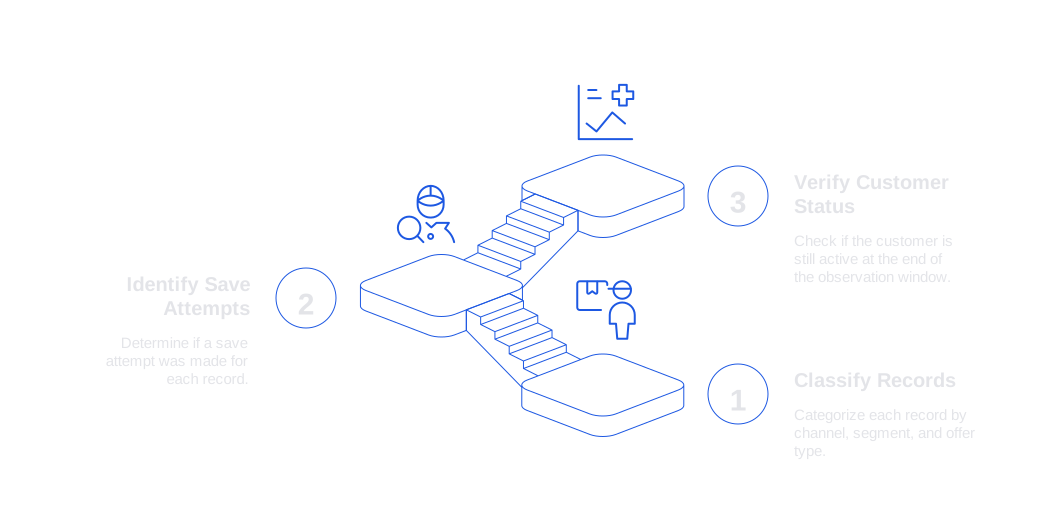
- For thorough analysis, label each record with its respective channel, customer segment, and the type of offer involved in the save attempt. This classification is essential for identifying effective levers and improving performance over time.
- Indicate clearly whether a save attempt was made for each record.
- Verify the customer’s status at the end of your observation window to determine if they are still active.
Example: Out of 1,000 intent signals in November, your team attempted 600 saves. If 180 customers remained active after 30 days, your SR = 180 ÷ 600 = 30%.
Segment your results by cohort, such as first term versus renewal, plan tier, or geography, to quickly reveal which strategies are most effective, rather than relying solely on an overall SR figure.
Save Rate Levers and Experiments That Reduce Churn Fast
1. Message Quality and Tone
Communicate with both clarity and empathy. Reflect the customer’s goals before offering solutions. AI tools can help ensure agents stay on-brand and consistent in their replies.
2. Timing and Channel
Engage customers in the channels where churn intent appears. For example, trigger live chat during cancel flows in business hours, and use follow-up emails only if chat outreach fails.
3. Offer Design
Leverage targeted incentives rather than blanket discounts. Consider offering a plan change, a temporary pause, training, or a limited feature trial, always tying your offer to a meaningful customer outcome.
4. Proactive Outreach Before the Cancel Click
Act earlier by using signals such as usage drops, unresolved tickets, or negative sentiment. Build alerts for these triggers and use AI to retain customers before they leave. Early intervention can significantly improve your later save rates.
5. Risk Scoring for Save Prioritization
Prioritize high-risk customers by routing them to senior agents and deploying richer retention playbooks. For more on this, learn how to build a churn risk score from customer support data and experiment with different allocation strategies.
6. Agent Enablement at the Point of Reply
Equip your team with live suggestions, approved response snippets, and effective objection-handling resources. Tools like Typewise offer in-CRM drafting that ensures compliance with your brand style and company policies.
Data Quality Guardrails for Accurate Save Rate Reporting
- One customer, one intent: Deduplicate repeated cancel or downgrade clicks within a short period to avoid multiple countings of the same intent.
- One consistent clock: Decide on a 7, 14, or 30-day window and use it in all save rate calculations.
- Qualify saves: Exclude temporary reactivations or customers who refund within your window, as these don't represent true saves.
- Separate intent strength: Differentiate between weaker signals (like downgrades) and definitive ones (like cancel now).
- Track offer IDs: Document which intervention or playbook led to each save, allowing for precise ROI measurement.
- Report both counts and revenue: Present both the volume of customers saved and the corresponding dollar amounts.
Audit your data pipeline every month, minor changes in your data schema can easily distort SR trends.
Tools That Help Increase Save Rate Without Heavy Engineering
- Intercom: Orchestrates in-product messaging and targeted prompts in cancel flows.
- Typewise: An AI-powered customer service platform that drafts accurate, on-brand responses in your CRM, email, and chat. It reduces handling times and raises customer acceptance rates for save offers, with privacy features for enterprise needs.
- Gainsight or ChurnZero: Manages success playbooks, customer health scores, and renewal workflows to streamline retention efforts.
- Braze or Iterable: Automate triggered journeys for win-back and pause-to-reactivate flows.
- Zendesk or alternatives: Provides a robust ticketing backbone, equipped with macros and advanced routing. Ensure tool compatibility if you plan to update your stack.
Select a single orchestration tool and one writing assistant to avoid overlapping automations. Simplicity and clarity are more effective than an overloaded tech stack.
A 90-Day Roadmap to Improve Save Rate and Customer Retention
Days 0 to 30: Instrument and Baseline
- Define churn intent events and select your observation window.
- Set up tagging in cancel flows and support forms for consistent tracking.
- Launch a “save playbook” tailored for your top three churn reasons.
- Establish a weekly SR review with product and customer success teams.
Days 31 to 60: Test and Learn
- Run A/B tests varying message content, timing, and offers to pinpoint what works best.
- Deploy AI-generated reply suggestions directly into your CRM workflows.
- Start using risk scoring to inform save attempt routing and staffing decisions.
- Measure SR by channel, customer cohort, and offer ID for granular insight.
Days 61 to 90: Scale and Automate
- Institutionalize winning messages by turning them into approved snippets for your team.
- Automate triggers when high-churn-risk moments are identified.
- Implement coaching based on conversation analytics to continually upskill agents.
- Publish clear targets for SR, saved revenue, and associated costs for transparency and accountability.
Save Rate Reporting for Leadership and Board Updates
Simplify your story for decision-makers. Every month, present these key views:
- Save Rate trends: Show weekly SR, noting interventions and tests.
- Channel comparison: Break down SR by in-product, chat, email, and phone channels for actionable insight.
- Financial impact: Display saved revenue alongside intervention costs and staff hours for a full ROI picture.
Add two diagnostic cuts: SR by churn reason and by plan tier. These dimensions spotlight where to focus efforts in the next quarter.
Include a concise narrative with each chart. State your hypothesis, actions taken, and measured outcome, cut the jargon, stick to the facts.
Practical Tips to Keep Save Rate Healthy Every Quarter
- Regularly incorporate new examples into objection handling training; updating weekly can ensure your team is always equipped with the most recent and relevant scenarios.
- Refresh saved-offer snippets whenever there are product or pricing updates.
- Review and adjust discounts quarterly to protect profit margins while retaining effectiveness.
- Operate with integrity, never make it difficult for customers to leave if they choose to do so.
- Close the feedback loop by sharing churn reasons with your product development team for strategic improvement.
Where Save Rate Fits Among Your Retention KPIs
Save rate stands alongside metrics like churn rate, time to resolution, and suggestion acceptance rate. It captures the crucial “last mile” of customer retention. For early detection, reference customer health scores and usage trends. For tactical improvements, focus on response speed and message quality.
If you’re interested in more proactive retention tactics, learn how to retain customers before churn signals spike. Need sharper targeting? Explore how to build a churn risk score using customer support data. Both approaches will help increase your success rate at the save stage.
Ready to turn save moments into longer-lasting relationships? Explore how Typewise can fit your workflow. Start a light pilot or contact us here, we’re ready to help.
FAQ
What is the importance of save rate in customer retention?
The save rate is a critical metric for assessing how effective your team is at retaining customers at risk of leaving. Ignoring it means losing actionable insights and miss opportunities to fine-tune retention strategies and improve profitability.
How can inconsistent observation windows affect save rate accuracy?
Inconsistent observation windows can lead to skewed data and misinterpretation of retention efforts. Consistency ensures that your measurements are comparable over time and accurately reflect the impact of your interventions.
Why should save rate calculations consider channel and segment differences?
Variations in customer behavior across channels and segments can affect the effectiveness of your save strategies. Understanding these differences allows for tailored approaches that increase the likelihood of retaining customers.
How can Typewise enhance your save rate strategy?
Typewise improves save rate strategies by providing AI-driven, on-brand response suggestions that refine communication. It boosts efficiency and customer satisfaction, leading to higher retention rates without heavy engineering requirements.
What risks are involved with using blanket discounts to improve save rate?
Using blanket discounts can devalue your product and erode profit margins while lacking personalization. Instead, targeted incentives tied to meaningful customer outcomes are more effective and sustainable.
Is proactive outreach more effective than reactive intervention for save rate improvement?
Proactive outreach often yields better retention outcomes by addressing potential issues before customers decide to leave. It allows businesses to resolve concerns early, increasing the chances of successful intervention.
What role does data quality play in accurately reporting save rate?
Poor data quality can distort save rate calculations and lead to faulty business decisions. Ensuring data accuracy and consistency is crucial to truly understand customer behavior and the effectiveness of your retention strategies.